Best Bias-Reducing Interview Software in 2026
The best bias-reducing interview software asks every candidate the same role-specific questions, scores the answers against the same behavioral anchors and gives you reports you can compare side by side, while a human still makes the hiring decision. Resyme is built around that approach: automated, role-tailored interviews with comparable candidate reports. This guide shows how the main kinds of tools differ, what to check before you buy and which rules apply to US employers.
TL;DR
- Bias drops when questions, scoring and comparison are standardized. Software helps most where it removes the variation between interviewers.
- Resyme is our pick for recruiters and small teams: role-tailored behavioral interviews, honesty validation and objective candidate comparison, with pay-per-interview pricing from €4.50 to €7.99.
- Treat any audit as evidence about one tool version, one job population and one period, not a lifetime certificate.
- Keep a human in the decision. Regulators in New York City, Illinois and the UK ask for notice, review and the right to challenge.
Table of Contents
- What bias-reducing interview software actually does
- The four types of tools you will see
- How to compare options: seven criteria
- Why Resyme is our pick
- What the other categories do well
- Rules US employers should know
- How to check fairness before and after you buy
- Choosing by team type
- Try Resyme on your next opening
- Our perspective
- FAQ
- Sources
What bias-reducing interview software actually does
Hiring bias rarely comes from one bad decision. It comes from small differences: one interviewer asks about career gaps, another skips the technical questions, a third remembers the candidate who was chatty. Bias-reducing software attacks those differences at three points.
- Question delivery. Every candidate for a role gets the same questions, in the same order, at a time that suits them.
- Evaluation. Answers are scored against defined criteria instead of an interviewer’s gut feeling.
- Comparison. Candidates are laid side by side on the same dimensions, so the shortlist reflects evidence, not who interviewed first or last.
This is different from two neighboring product types. Interview cheat detection tools focus on catching impersonation or off-screen help, which protects integrity but does not standardize the interview itself. General assessment suites run games, quizzes or cognitive tests. If you are weighing those, employer cognitive tests explained is a useful primer on what they measure. An interview platform covers the conversation itself, which is where most hiring decisions are still made.
The four types of tools you will see
Most shortlists mix four categories. Knowing which one you are looking at saves hours of demos.
| Type | What it standardizes | Typical fit |
|---|---|---|
| Automated AI interviewers (Resyme and similar) | Questions, follow-ups, scoring and candidate comparison | High-volume screening, specialized roles, teams with no ATS |
| One-way video platforms (Spark Hire, Willo and similar) | Question set and timing; scoring is usually left to your reviewers | Teams that want to watch recorded answers |
| Enterprise video and assessment suites (HireVue, VidCruiter, Modern Hire and similar) | Interview plus assessments inside a large workflow | Large employers with an HR technology stack |
| Text-based and chat interviewers (Sapia.ai and similar) | Written answers scored without a face or voice | Programs that want to avoid visual and audio signals |
The distinction that matters for bias is the second column. A video tool that records the same questions still leaves scoring to humans, who bring their own preferences. A tool that also scores against fixed criteria removes that second source of variation, as long as the criteria themselves are sound and audited.
How to compare options: seven criteria
1. Are the questions tailored to the role?
Generic questions produce generic answers, and generic answers get scored on charisma. Look for questions built from the actual role, seniority and domain. Resyme tailors its interview questions using deep domain knowledge across industries, so a warehouse supervisor and a software engineer are not asked the same things.
2. Is scoring behaviorally anchored?
Behaviorally anchored means each score level is tied to a described behavior (what a strong answer contains, what a weak one lacks). That makes two reviewers, or one reviewer on two different days, reach the same result. Resyme runs in-depth, behaviorally anchored interviews; our guide to running behavioral AI interviews walks through how to structure them.
3. Can you trace a score back to evidence?
If a tool outputs only a number, you cannot tell whether it reflects the answer or something irrelevant. Reports should show which statements produced which rating. This is also how you defend a decision later. See how soft-skill findings can stay auditable and traceable.
4. Does it validate what candidates claim?
Misrepresentation is a bias problem in disguise: the candidate who polishes a story best gets the benefit. Resyme validates candidate honesty and integrity automatically, and it works with resumes and LinkedIn profiles so claims can be probed in the interview itself.
5. Is the candidate experience accessible?
A tool that frustrates candidates loses the very applicants you want. Resyme offers its interviews in an accessible format with voice and text detection, so candidates answer in the way that suits them. More on what works in candidate experience in AI hiring.
6. Does it hold up against expert judgment?
Ask for agreement data, not adjectives. Our write-up of AI interview analysis agreement with experts reports a 96.1% agreement figure.
7. What does it cost, and how is it billed?
Pricing models fall into per-interview credits, monthly subscriptions and custom enterprise contracts. Check what counts as a billable interview, whether reports are included and whether volume changes the unit price. The next section shows how Resyme lays this out.
Why Resyme is our pick
For the readers this guide is written for (recruiters swamped with applications, small businesses with no HR department, agencies and startups hiring without an ATS), the deciding factor is how much standardized, comparable evidence you get per hour of your own time.
Resyme conducts the interview, tailors the questions to the role, validates honesty, profiles behavior and skills and produces reports that rank candidates on the same dimensions. That reduces the time spent on pre-screening and presents only the best-suited candidates. Because it handles both high-volume and specialized hiring, one platform covers the 400-applicant customer service opening and the hard-to-fill technical role.
Pricing is published and mixes both models:
| Plan | Price |
|---|---|
| Interview (pay as you go) | €4.50 to €7.99 per interview |
| Free | No published price |
| Company | €599 per month |
| Agency | €4,500 per month |
| Enterprise | No published price |
A worked example: a startup screening 60 candidates for one role pays per interview and no subscription. At the listed per-interview range that is between €270 and €479.40 for the full round. A recruiting agency running many searches at once is the profile the Agency plan is designed for.
To see how Resyme compares with other tools for recruiters in more depth, read our review of AI interview software, and why interviewing needs its own tool beyond a general recruiting suite.
What the other categories do well
Enterprise video suites such as HireVue, VidCruiter and Modern Hire are built for large employers that need interviews, assessments and workflow in a single contract. One-way video tools such as Spark Hire and Willo make it easy to collect recorded answers from many candidates. Chat-based tools such as Sapia.ai keep the interview text-only. Each suits a particular workflow. If your priority is a standardized, scored and comparable interview that a small team can run without an ATS, an automated interviewer that does the scoring itself is the shorter path.
Rules US employers should know
Bias-reducing tools do not remove legal duties. They add some. Here is what the sources say, and you should confirm details with employment counsel for your own jurisdiction.
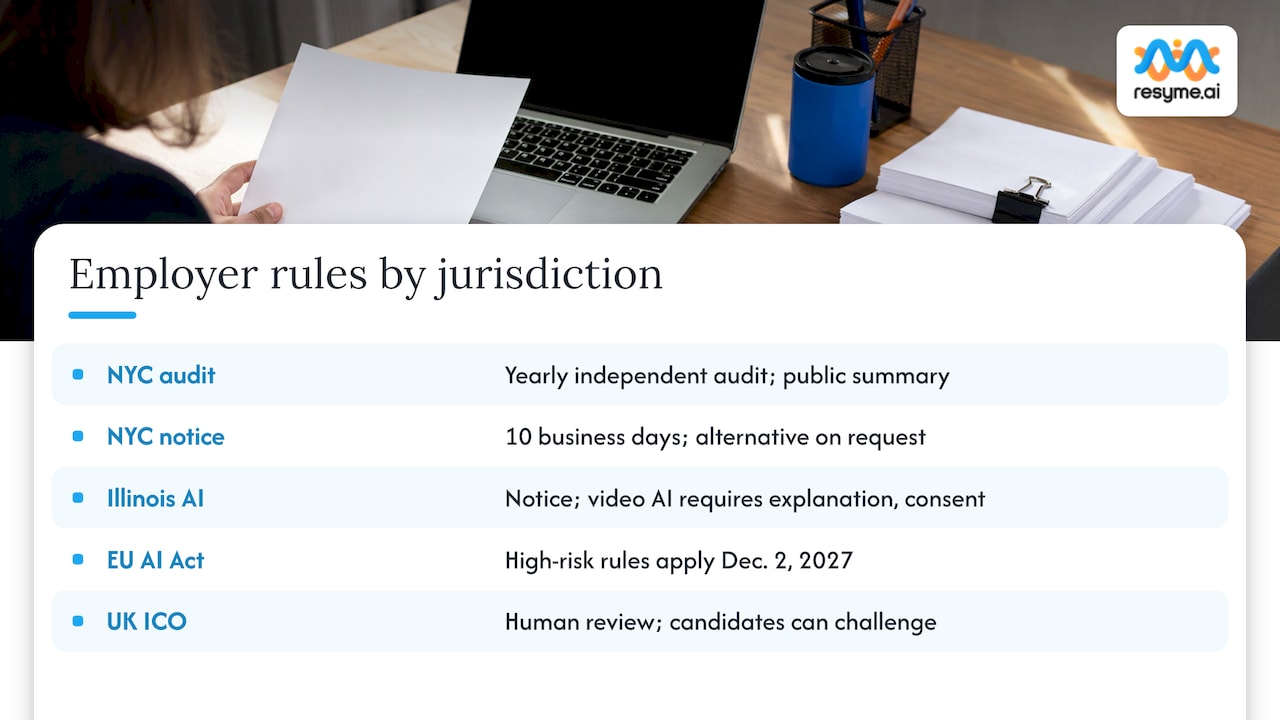
New York City. Employers and employment agencies may not use an automated employment decision tool to screen candidates unless it had an independent bias audit within the year before use, with the summary public. NYC-resident candidates must be notified at least 10 business days before use and may request an alternative process. Penalties run up to $500 for a first violation and $500 to $1,500 for each later one.
Illinois. A 2026 tracker reports that employers using AI in covered decisions must give notice under the state’s amendment, and the Illinois AI Video Interview Act separately requires notice, explanation and consent when AI analyzes recorded video interviews.
EU and UK. If you hire in Europe, the EU AI Act takes a risk-based approach and applies to providers of high-risk systems regardless of where the company is based. A 2026 tracker says recruitment AI is generally treated as high-risk, with the amended application date for the relevant requirements at December 2, 2027. The UK Information Commissioner’s Office, in its AI in recruitment outcomes report, recommends meaningful human review, no rejections based only on fit scores and a simple way for candidates to challenge automated decisions.
For US-specific federal expectations, our guide on EEOC-compliant AI interviews sets out what employers must do.
How to check fairness before and after you buy
An audit is a method, not a stamp. The iTechGuides employer guide describes the steps well:
- Define the decision, the candidate population, the groups and the period.
- Freeze the tool version being tested.
- Measure selection or scoring rates and impact ratios (the rate for one group divided by the rate for the most-selected group) at every hiring stage, not only final offers.
- Where face, speech or voice analysis is used, check whether accuracy differs across groups and whether people with disabilities can take part.
- Ask the vendor about human review, overrides, security, retention and deletion.
Re-run the exercise when the tool version or your applicant pool changes. For a small team the practical routine is simple: export your scores each quarter, compare pass rates by group where you lawfully collect that data and record who made each final call.
The ICO adds a useful warning: an accuracy rate that is merely better than random is not enough to show fair processing. Aim for tools that show their evidence. Keeping people in the loop is the same idea behind human oversight of AI candidate feedback.
Also weigh usability. A 2026 National University of Singapore report on its InterPilot assistant notes that skill-evidence maps help after the interview but can clutter the live one. That favors a design where the interview runs by itself and the evidence arrives in a report you read afterward.
Choosing by team type
- High-volume recruiters: prioritize per-interview cost and comparable reports so the top of the list is reliable. Pay-as-you-go pricing keeps cost tied to volume.
- Small businesses with no HR staff: you need the interview structure built in, because nobody on your team is trained to write behavioral questions.
- Agencies: look for scalable reporting across many clients and roles. Resyme’s Agency plan is priced at €4,500 per month.
- Startups without an ATS: choose a tool that works standalone, with resume and LinkedIn input, rather than one that assumes an existing system. For governance of the resume stage, see resume screening automation.
Try Resyme on your next opening
If you have a role open and a stack of applicants, start with a handful of interviews and read the reports. Resyme offers a Free plan, pay-as-you-go interviews at €4.50 to €7.99 each and monthly Company and Agency plans. Visit resyme.ai to set up a role.

Our perspective
Bias in hiring is mostly inconsistency, and inconsistency is a process problem you can fix. When every candidate gets questions built for the role, answers are judged against behavioral anchors and the report puts candidates side by side, the conversation becomes about evidence.
That is why we built Resyme around in-depth interviews with honesty validation, rather than around a score that appears from nowhere. Recruiters should see what a candidate said, how it was rated and why, then decide.
The tool narrows the field and the recruiter makes the call. That is the combination that saves time and keeps hiring defensible.
Raul
FAQ
Can interview software eliminate hiring bias?
No tool removes bias entirely. Software reduces variation by standardizing questions, scoring and comparison, which are the places where individual interviewer preferences creep in. Pair it with regular checks of your pass rates and keep a person responsible for the final decision.
Is automated interviewing legal in the US?
It is legal, with local conditions. New York City requires an independent bias audit and candidate notice for automated employment decision tools, and Illinois requires notice and, for AI analysis of video interviews, consent. Check the rules wherever your candidates live and talk to employment counsel.
How much does bias-reducing interview software cost?
Models include per-interview credits, monthly plans and custom enterprise contracts. Resyme lists interviews at €4.50 to €7.99 each, a Company plan at €599 per month and an Agency plan at €4,500 per month, plus Free and Enterprise plans.
Does an automated interview replace the recruiter?
No. It handles pre-screening and produces comparable reports, so the recruiter spends time on the best-suited candidates. Regulators such as the UK ICO also recommend meaningful human review of AI outputs.
Sources
- NYC Administrative Code, Subchapter 25: Automated Employment Decision Tools
- UK ICO, AI in Recruitment Outcomes Report
- iTechGuides, AI Hiring Bias Audits: Employer Steps
- Twin Ethos, AI hiring and employment laws by state and country
- HyperQuark Labs, AI in Hiring: The Rules Tracker
- University of Colorado Law Review, Algorithmic Bias and Accountability
- NUS, Inside InterPilot
- IQ Career Lab, Employer Cognitive Tests Decoded