Analyze Soft Skills Recruiters Can Audit with Traceable SIOP Aligned AI

Analyze soft skills by running structured, role-specific behavioral interviews and scoring them with AI that traces every rating back to quoted evidence in the transcript. Layer human review on top before any hiring decision, and audit the pipeline for adverse impact on a fixed schedule. Platforms like Resyme.ai are built to scale that exact workflow. The one guardrail that can’t slip: no AI score should exist without a matching quote and a rubric anchor behind it.
TL;DR:
- AI assessments focus on structural signals like STAR component presence, quantified outcomes, semantic consistency, and specific actions, not tone or charisma.
- Building effective rubrics requires role-specific job analysis, clear behavioral anchors, and follow-up prompts to address missing STAR elements, with calibration to avoid overestimating weak responses.
- Trust in AI scores depends on evidence-linked ratings, transparency, and regular audits for bias and score drift, with every report linking scores directly to candidate quotes for quick validation.
- Adverse impact checks, candidate notice, and documentation retention are non-negotiable for legal defensibility, with consistent governance crucial for fair, compliant AI-based hiring.
- AI should serve as an informative amplifier alongside human judgment, with tools like Resyme facilitating evidence-based, scalable soft skills evaluation while maintaining detailed audit trails.
Table of Contents
- What Does AI Actually Measure When It Analyzes Soft Skills?
- How Do You Design Rubrics and Interview Pipelines You Can Trust?
- How Should You Read an AI Soft Skills Report?
- What Compliance and Fairness Checks Are Non-Negotiable?
- Treat AI as an Amplifier, Not a Verdict Machine
- Put Evidence-First Interviewing to Work With Resyme
- Sources
- FAQ
What Does AI Actually Measure When It Analyzes Soft Skills?
AI soft-skills assessment software doesn’t grade tone of voice or charisma. It extracts specific, checkable signals from what a candidate actually said and ties each one to a job-relevant rubric.
The signals that hold up under scrutiny share one trait: they’re structural, not stylistic.
- STAR component presence — did the candidate name a Situation, Task, Action, and Result, or did they skip the result entirely?
- Quantified outcomes — “reduced onboarding time by two weeks” beats “made things faster.”
- Semantic consistency — does the candidate describe the same competency the same way across two different questions, or do the stories contradict each other?
- Specificity of action — concrete decisions versus vague team-speak (“we collaborated,” “we synergized”).
Structured behavioral responses out-predict free-flowing conversation because they give evaluators, human or machine, a fixed unit to compare across candidates. The SIOP Statement on the Use of Artificial Intelligence for Hiring lists job-related content and predictive validity as two of its five core criteria for any AI-based assessment, which is exactly what structured behavioral prompts deliver and open-ended chat doesn’t.
Statistic to remember: LLM pipelines that extract STAR components and score against behavioral anchors reached roughly 76 to 80 percent agreement with certified human evaluators on leadership competency scoring, but only when the extraction stayed grounded in the transcript.
Watch what you don’t reward. Vocal energy, camera engagement, and answer length correlate weakly with job performance and strongly with confidence and camera comfort, neither of which is a competency. A candidate who talks for four minutes without naming a single decision they made isn’t showing depth. They’re showing verbosity.

How Do You Design Rubrics and Interview Pipelines You Can Trust?
Rubric quality determines whether your soft skills assessment tools produce signal or noise. Build the pipeline in this order:
- Run a focused job analysis. Interview two or three top performers and their managers. Pull out the actual KSAOs (knowledge, skills, abilities, other characteristics) the role demands, not a generic competency list copied from a job board.
- Write behavioral anchors for every score level. A “3 out of 5” on conflict resolution should describe an observable behavior, not a vibe. “Named the disagreement, proposed one alternative, checked in with the other party afterward” is an anchor. “Handled it well” is not.
- Build in discriminant validity. Make sure your communication skills evaluation questions don’t secretly measure the same thing as your teamwork questions. Overlapping anchors inflate scores without adding information.
- Design follow-up prompts that recover missing STAR components. If a candidate skips the result, the next question should ask for it directly rather than let the AI infer one.
- Score per-question or on a rolling basis, not only at the end. A single end-of-interview number can hide a candidate who started strong and fell apart on the harder questions.
- Hold monthly calibration meetings. Compare AI scores against actual onboarding outcomes and adjust anchors when the two drift apart.
Pro Tip: Run your rubric against three intentionally weak transcripts before deploying it. If the AI still scores them a 4 out of 5, the anchors are too generous, not the candidates too impressive.
How Should You Read an AI Soft Skills Report?
A usable report answers one question fast: can I trust this score without re-reading the whole interview? The best soft skills assessment tools present a competency-by-evidence matrix, meaning every rating sits next to the exact transcript quote that produced it. That format lets a hiring manager audit a score in ten seconds instead of ten minutes, and it’s the recommendation research on AI interview scoring keeps landing on: put the quoted evidence next to every competency score, not buried in an appendix.
Good reports also flag their own uncertainty instead of hiding it.
- Cross-question inconsistency on the same competency (confident about teamwork in question two, contradictory in question five).
- Missing STAR components marked explicitly as “absent,” not silently filled in by the model.
- A suggested next step when confidence is low: a work sample, a reference check, or a follow-up interview.
Set your escalation rule before you look at a single report, not after. A common structure: scores above a defined threshold with no flags move forward automatically; anything with a cross-question flag or a missing evidence span routes to a human reviewer before the candidate advances.
The value of soft skills interview assessment isn’t the score itself. It’s whether a hiring manager can trace that score back to a sentence the candidate actually said, and decide for themselves if it holds up.
AI handles scale and consistency across hundreds of candidates. Humans handle context, veracity checks, and the judgment calls a rubric can’t fully encode. Neither replaces the other.
What Compliance and Fairness Checks Are Non-Negotiable?
Governance isn’t optional overhead here. It’s what separates a defensible hiring pipeline from a lawsuit.
- Run adverse impact checks on a fixed cadence. The four-fifths rule flags a problem when a protected group’s selection rate falls below 80 percent of the highest-scoring group’s rate. Check this regularly, with more frequent checks advisable when hiring at volume.
- Give candidates notice and, where required, an alternative. Illinois’s AI Video Interview Act and New York City’s Local Law 144 both require disclosure and, in some cases, an independent bias audit before an automated tool factors into a hiring decision.
- Keep every rubric version, calibration log, and evidence quote on file. If a candidate challenges a decision a year later, you need to reconstruct exactly what the AI saw and why it scored the way it did.
- Set a data retention policy that accounts for multiple jurisdictions if you hire across state or national lines, since consent and storage rules differ.
- Stand up a small internal AI governance group that meets quarterly to review flagged cases, audit results, and any drift between scores and actual hire outcomes.
Statistic to remember: SIOP’s five criteria for evaluating any AI-based assessment come down to fairness, job-related scoring, predictive validity, consistency, and documentation. Miss the documentation piece and the other four become impossible to defend in an audit.
None of this is unique to soft-skills interviews, either. The same audit trail that protects you legally is what makes the tool useful day to day: if you can’t explain a score, you can’t trust it.
Treat AI as an Amplifier, Not a Verdict Machine
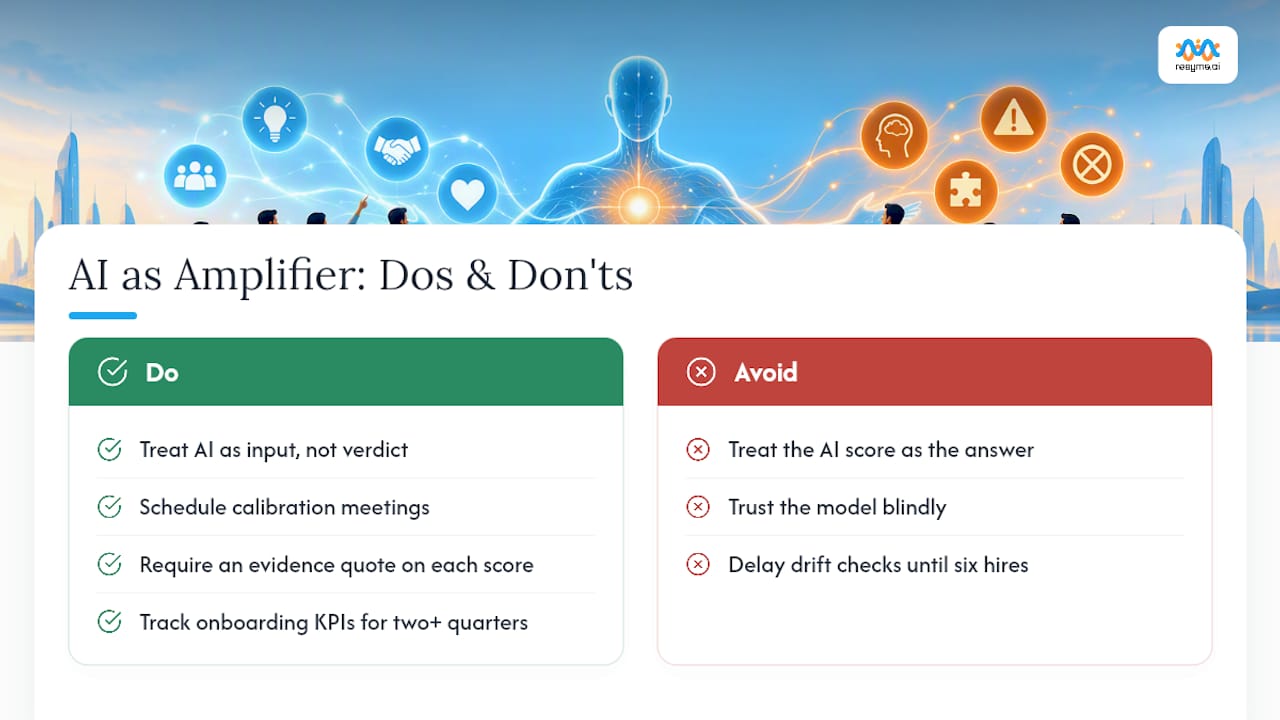
The biggest mistake teams make with AI soft skills analysis isn’t technical. It’s cultural. They treat the AI score as the answer instead of as one well-documented input into a decision a human still owns. That framing shift changes everything downstream: you schedule calibration meetings instead of trusting the model blindly, you require an evidence quote on every score before it reaches a hiring manager, and you track onboarding KPIs against those scores for at least two quarters so drift gets caught early instead of six hires later.
Resyme.ai’s approach, tailoring interview questions to domain and role while keeping every rating traceable to a transcript span, reflects where this practice needs to go: less “trust the score” and more “show me the sentence.” That’s a genuinely higher bar than most legacy screening methods clear, and it’s worth holding every vendor to it, including this one.
— Raul
Put Evidence-First Interviewing to Work With Resyme
Resyme is built around the exact workflow this article just walked through: role-tailored behavioral questions, automatic extraction of evidence from every answer, and candidate reports you can audit in minutes instead of re-listening to a full interview. Recruiters running high-volume or specialized hiring use it to cut pre-screen time while keeping every soft-skills rating tied to a quoted answer, not a gut feeling.

Where a traditional screening call leaves you with notes and an impression, Resyme leaves you with a behaviorally-anchored report you can compare across every candidate in the pipeline, objectively and side by side. Recruitment agencies and in-house teams use the Company plan at €599 per month or the Agency plan at €4,500 per month for ongoing volume, and pay-as-you-go teams can run individual interviews for €4.50 to €7.99 each. For teams building out interview prep and scored evaluation workflows more broadly, scored mock oral boards offer a useful parallel model worth studying. Head to the Resyme landing page to see plan details and start your first interview batch.
Sources
- SIOP Statement on the use of Artificial Intelligence for Hiring
- AI applied to selection — SIOP event page
- Interview evaluation by AI agents: behavioral signal extraction from conversation transcripts — Zylos Research
- Navigating the open seas of AI-based hiring technologies — SIOP discussion article
FAQ
What’s the fastest way to start analyzing soft skills with AI?
Start with a focused job analysis to define the two or three competencies that actually predict success in the role, then build behavioral anchors for each score level before you run a single interview. Platforms like Resyme.ai apply role-tailored questions automatically, which shortens this setup considerably for recruiters hiring at volume.
How accurate is AI at scoring behavioral interview answers?
Well-grounded LLM pipelines that extract STAR components and score against behavioral anchors reached roughly 76 to 80 percent agreement with certified human evaluators in leadership competency scoring. That’s strong enough to triage at scale, but not strong enough to skip human review on borderline scores.
What is the four-fifths rule and why does it matter for soft skills assessment?
The four-fifths, or 80 percent, rule flags adverse impact when a protected group’s selection rate falls below 80 percent of the highest-scoring group’s rate. Any team running AI-scored interviews at volume needs this check on a recurring schedule, not just once at launch.
Do candidates need to be told an AI is scoring their interview?
In several jurisdictions, yes. Illinois’s AI Video Interview Act and New York City’s Local Law 144 both require candidate notice and, in some cases, an independent bias audit before an automated score factors into a hiring decision.
How much does Resyme cost per interview?
Resyme offers pay-as-you-go pricing per interview and monthly subscription plans. Full plan details are listed on the Resyme site.