Skills-Based Hiring Assessment: A Practical Guide for Recruiters

A skills-based hiring assessment tests what a candidate can actually do against the skills the job needs, instead of judging them by a resume, a degree or a job title. The version that works at volume has four parts: a short list of required skills, one structured method applied the same way to everyone, verification of what candidates claim, and a scored report you can compare. Resyme’s automated interviews are built for that last stretch: role-tailored, behaviorally anchored questions, honesty validation and comparable candidate reports, so a small team can screen hundreds of applicants without reading hundreds of resumes.
TL;DR
- Pick 6 to 10 skills that matter on day one, then score every candidate on those only.
- One method is rarely enough. Combine structured interviews, work samples and short tests, and run them the same way each time.
- Resumes overstate skills. In one AI-assisted recruitment study, about 21% of completers listed a required technical skill that the AI rated “Not Familiar”.
- Structured interviews are among the best predictors of job performance, and an automated interview lets you run one for every applicant.
- You do not need an ATS to start: a skills scorecard and a consistent first-round interview are enough.
Table of Contents
- What skills-based hiring means in practice
- Step 1: Define the skills before you look at a single resume
- Step 2: Choose assessment methods that fit your volume
- Step 3: Verify what candidates claim
- Step 4: Keep the process fair, accessible and consistent
- Step 5: Make it work at high volume, with or without an ATS
- Where Resyme fits
- Our perspective
- FAQ
- Sources
What skills-based hiring means in practice
The U.S. Department of Labor describes skills-first hiring as hiring workers based on skills, knowledge and abilities they can demonstrate, regardless of how or where they acquired them. Dropping a degree requirement is only one piece. The OECD makes the same point: it warns that skills-first hiring is often misread as simply removing degree requirements, when it is really about assessing demonstrated skills.
The assessment is the part that makes this real. Without it, you have removed a filter and put nothing in its place, and reviewers fall back on gut feel.
Step 1: Define the skills before you look at a single resume
This is where most processes go wrong. If the skills are vague, every later step is vague.
- Start from the job’s purpose. The DOL Starter Kit suggests asking what the job is for, which skills lead to success, how important each is, and which can be learned on the job. Split them into core and nice-to-have.
- Keep the list short. Canada’s Job Bank guide advises no more than 6 to 10 essential competencies per role, judged by how critical the task is, how often it is used and what an error costs.
- Tie skills to real tasks. The U.S. Digital Service says defensible competencies come from actual tasks expected on the first day, listed by people who do the job.
- Write a scoring rubric. Define what weak, solid and strong look like for each skill before anyone is interviewed.
The rubric is what lets you compare a candidate screened Monday with one screened Friday. Our guide to defensible interview question design shows how to turn each skill into a small set of questions.
Step 2: Choose assessment methods that fit your volume
No single method gives a fair picture. The DOL advises combining structured interviews, hands-on evaluations, simulations and written tests, and choosing an approach you can run consistently for every candidate given your time and resources.
That last clause matters most for busy teams. A brilliant work-sample test you can only grade for ten people is worse than a simpler method you can apply to two hundred.
| Method | Best for | Where it goes wrong at volume |
|---|---|---|
| Short skills test | Hard, checkable skills (software, math, language) | Says little about judgment or how someone handled real situations |
| Work sample or simulation | Final-stage evidence on core tasks | Grading takes hours per candidate |
| Structured interview | Behavior, judgment, depth of experience | Interviewers drift from the script and score inconsistently |
| Resume review | Spotting candidates to invite | Unreliable as a predictor on its own |
The evidence favors structure. A U.S. Merit Systems Protection Board study found that tallies of years of experience, training classes, GPA and resume contents predict future performance poorly, while structured interviews have a predictive validity of .51, in its “Very Useful” category.
A structured interview means every applicant gets the same questions in the same order, each linked to a job-relevant skill and scored on the same scale. Doing that by hand for every applicant is the bottleneck. Automating it is the fix, and our comparison of AI screening versus interviews explains where each belongs in the funnel.
Step 3: Verify what candidates claim
A skills assessment is only useful if the answers are honest. The MSPB notes that applicants are not always honest about past training or experience, and recommends grounding assessments in job analysis, verifying claims and using structured interviews.
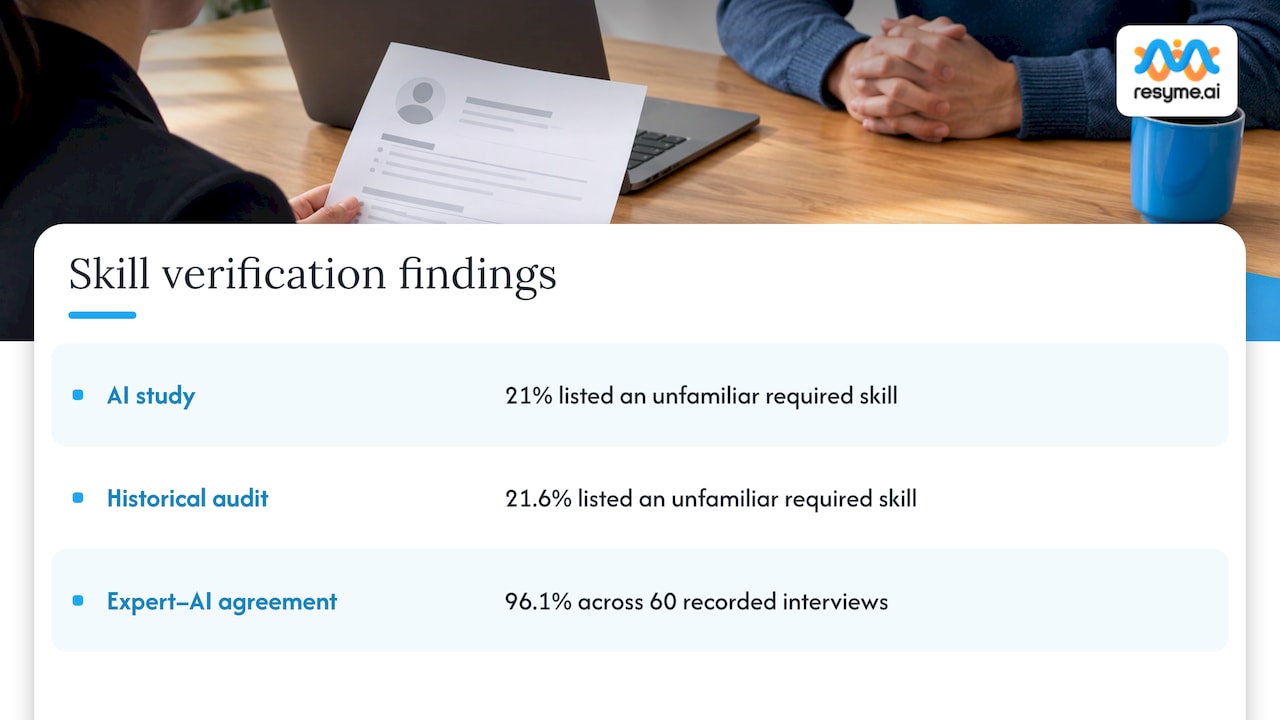
The size of the problem is visible in recent research. An AI-assisted recruitment study found that about 21% of completers listed at least one required technical skill that the AI rated “Not Familiar”, and a 720-candidate historical audit found 21.6%. An independent expert agreed with the AI on 96.1% of skill classifications in a random subset of 60 recorded interviews. We break down those results in AI interview analysis.
AI tools also change the candidate side. A peer-reviewed experiment with 245 participants found that candidates using ChatGPT in asynchronous video interviews scored higher on content but received much lower honesty ratings (averages of 42.77 and 59.40 versus 81.83 out of 100 for candidates who did not use it). A polished answer is not proof of skill.
This is the step where we take work off your hands. Resyme interviews validate candidate honesty automatically, tailor questions to the role with domain knowledge and use voice and text detection, so a claim on a resume gets tested in conversation rather than taken at face value. For the manual side of verification, see our recruiter’s playbook for verifying resume claims, and for the live-interview side, interview cheating detection.
Step 4: Keep the process fair, accessible and consistent
Skills-based assessment is meant to widen the pool, so design it that way. The DOL Starter Kit recommends plain language, accessible technology, diverse review panels and optional phone interviews for candidates without broadband, and sharing questions in advance for people with anxiety disorders. It also cites studies showing a 30% increase in women’s successful selection through blind evaluation.
The OECD reports a Helsinki pilot of anonymous screening across 13 roles in 2020: applicants with an immigrant background were more likely to be invited and hired, with no significant difference in wages or turnover, and more applicants overall.
Two practical cautions for any automated step:
- The OECD notes that algorithmic tools can reduce some human bias but also reproduce or amplify it, depending on design, training and use. Review the outcomes by group, not only the scores.
- Validity belongs to how a score is used, not to the tool. The APA’s personnel selection principles say that promotional literature and testimonials are not validity evidence; what counts is evidence that the assessment relates to the job. Our article on candidate assessments and validity covers what U.S. employers should document.
For compliance questions about a specific assessment, talk to your employment lawyer.
Step 5: Make it work at high volume, with or without an ATS
The Markle Foundation’s playbook recommends 5 to 10 minute pre-screen assessments aligned with required skills, anonymous resume review and less reliance on ATS keyword and degree filters. It argues that keyword screeners tend to reward applicants who look like current employees, which is the opposite of what you want.
A lean routine for a startup or small business with no ATS:
- Write the 6 to 10 skills and the rubric for each role.
- Put the same first-round interview in front of every applicant, before you read resumes.
- Review the scored reports side by side, not the resumes.
- Invite the top group to a work sample or live conversation with the hiring manager.
- Record the scores, so you can see later which signals predicted good hires.
If you have no HR team, our guide for founders building a hiring process without HR walks through this. If you already use software to sort resumes, resume screening automation governance covers how to keep it accountable.
Where Resyme fits
Resyme runs the structured interview for you. It builds role-tailored, behaviorally anchored questions, validates honesty, profiles behavior and skills, works with resumes and LinkedIn profiles, and produces scalable reports that compare candidates objectively. Candidates get an accessible format, and you get a ranked, comparable shortlist instead of a pile.
Pricing is listed on our site: €4.50 to €7.99 per interview on pay-as-you-go, the Company plan at €599 per month and the Agency plan at €4,500 per month. There is also a Free plan and an Enterprise plan, both without a published price.

If you screen high volumes or hire for specialized roles, start with one open role and run every applicant through the same interview.
Our perspective
Most skills-based hiring programs fail at the same point: the plan is good and the first round is still a resume skim. The skim is fast, so it wins.
We built Resyme around the idea that the first round should test skills, not paperwork. When every candidate answers the same behaviorally anchored questions, written for the role with real domain knowledge, you stop guessing who is credible. Honesty validation matters because the research is consistent: resumes and self-reported experience are weak predictors, and structured interviews are strong ones.
The point is not to replace your judgment. It is to give it better evidence, in the same format for every candidate, so the people you meet are the ones most likely to be right for the role.
Raul
FAQ
Do I need an ATS to run skills-based hiring?
No. What you need is a defined skills list, a scoring rubric and one consistent first-round method. A spreadsheet of scores plus an automated interview covers a small team’s needs. An ATS helps with tracking later, but it does not make the assessment skills-based.
How many skills should I assess per role?
Stay within 6 to 10 essential skills, as Canada’s Job Bank guidance suggests. Longer lists make scoring inconsistent and candidates harder to compare. Separate the skills needed on day one from those someone can learn on the job.
Is a structured interview really a skills assessment?
Yes, when each question maps to a skill from your job analysis and every answer is scored on the same scale. The MSPB study rates structured interviews at .51 predictive validity, well above resume contents. Behaviorally anchored questions ask for specific past situations, which exposes shallow claims.
How do I handle candidates who use AI to answer?
Use questions that require specifics and follow-ups, and combine methods so one polished answer cannot carry a candidate. Resyme’s voice and text detection and honesty validation are built for this.
Sources
- Skills-First Hiring Starter Kit, U.S. Department of Labor
- Promoting skills-first hiring and talent management, OECD
- Hire employees, Job Bank Canada
- Subject Matter Expert Qualification Assessments, U.S. Digital Service
- Evaluating Job Applicants, U.S. Merit Systems Protection Board
- Quantifying the Benefits of AI-Assisted Recruitment
- ChatGPT, can you take my job interview?
- Principles for the Validation and Use of Personnel Selection Procedures, APA
- Skills-Based Sourcing & Hiring Playbook, Markle Foundation