HR Teams: 5 Steps to Use Structured vs Unstructured Interviews

Structured interviews should be the default for any hiring decision that affects job performance, pay, or legal exposure. They ask every candidate the same job-relevant questions, score answers against fixed anchors, and produce results that hold up in an audit. Unstructured interviews still have a place: early cultural-fit chats and exploratory conversations where rapport matters more than comparability. For anything that decides who gets the job, structure wins.
TL;DR:
- Structured interviews can be up to twice as effective at predicting job performance compared to unstructured formats when questions are well designed and consistently scored.
- They require upfront work including job analysis, question development, and interviewer training; poor question wording can significantly reduce their predictive power.
- Use fully structured interviews for high-stakes roles and high-volume hiring, while employing a blended or unstructured approach only for early exploratory or relationship-building conversations.
- Validity depends heavily on question clarity, interviewer training, and real-time scoring, making measurement and continuous improvement essential.
- Automation platforms like Resyme can help scale structured interviews efficiently by managing question asking, scoring, and candidate report generation at volume.
Table of Contents
- Structured vs Unstructured Interviews at a Glance
- What Structured Interviews Are and Why They Predict Better
- Unstructured Interviews: Where They Help and Where They Fail
- When to Use Structured, Unstructured, or Semi-Structured Interviews
- How to Design and Run a Structured Interview
- Sample Structured Interview Questions and a Scoring Rubric
- What the Research Actually Says About Interview Validity
- An Editorial Take on Structure vs. Candidate Experience
- Scaling Structured Interviews Without Slowing Down Hiring
- Sources
- FAQ
Structured vs Unstructured Interviews at a Glance
The five dimensions that matter most in this comparison almost always favor structure, but not by the same margin.
- Predictive validity and reliability: structured interviews consistently outperform unstructured ones and can be up to twice as effective at forecasting job performance.
- Fairness and legal defensibility: standardized questions and documented scoring hold up better under scrutiny; free-flowing conversations leave no consistent record to defend a decision.
- Time and preparatory effort: unstructured interviews take minutes to plan; structured ones require job analysis, question design, and rater training up front.
- Candidate experience: structured formats feel more consistent and fair to applicants, while unstructured ones can feel warmer but wildly inconsistent between candidates.
- Scalability and repeatability: structured interviews scale across recruiters and locations because everyone asks the same things; unstructured interviews scale poorly because quality depends entirely on who’s in the room.
The practical takeaway: build structure into anything that decides an offer, and save the free-form conversation for rapport, not evaluation.
What Structured Interviews Are and Why They Predict Better
A structured interview asks every candidate the same set of job-relevant questions, in the same order, scored against the same rating scale. The format has five core pieces.
- A job analysis that identifies the competencies actually tied to performance in the role.
- Fixed questions, usually a mix of behavioral (“tell me about a time…”) and situational (“what would you do if…”) prompts.
- Anchored rating scales that define what a 1, 3, or 5 answer actually sounds like.
- Multiple raters scoring independently before comparing notes.
- Documentation of every question, answer, and score.
The evidence for this format is not close. Meta-analytic reviews find structured interviews consistently outperform unstructured ones across the research literature, and the OPM’s structured interview guide ties that predictive edge directly to job analysis and standardized scoring, both of which also strengthen legal defensibility if a hiring decision is ever challenged.
None of that comes free. Writing good behavioral and situational questions takes real time, and a badly worded question can overload candidates with cognitive load instead of testing the competency you actually care about. The fix is not more questions. It’s fewer, sharper ones, piloted before rollout.
Pro Tip: Run your first draft of structured questions on two or three internal employees before using them on candidates. If a strong performer struggles to answer, the question is testing the wrong thing.
Unstructured Interviews: Where They Help and Where They Fail
An unstructured interview has no fixed script. Questions shift based on the conversation, follow-up topics emerge on the fly, and no two candidates necessarily hear the same thing. That flexibility is the whole appeal and the whole problem.
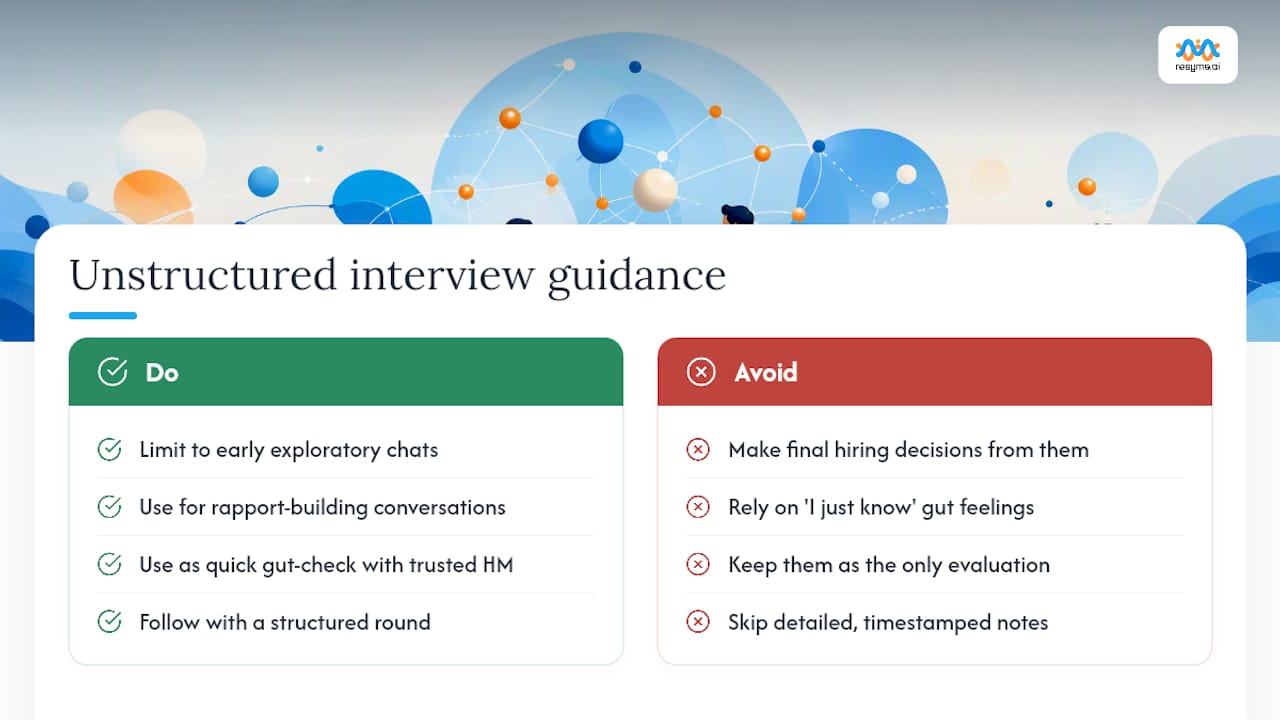
Unstructured formats genuinely help in a few situations: an early exploratory chat before a role is fully defined, a rapport-building conversation meant to sell a candidate on the company, or a quick gut-check with a hiring manager who already trusts the shortlist. Nobody is making a final call based on that conversation alone.
Where unstructured interviews fail is everywhere else. They show lower reliability and validity than structured formats, they leave far more room for interviewer bias to creep into scoring, and they create legal exposure because there’s no consistent record showing candidates were evaluated on the same criteria. An interviewer who “just knows” within five minutes is usually responding to affinity bias, not competence.
If you’re going to use unstructured interviews at all, keep them off the decision path. Limit them to early screening or relationship-building, follow every one with a structured round before any offer decision, and take detailed, timestamped notes so at least there’s a record of what was actually said.
When to Use Structured, Unstructured, or Semi-Structured Interviews
The decision usually comes down to three variables: how much the hire matters, how many you’re making, and how complex the role is.
- High-stakes roles (leadership, technical specialists, anything tied to compliance): go fully structured. The cost of a bad hire far outweighs the extra prep time.
- High-volume hiring (retail, call centers, seasonal roles): structured interviews scale because every recruiter asks the same questions and scores them the same way, which keeps quality consistent across dozens or hundreds of interviews.
- Senior or highly complex roles: use a blended approach. Structured questions cover core competencies, with a shorter unstructured segment for strategic or cultural discussion the job analysis can’t fully anticipate.
- Early-stage or exploratory conversations: unstructured is fine here, since no hiring decision is being made yet.
A semi-structured format splits the difference. Standardize the competency questions and the scoring rubric, since that’s where reliability actually comes from, but leave room for a handful of open follow-up questions tailored to each candidate’s background.
The funnel that works best for most teams runs in three stages: an automated or structured screening pass to filter volume, a structured panel interview to score core competencies, and a short conversational call focused purely on cultural fit and candidate questions. Each stage does one job, and none of them tries to do all three at once.
How to Design and Run a Structured Interview
Building a structured interview process takes five steps, and skipping any one of them weakens the whole thing.
- Run a job analysis. Identify four to six competencies that actually predict performance in the role, not a wish list of nice-to-haves.
- Write behavioral and situational questions. Map each one directly to a competency, mixing “tell me about a time” prompts with “what would you do” scenarios.
- Build anchored rating scales. Define what a weak, average, and strong answer looks like for each question, and train every interviewer to score answers immediately after each response rather than waiting until the end.
- Pilot and revise. Test questions on a small group first, check inter-rater agreement, and rewrite anything that produces confusing or wildly inconsistent scores.
- Document everything. Keep the question set, the rubric, and every candidate’s scored answers on file. This is what OPM’s guidance points to as the backbone of legal defensibility.
Pro Tip: Score each answer the moment the candidate finishes it, not after the whole interview ends. Rating in real time cuts down on memory bias and noticeably improves agreement between interviewers.
Sample Structured Interview Questions and a Scoring Rubric
Behavioral and situational questions are the backbone of any structured interview method, and a few well-built templates go a long way.
- “Tell me about a time you had to deliver bad news to a client or stakeholder. What did you say, and how did they respond?” Follow up by asking what they’d do differently now.
- “Describe a situation where you disagreed with your manager’s decision. What did you do?” Probe for the specific outcome, not just the disagreement.
- “Tell me about a project that failed. What was your role in it?” Push for what changed in their process afterward.
- Situational: “If a top client threatened to cancel their contract over a missed deadline, what would you do in the next 24 hours?”
- Situational: “You discover a colleague made an error that affects a deliverable due tomorrow. Walk me through your next steps.”
| Score | Descriptor |
|---|---|
| 5 | Specific, relevant example with a measurable, positive outcome |
| 3 | Relevant example, but outcome or reasoning is vague |
| 1 | No concrete example, or answer doesn’t address the question |
What the Research Actually Says About Interview Validity
The core finding is hard to argue with: structured interviews are up to twice as effective at predicting job performance as unstructured ones, and Google’s re:Work guidance backs the same conclusion with its own internal practice of identical questions and shared scoring rubrics across candidates.
Structured interviews are up to twice as effective at predicting job performance as unstructured interviews, according to research summarized by the Public Service Commission of Canada.
That said, validity isn’t a flat number. Reviews on moving beyond mean validity point out that structured interviews have the highest average predictive power among common hiring tools, but that power swings depending on how well the questions are written, how much cognitive load candidates face, and how consistently interviewers apply the rubric. A poorly worded structured interview can underperform a well-run one significantly.
- Question wording and clarity moderate validity more than most teams expect.
- Job type changes which competencies and question formats predict best.
- Interviewer training and real-time scoring reduce the variance that undercuts otherwise solid rubrics.
Treat structure as a starting point, not a guarantee. The wording and the rater training are what make it actually work.
An Editorial Take on Structure vs. Candidate Experience
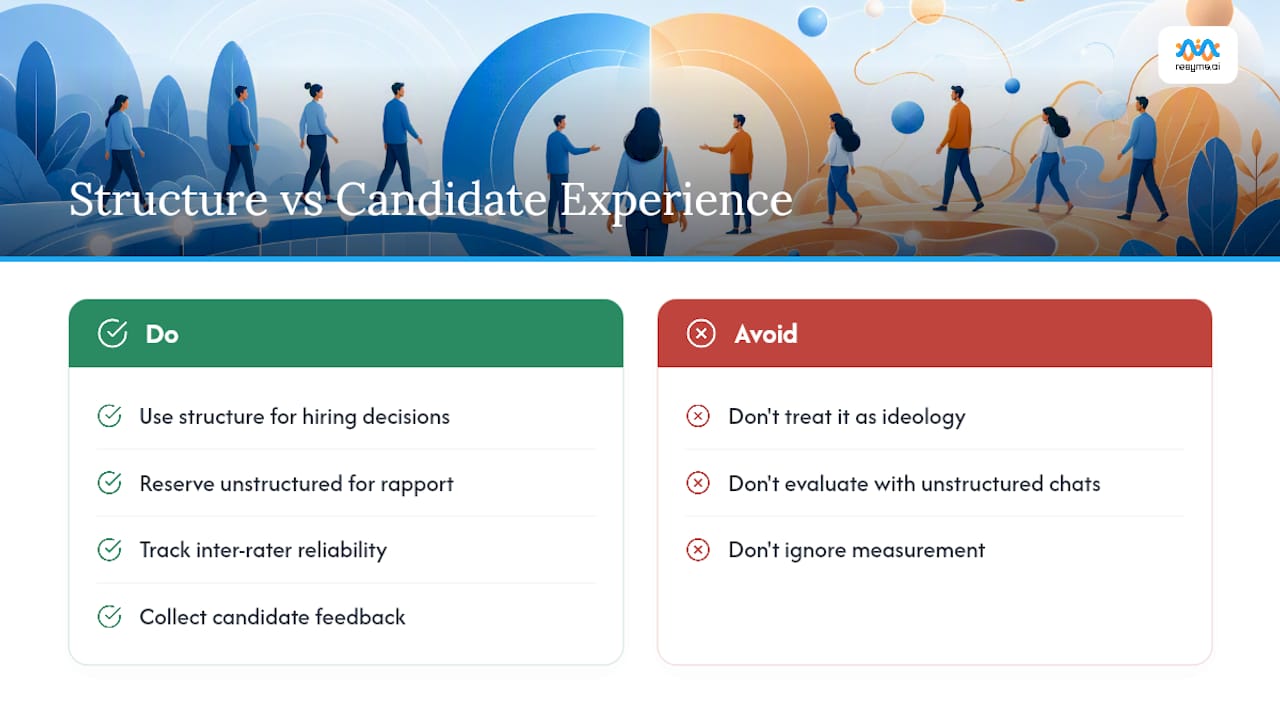
The debate over structured versus unstructured interviews gets treated as ideological when it’s really just a design problem. Structure should govern anything tied to a hiring decision, full stop. Save the unstructured conversation for rapport, not evaluation, and it stops being a liability.
What gets underrated is measurement. Teams that track inter-rater reliability and candidate feedback as ongoing metrics catch bad questions and biased scoring long before they cost a good hire. Automation helps here mainly by making that consistency achievable at volume instead of aspirational.
— Raul
Scaling Structured Interviews Without Slowing Down Hiring
A platform can give recruiters the consistency structured interviewing demands without the manual load of writing, scheduling, and scoring every question by hand. Such platforms can automate asking and scoring role-specific, behaviorally anchored questions, validate candidate honesty during the process, and produce comparable candidate reports so hiring managers see a fair, side-by-side view instead of a stack of inconsistent notes.

That matters most in high-volume or specialized hiring, where writing a fresh structured interview for every requisition isn’t realistic. Resyme handles the question design and scoring consistency automatically, whether you’re screening for one role or fifty. It’s one option among several for scaling structured interviews, and the most honest way to know if it fits your process is to run it on a real requisition. Try a pilot round through the Resyme platform and compare the candidate reports against your current process before rolling it out further.
Sources
- Structured interviews: literature summary (Public Service Commission of Canada)
- Structured Interview Guide (U.S. Office of Personnel Management)
- The structured employment interview: narrative and quantitative review of the research literature
- A guide to structured interviewing for better hiring practices (Google re:Work)
- Structured interviews: moving beyond mean validity (Industrial and Organizational Psychology)
FAQ
What is an example of an unstructured interview?
An unstructured interview might start with “walk me through your resume” and drift wherever the conversation goes, with no fixed question list or scoring criteria. It’s common in early networking chats or informal coffee meetings before a role is fully scoped.
Which type of interview is most effective for hiring decisions?
Structured interviews are consistently the most effective format for predicting job performance, and some research puts them at up to twice as predictive as unstructured formats. Effectiveness depends heavily on question wording and rater training, so a poorly built structured interview can still underperform.
What are the three C’s of interviewing?
Definitions vary across recruiting resources, so there’s no single agreed-upon version of “the three C’s.” Most hiring guides focus instead on consistency, competency alignment, and clear scoring criteria as the traits that actually drive better interview outcomes.
What are the four main types of interviews?
The four formats most HR teams reference are structured, unstructured, semi-structured, and panel interviews, though panel and semi-structured formats often overlap with the first two. Structured and semi-structured formats tend to produce the most consistent, defensible results for final hiring decisions.
Does Resyme replace structured interviews entirely?
No. Resyme automates the asking and scoring of structured, behaviorally anchored questions at scale, but it works alongside your existing hiring criteria rather than replacing the job analysis and rubric design work behind them. Current pricing and plan details are available on the Resyme site.