3 Fixes to Reduce Time to Hire Without Lowering Your Bar

The fastest, most reliable way to reduce time to hire is combining three things: a warm, pre-vetted candidate pipeline, structured screening with standardized scorecards, and pre-approved offer parameters that let you decide within 24 to 48 hours. Teams that fix these three bottlenecks routinely cut a substantial amount of time off their timeline. Track cycle time by stage, not just start to finish, so you know exactly where the delays live.
TL;DR:
- Building and maintaining a warm candidate pipeline reduces sourcing time to near zero when a requisition opens.
- Using structured scorecards and automated screening tools shortens interview stages by focusing only on critical signals and flagging issues early.
- Pre-approving salary bands and setting strict decision deadlines enable same-day offers, minimizing delays after final interviews.
- Tracking hiring stages separately reveals bottlenecks more accurately than a single overall cycle time, allowing targeted process improvements.
- Automation platforms like Resyme can dramatically shorten screening and decision stages by conducting objective, role-specific assessments automatically.
Table of Contents
- The Priority Order for Cutting Hiring Time
- What Should You Clarify Before You Start Sourcing?
- How Do You Keep a Talent Pipeline Warm Between Openings?
- How Can You Screen Candidates Faster Without Cutting Corners?
- How Many Interview Rounds Should You Actually Run?
- How Do You Speed Up the Final Decision and Offer?
- How Do You Keep Candidates Engaged So Offers Actually Close?
- Which Metrics Actually Tell You Where Hiring Slows Down?
- How Resyme Maps to Faster, Better Hiring Decisions
- Where Does Automation Actually Save Time in Recruiting?
- How Do You Forecast Hiring Needs Before You’re Already Behind?
- How Do You Get More Out of Employee Referrals?
- How Do You Write Job Postings That Attract the Right Candidates Faster?
- What’s the One Experiment Worth Running First?
- Ready to Cut Screening and Decision Time?
- Sources
- FAQ
The Priority Order for Cutting Hiring Time
Not every fix delivers equal payoff, and trying to overhaul everything at once just creates more chaos. Start with the levers that touch the most candidates and most days.
- Build pipelines first. This shortens sourcing before a req even opens, often the single biggest time sink.
- Standardize screening second. Structured interviews with scorecards cut post-interview debate and speed the interview-to-decision gap.
- Pre-approve offers third. Locking salary bands ahead of time turns a multi-day offer process into a same-day one.
- Automate scheduling throughout. Removing calendar back-and-forth saves days across every stage, not just one.
Measure sourcing, screening, interview, decision, and offer stages separately so you can spot which one is actually broken before you fix it.
What Should You Clarify Before You Start Sourcing?
Most hiring delays start before the first resume ever lands, because the team never agreed on what “right” looks like. That gap causes rework, restarts, and finger-pointing three weeks in, once everyone realizes they wanted different things.
Fixing this takes one meeting, not a committee. Run through this sequence with the hiring manager and any key stakeholders before you write the job posting:
- Separate must-have skills from nice-to-haves, and write down what success looks like in the first 90 days.
- Build a role-specific scorecard with 4 to 6 evaluation criteria, agreed on by everyone who will interview.
- Decide who has final sign-off and who has input only, so approval doesn’t stall at the finish line.
- Confirm the salary range and level with finance or leadership before the requisition goes live.
Skipping this step is one of the most common reasons hiring managers reject candidates late in the process. Most delays trace back to structural issues like unstructured interviews and unclear expectations rather than a thin candidate pool, according to CLIMB’s recruiting research.
How Do You Keep a Talent Pipeline Warm Between Openings?
Sourcing from zero every time a role opens is the slowest possible way to hire. Hiring managers who prioritize warm pipelines over “just working faster” consistently see the biggest speed gains, according to CLIMB’s analysis of recruiting bottlenecks.
- Keep a running list of strong runner-up candidates from past searches and check in with them quarterly.
- Set referral bonuses that pay out fast (within 30 days of the new hire’s start date) to keep employees motivated to refer.
- Review internal mobility candidates before posting externally. Someone already inside the company skips half the funnel.
- For chronically hard-to-fill roles, build a talent community. A quarterly newsletter or LinkedIn group keeps passive candidates engaged until a seat opens.
- Reconnect with silver-medalist candidates from finalist rounds. They already cleared your bar once.
A pipeline with even five warm names cuts sourcing time to nearly zero the moment a requisition opens.
How Can You Screen Candidates Faster Without Cutting Corners?
Screening is where most hiring managers try to save time by cutting steps, and it usually backfires. The better approach is narrowing what each gate actually tests, not skipping gates altogether.
- Design each screening stage around 2 to 3 role-critical signals only. Test those and nothing else.
- Replace a second or third phone screen with a short, scored work sample or timed task tied directly to the job.
- Use automated interview tools to capture and score responses so hiring managers review transcripts instead of scheduling redundant live calls.
- Flag inconsistencies in candidate answers early. Catching a misrepresentation at screening saves an entire interview loop later.
Automated interview platforms can also tailor their questions to specific role domain knowledge, so screening tests real competence instead of generic small talk.
Pro Tip: Score every screening response against the same rubric you built for the full interview loop. If a candidate would fail on a criterion at the screening stage, don’t advance them just to be thorough. It only delays the “no.”
How Many Interview Rounds Should You Actually Run?
Interview bloat is one of the easiest things to fix and one of the least fixed, because nobody wants to be the one who removes a round someone insisted on. Audit what you actually have first.
- Count your current rounds. If you’re running more than three, ask what each one is testing that the others aren’t.
- Consolidate redundant rounds into a single panel interview covering multiple competencies at once.
- Give every interviewer a structured guide with the same scorecard from step one, so nobody freelances their own criteria mid-loop.
- Route scheduling through automation instead of manual email threads, which routinely add days of back-and-forth.
Structured interview guides paired with standardized scoring reduce the post-interview debate that stalls decisions, and cutting unnecessary rounds measurably reduces candidate dropout, according to Yahoo Finance’s reporting on hiring process design. Teams using scheduling bots report same-day confirmations and far fewer reschedules, according to Simera’s research on hiring cycle bottlenecks.
Pro Tip: Set a rule that no candidate re-answers a question already scored in a prior round. Repetition frustrates candidates and adds nothing to your data.
How Do You Speed Up the Final Decision and Offer?
The gap between “great candidate” and “signed offer” is where good hires slip away to competitors. Most of that gap is preventable paperwork, not genuine deliberation.
- Pre-approve salary bands and negotiation limits with finance before interviews start, not after you’ve found your candidate.
- Set a hard decision deadline of 24 to 48 hours after the final interview, tied directly to the scorecard from your alignment meeting.
- Run a short, structured debrief where each interviewer scores against the same rubric instead of an open-ended discussion.
- Have offer letter templates and onboarding steps drafted in advance so the offer goes out the same day the decision is made.
Pre-approving compensation and preparing templates in advance turns the offer gap into hours instead of days, according to CLIMB’s recruiting playbook.
How Do You Keep Candidates Engaged So Offers Actually Close?
A fast process that feels cold loses candidates just as often as a slow one. Communication is not a soft skill here. It’s a retention mechanism for candidates you already spent weeks courting.
- Tell candidates upfront how many stages remain and roughly when they’ll hear back at each one.
- Send a status update within 24 hours of every interview, even if the update is “still deciding.”
- Build onboarding-forward messaging into the offer stage. Mention start-date logistics and first-week expectations before they even sign, so acceptance feels like a formality, not a leap.
- Ask candidates directly, before the offer, if they have any open questions or competing offers on the table. Surfacing hesitation early beats losing them silently after the offer goes out.
Standardizing feedback and closing communication gaps measurably reduces candidate dropout during the final stages, according to Yahoo Finance’s coverage of hiring process redesign.
Which Metrics Actually Tell You Where Hiring Slows Down?
Tracking one number, days from posting to hire, tells you almost nothing about where the process actually breaks. Break it into stages instead, because the bottleneck is rarely evenly distributed.
| Stage | What to measure | Common bottleneck signal |
|---|---|---|
| Sourcing | Days from req open to first qualified applicant | Thin or empty pipeline |
| Screening | Days from application to screen completion | Manual scheduling, too many phone screens |
| Interview | Days from screen to final interview | Too many rounds, panel availability |
| Decision | Hours or days from final interview to decision | No deadline, unstructured debrief |
| Offer | Hours from decision to signed offer | No pre-approved salary bands, missing templates |
Recruiting teams that break time-to-hire into these stages, rather than tracking one blunt total, are far better positioned to find and fix the actual bottleneck, according to Simera’s research on hiring cycle length. Review these numbers monthly, run one experiment per stage (a new scorecard, a scheduling tool, a revised salary approval flow), and measure again before adding the next fix. Small stage-level gains compound fast over a year of hiring.
How Resyme Maps to Faster, Better Hiring Decisions
Some automated interview platforms are built around the bottlenecks that stretch out screening and decision stages. Here’s how features may line up with the tactics above:
- Role-tailored interview questions may shorten the screening stage by testing domain-specific competence instead of generic questions that require follow-up rounds.
- Automated honesty and integrity validation can catch misrepresentations at screening, before they cost a hiring manager a wasted final-round interview.
- Behavioral and skill profiling can feed into the structured scorecard approach, providing interviewers consistent, comparable data instead of subjective notes.
- Objective candidate comparison can speed the decision stage by giving hiring managers a clear, side-by-side basis for a timely decision window.
Such platforms don’t replace your hiring managers’ judgment. They replace the slow, manual parts of screening that keep them from exercising that judgment sooner.
Where Does Automation Actually Save Time in Recruiting?
Automation doesn’t shorten hiring by skipping steps. It shortens hiring by removing the handoffs and dead time between steps, which is where most days actually disappear.
An applicant tracking system (ATS) eliminates the manual sorting and status tracking that used to eat hours of a recruiter’s week. Scheduling bots remove the email back-and-forth that routinely adds three to five days between “let’s schedule the interview” and the interview actually happening. AI screening tools compress the review of dozens of candidate responses into minutes instead of days of manual phone screens.
AI-driven workflows that combine autonomous sourcing, automated screening, scheduling automation, and interview intelligence can reduce time-to-hire substantially from typical industry averages to under two weeks in reported cases, according to Thehirehub. That gain doesn’t come from cutting a decision-making step.
The practical takeaway for HR teams: audit where your recruiters spend the most non-decision-making time (data entry, chasing calendar availability, manually transcribing interview notes) and automate that first. The decision itself should stay human. The friction around it doesn’t need to be.
How Do You Forecast Hiring Needs Before You’re Already Behind?
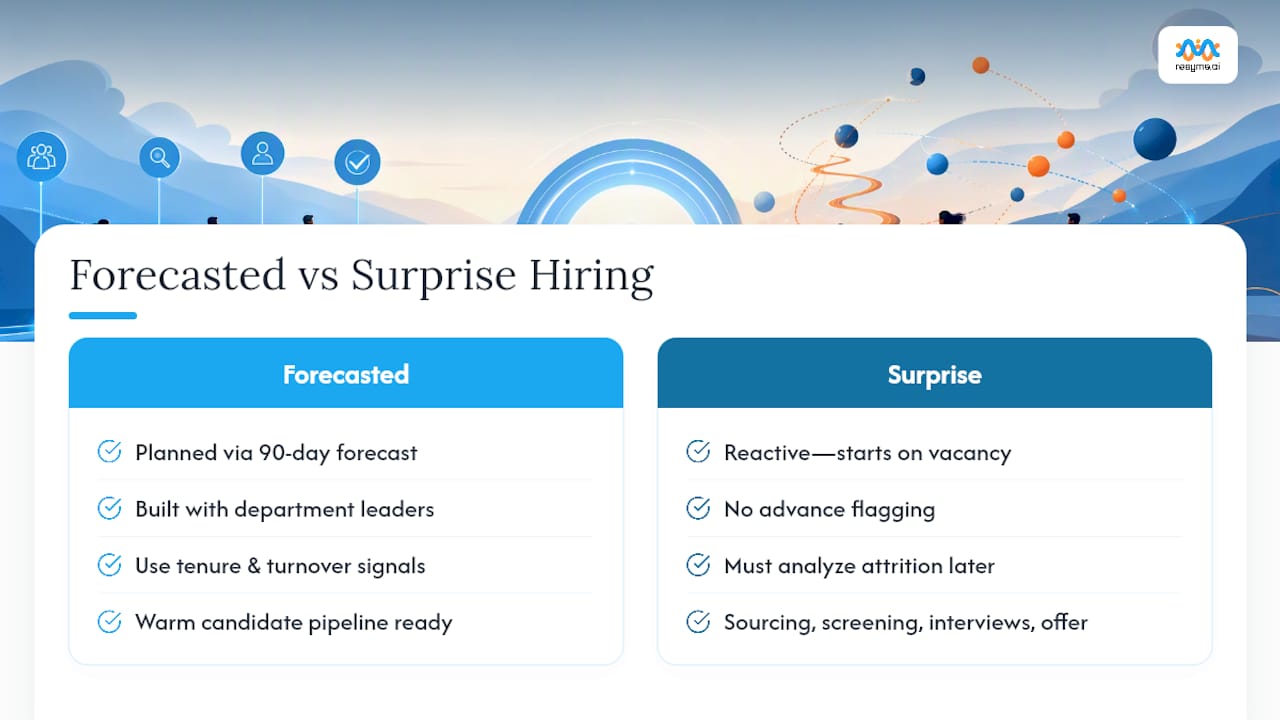
Reactive hiring, waiting until a role is empty to start sourcing, is a self-inflicted delay. The fix is treating headcount planning as a quarterly exercise tied to business goals, not a fire drill triggered by a resignation.
Start by reviewing historical hiring patterns. If your company reliably needs three customer support hires every quarter during a product launch cycle, that’s not a surprise anymore, it’s a plan. Build a rolling 90-day forecast with department leaders that flags likely openings before they’re official requisitions.
Attrition forecasting matters just as much as growth forecasting. Look at tenure data, engagement signals, and historical turnover by role type to flag which positions are likely to open in the next two quarters. That gives your recruiting team a head start on sourcing before the req is even approved.
Labor market conditions shift the math too. Comparing your internal time-to-hire against sector benchmarks from BLS job openings data helps you set realistic targets instead of guessing whether 30 days or 60 days is normal for your industry.
The payoff of forecasting isn’t abstract. A role you saw coming three months out already has a warm pipeline attached to it by the time it opens, collapsing sourcing time to nearly zero. A role that surprises you starts the entire clock from scratch, sourcing, screening, interviews, and offer, all stacked end to end instead of overlapping with pipeline work already done.
How Do You Get More Out of Employee Referrals?
Referrals consistently produce faster hires than open postings, because a referred candidate arrives with built-in vetting from someone who already works there. The problem is most referral programs are underused, not underperforming.
Make the incentive fast and visible. A referral bonus paid out 90 days after the hire’s start date feels disconnected from the original referral; paid within 30 days, it stays top of mind and encourages a second and third referral. Communicate open roles internally before they go external, giving employees a real window to think of someone before the req is public.
Give referring employees a light-touch way to flag interest, not a clunky form buried in an intranet page. A two-question Slack or email prompt (“Know anyone who’d be great for this role?”) tied to specific open positions outperforms a generic “refer a friend” banner nobody remembers exists.
Close the loop with referrers regardless of outcome. If their referral doesn’t move forward, tell them why in one sentence. Silence discourages future referrals more than a rejection does.
Track referral hires as their own pipeline stage. If referrals consistently move faster from application to offer than other sourcing channels, and they usually do, that’s a signal to invest more incentive budget there rather than spreading it evenly across every channel.
How Do You Write Job Postings That Attract the Right Candidates Faster?
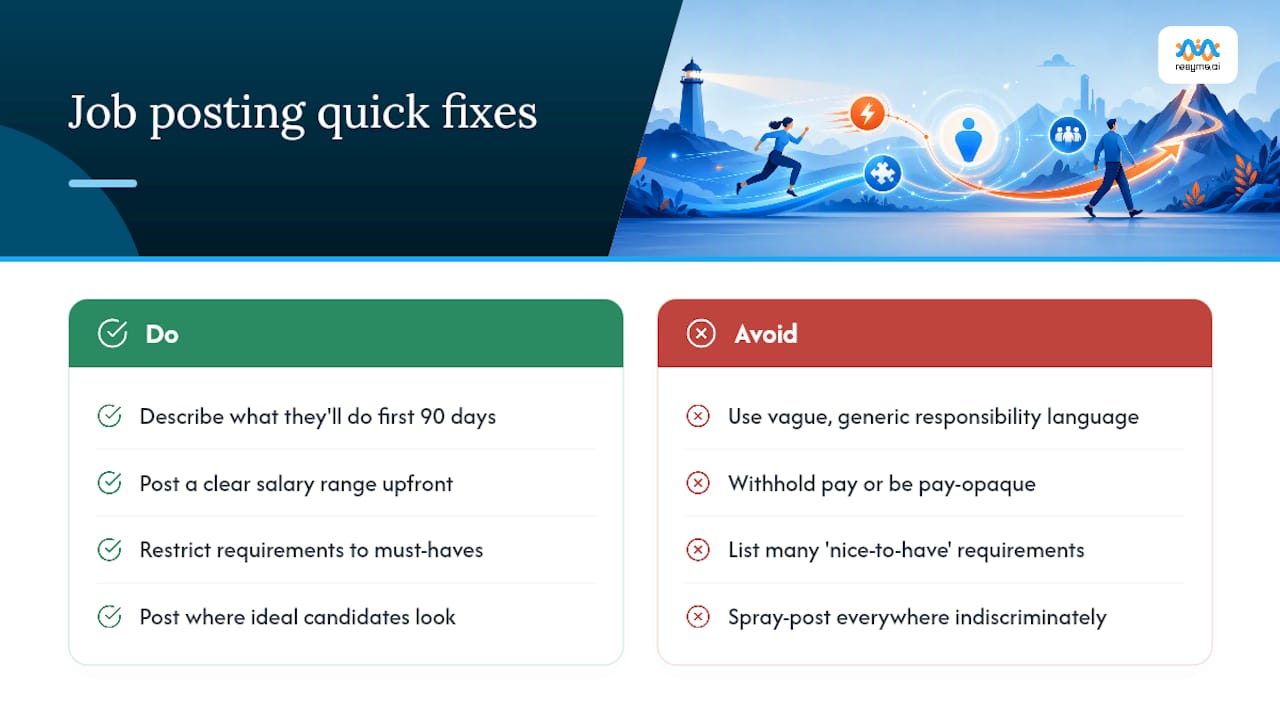
A vague job posting doesn’t just get fewer applicants. It gets the wrong applicants, which means more screening time spent filtering people out instead of moving strong candidates forward.
Lead with the concrete parts of the role: what the person will actually do in the first 90 days, not a list of abstract responsibilities lifted from a generic template. Candidates skim postings looking for whether the job matches what they want to do next, and specificity gets them to apply or self-select out faster.
Post the salary range. Postings without pay transparency generate more applications from candidates who aren’t a fit and lose strong candidates who won’t apply without knowing the range upfront. That mismatch costs screening time on both ends.
Cut the requirements list down to what you defined as must-have in your alignment meeting. A posting with 15 bullet points of “requirements,” half of which are actually nice-to-haves, discourages qualified candidates who assume they don’t meet the bar and attracts an oversized pool of applicants who don’t either.
Distribute postings where your ideal candidate actually looks, not everywhere at once. A niche technical role buried in a general job board generates volume without quality; the same role posted in a relevant community or through targeted outreach generates fewer, better-fit applicants who move through screening faster.
What’s the One Experiment Worth Running First?
If you’re only going to change one thing this quarter, pick a single high-volume role and run it with a structured screening process and a scheduling bot end to end. Watch time-to-hire drop for that role specifically before you roll the change out company-wide.
Expect the biggest gains in the screening-to-interview gap, since that’s usually where manual scheduling and unscored phone screens eat the most days. Watch for hiring manager pushback on “less time per candidate,” which usually fades once they see the scorecard data is actually more consistent, not less. Recruiting operations improve through disciplined process changes tested on real requisitions, not theory.
— Raul
Ready to Cut Screening and Decision Time?
Everything above works better with a screening layer that actually scales. Resyme is built to shorten exactly the two stages that drag out most hiring timelines: screening and decision-making. Instead of a recruiter manually reviewing dozens of phone screens, Resyme runs automated interviews with role-tailored questions, flags inconsistencies through built-in honesty and integrity validation, and scores every candidate against the same behavioral and skill criteria.

That means hiring managers walk into the decision stage with an objective, side-by-side comparison instead of a stack of inconsistent notes, which is exactly the kind of clarity that turns a multi-day debrief into a same-day decision. Whether you’re running high-volume hiring or filling a handful of specialized roles, the screening bottleneck looks the same, and it’s the one automation handles best. Visit Resyme to see how automated interviews fit into your current hiring workflow and get a sense of pricing for your hiring volume.
Sources
- How to Hire Faster: Speed Up Every Stage of Recruiting - CLIMB
- How to shorten the hiring process (and still find qualified employees) - Yahoo Finance
FAQ
How do you reduce time to hire?
Build a warm talent pipeline before roles open, standardize screening with scorecards, and pre-approve salary bands so offers can go out within 24 to 48 hours of a final decision.
What is the 70/30 rule in hiring?
There’s no single agreed-upon definition of a “70/30 rule” in hiring; the term is sometimes used informally to describe splitting effort between active sourcing and passive pipeline building, but it isn’t a standardized industry framework.
What is the hardest month to get hired?
Hiring volume typically slows in December and early January due to holiday schedules and budget resets, and it can also dip in late summer when decision-makers are on vacation, though this varies by industry and role.
Can AI tools like Resyme actually shorten time-to-hire?
Yes. Automated interview platforms remove manual phone screening and give hiring managers scored, comparable candidate data upfront, which shortens both the screening stage and the final decision stage.