15–20 Minute Prescreening Interview Playbook for Recruiters & Candidates

A pre-screening interview is a 10 to 20 minute filter that checks non-negotiables before anyone invests in a full interview. Candidates should walk in with a 60 to 90 second fit pitch and a calibrated salary range ready to go. Recruiters should verify deal-breakers (location, salary band, availability) in the first few minutes and score the call against a simple rubric before moving on.
TL;DR:
- Most pre-screening calls should last between 10 and 20 minutes, focusing only on essential logistics and basic fit questions to prevent wasting time.
- Candidates must prepare a brief 60 to 90 second pitch highlighting current role, measurable achievement, and motivation for the role they seek.
- Recruiters should verify deal-breakers such as salary range, location, and availability within the first few minutes and score the candidate immediately afterward.
- Using a structured, consistent question set and live scoring helps ensure fairness and improves pipeline quality, especially when handling high volume.
- Automated platforms are suitable for high-volume, logistics-driven pre-screens but should be supplemented by live interviews for senior or nuanced roles.
Table of Contents
- What Is a Pre-Screening Interview, and Where Does It Fit?
- The Pre-Screen Question Bank: What Gets Asked and How to Answer It
- How Do You Prepare for a Pre-Screening Interview?
- Running a Structured Pre-Screen: A Recruiter’s Setup
- Scoring Rubric: How to Make a Fair Advance-or-Reject Call
- How Long Should a Pre-Screen Take, and What Format Works Best?
- What Are the Legal Limits on Pre-Screening Questions?
- What We Got Wrong About Pre-Screens for Years
- When Automated Pre-Screens Make More Sense Than Live Calls
- Sources
- FAQ
What Is a Pre-Screening Interview, and Where Does It Fit?
A pre-screening interview is the first real filter in a hiring funnel, sitting between the resume review and the actual interview loop. It’s short by design, usually run by a recruiter or sourcer over the phone, on a quick video call, through an asynchronous video tool, or sometimes via a short form. The goal isn’t to assess whether someone can do the job well. It’s to confirm they can do the job at all, on the terms both sides need.
That distinction matters because teams often conflate a pre-screen with a phone screen, and the two aren’t identical. A pre-screen checks logistics and basic fit. A phone screen (sometimes the same call, sometimes a separate one) goes a layer deeper into skills and motivation. A full interview loop is where technical depth, behavioral history, and team fit actually get tested.
Standard pre-screens cover a narrow set of things:
- Salary expectations and whether they align with the budgeted range
- Availability, notice period, and start date
- Location or remote-work constraints
- Basic professional background and interest in the specific role
Indeed’s breakdown of standard pre-screening questions confirms this scope stays close to logistics rather than in-depth technical competency. That’s intentional. Teams that skip this step end up running 45-minute interviews with candidates who were never going to accept the salary anyway.
The Pre-Screen Question Bank: What Gets Asked and How to Answer It
A well-run pre-screen follows a predictable order: logistics first, then must-haves, then motivation, then a couple of red-flag probes, then a close. Recruiters should aim for a moderate number of questions to fit within a short, focused timeframe. Fewer and you risk missing a deal-breaker; more and the call starts to feel like a full interview.
Here’s a bucketed set you can lift directly:
1. Logistics (ask these first, always)
- “What’s your salary expectation for this role?”
- “What’s your earliest possible start date?”
- “Are you open to [hybrid/remote/onsite] work at [location]?”
Candidate framing: Give a range, not a single number. “I’m looking at $75,000 to $85,000 depending on the full package” sounds calibrated. A flat number sounds like a demand.
2. Core must-haves
- “Walk me through your experience with [specific required skill].”
- “Have you worked in [industry/environment] before?”
Candidate framing: Lead with the outcome, not the task. “I managed a team of six and cut onboarding time by two weeks” beats “I was a manager.”
3. Motivation
- “Why are you looking to leave your current role?”
- “What drew you to this position specifically?”
Candidate framing: Avoid trashing a past employer. Frame it as seeking growth, not escaping a bad situation.
4. Working style
- “How do you prioritize when everything feels urgent?”
- “Describe how you like to receive feedback.”
5. Red-flag probes
- “Can you tell me about a time a project didn’t go as planned?”
- “What gaps exist in your resume, if any?”
6. Closing questions
- “Do you have any questions about the role or company?”
- “Is there anything that would stop you from accepting an offer if extended?”
For specialized or senior roles, swap in one or two deeper questions (a scenario-based prompt, a portfolio walkthrough) but keep the total under 12. Longer than that, and you’re no longer running a screen.
How Do You Prepare for a Pre-Screening Interview?
Preparation for a candidate boils down to three things: a tight pitch, a realistic number, and a clear answer on timing.
Build your 60 to 90 second fit pitch around three beats: what you do now, one measurable result, and why this specific company. Something like: “I’m a customer success manager at a SaaS company, where I reduced churn by tightening our onboarding process. I’m looking at [Company] because your product sits in a space I’ve wanted to move into for a while.”
Salary framing trips up more candidates than any other part of the call. Anchor with a range based on real market data, not a wish. State it early if asked directly. Avoid saying “flexible” or “open” as your entire answer. It reads as unprepared, not accommodating.
Availability questions are simple but candidates overcomplicate them. State your notice period plainly: “I can start within two weeks of an offer” is a complete answer.
Pro Tip: Rehearse your pitch out loud, timed. If it runs past 90 seconds, you’re including detail that belongs in a full interview, not a screen.
Three mistakes to avoid:
- Rambling past the question asked (recruiters notice, and it eats your limited time)
- Giving a salary number with no range or reasoning behind it
- Treating the pre-screen as low-stakes and under-preparing
Running a Structured Pre-Screen: A Recruiter’s Setup
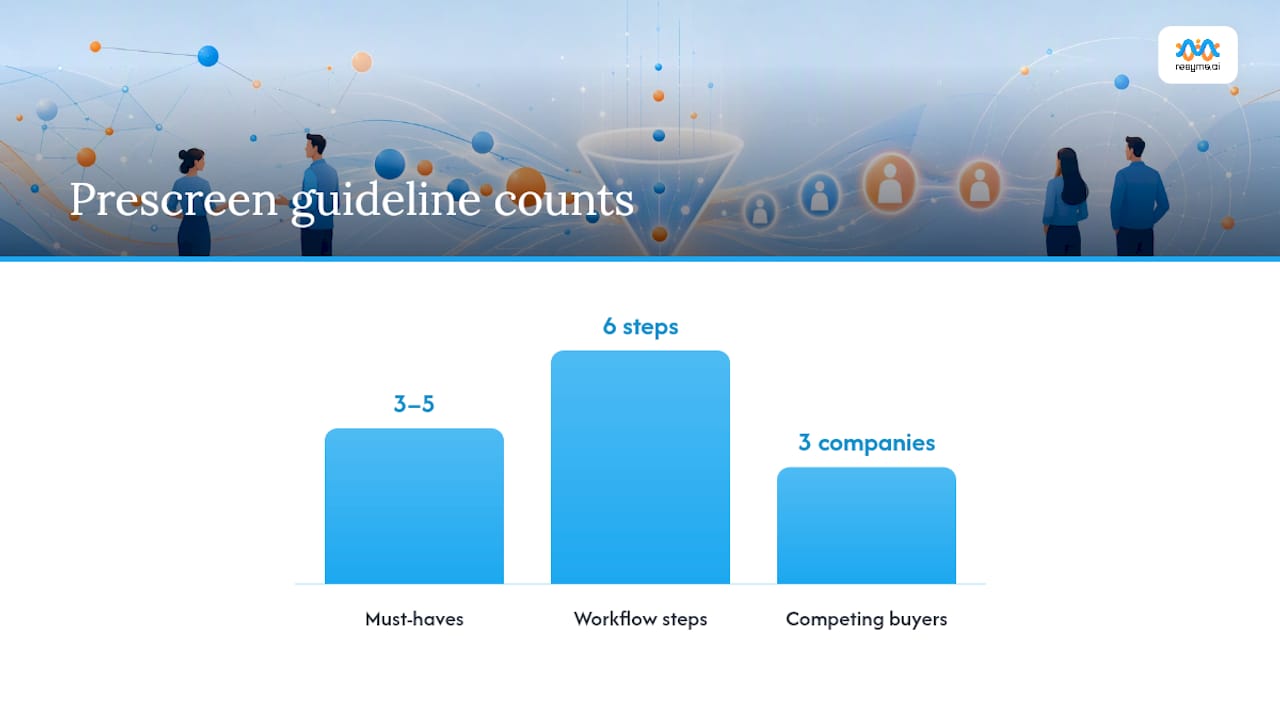
Before the call starts, define your non-negotiables. Three to five must-haves, no more. If a candidate misses even one, that’s your rejection criteria decided in advance rather than in the moment.
A workable process looks like this:
- Set the timebox. Fifteen minutes is the sweet spot. Tell the candidate up front so they can pace their answers.
- Open with logistics. Confirm salary, location, and availability in the first two or three minutes. This is where most disqualifications happen, and it saves everyone time if the fit isn’t there.
- Run the same question set every time. A fixed script, not an improvised chat, is what makes comparisons across candidates fair.
- Take one-line notes per answer. You don’t need a transcript. You need enough evidence to justify your score later.
- Score live, right after the call ends, while the answers are still fresh.
- Communicate the outcome within 24 to 48 hours, even if it’s a pass.
That structure isn’t arbitrary. A 6-step pre-screen workflow built around defining must-haves, scripting the call, and scoring immediately has been shown to save real interviewer time while improving pipeline quality, particularly for smaller teams juggling multiple open roles at once.
Prompt follow-up isn’t just good manners. Fast communication after a screen is a competitive edge, especially in a market where a strong candidate is talking to three companies at once.
Scoring Rubric: How to Make a Fair Advance-or-Reject Call
A three-point rubric beats a gut feeling every time. Score each answer Green, Yellow, or Red as the call happens, not afterward from memory. A structured live scoring approach cuts down the memory bias that creeps in when you’re comparing candidate five to candidate one a week later.
Green means the answer clearly meets the requirement with concrete evidence. Yellow means partial fit or a vague answer that needs a follow-up question before you can decide. Red means a clear miss on a must-have, such as a salary expectation well outside the budget or availability that doesn’t work at all.
Red flags that warrant an automatic reject:
- Salary expectation more than 20% above the posted range with no flexibility
- Availability that doesn’t match a hard start-date requirement
- Location mismatch on a role with no remote option
- Evasive or contradictory answers about basic work history
Yellow flags need a second look, not an instant pass or fail. A candidate who hedges on salary but seems genuinely interested might just need a clearer number stated back to them.
| Score | Meaning | Typical action |
|---|---|---|
| Green | Meets all must-haves clearly | Advance to next round |
| Yellow | Partial fit, needs clarification | Follow up or escalate to hiring manager |
| Red | Fails a non-negotiable | Reject, send notice within 48 hours |
Keep the notes and scores in your applicant tracking system, not a scratch pad. Six months later, when someone asks why a candidate was passed over, you want a one-line answer on file, not a guess.
How Long Should a Pre-Screen Take, and What Format Works Best?
Fifteen to 20 minutes with 8 to 12 questions is the efficient zone. Research on pre-screening best practices backs this window specifically. Push past it and you’re running a full interview without calling it one.
- Phone or live video works best when communication style is part of the job (sales, support, client-facing roles).
- Asynchronous video or form-based screens fit high-volume roles where speed matters more than back-and-forth nuance.
- In-person or extended video should wait for the actual interview stage.
If a call starts running long because a candidate’s answers are genuinely strong and the conversation is heading into deeper skill assessment, that’s your signal. Pause, tell them you’d like to schedule a full interview, and end the screen on time. Letting it drift defeats the purpose of having a screen at all.
What Are the Legal Limits on Pre-Screening Questions?
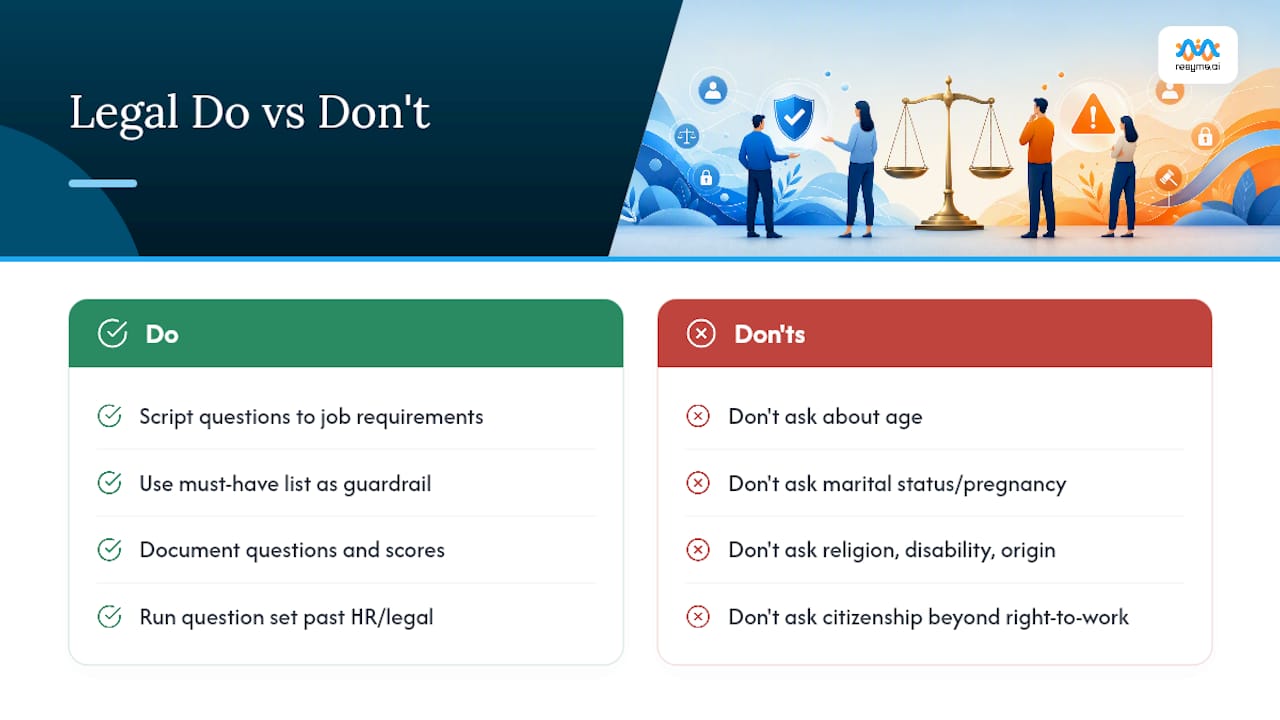
Pre-screening interviews carry real legal exposure because they happen fast and informally, which is exactly when interviewers slip into questions they shouldn’t ask. Questions about age, marital status, family or pregnancy plans, disability, religion, national origin, and citizenship status (beyond legal right-to-work confirmation) are off-limits in most jurisdictions and can expose an employer to discrimination claims.
The safest approach is to script every question around the job’s actual requirements, not the candidate’s personal life. Instead of asking whether someone has children, ask whether they can meet the schedule the role requires. Instead of asking their age, ask if they meet the minimum experience threshold. The must-have list you built before the call should double as your legal guardrail. If a question doesn’t map to a documented job requirement, cut it.
Consistency matters here too. Asking every candidate the identical script, in the same order, isn’t just good practice for comparison. It’s a defense against claims that one candidate was treated differently than another. Document what was asked and how it was scored, and keep that record with your notes.
Rules vary by country and by state, so treat this as a starting framework, not a substitute for checking your specific jurisdiction’s employment law. When in doubt, run your question set past HR or legal counsel before it becomes the standard script for your team. Skills-based framing, focused on what a candidate can demonstrate rather than who they are, tends to hold up better both legally and practically, a point echoed in guidance on skills-based hiring.
What We Got Wrong About Pre-Screens for Years
Most hiring advice treats pre-screening interviews as a formality, a box to check before the “real” interview starts. That framing undersells the moment entirely. The pre-screen is where most bad hiring decisions get baked in, not caught. A recruiter who rushes the logistics questions or skips scoring until later ends up carrying gut-feel bias into every round that follows.
The bigger blind spot is scale. Teams that rely purely on live human screens hit a ceiling fast once volume climbs past a handful of roles a week, and consistency starts slipping exactly when it matters most. Automation earns its place there, not by replacing judgment, but by keeping the same rigor across the hundredth call that you had on the first one.
— Raul
When Automated Pre-Screens Make More Sense Than Live Calls
An automated pre-screening platform can handle the repetitive, logistics-heavy part of pre-screening so your team’s live time goes to candidates who’ve already cleared the must-haves. Such platforms run structured, behaviorally-anchored interviews that flag inconsistencies and validate honesty, tailored to the specific role’s domain rather than a generic script.

Automation fits best where volume is high and the must-have criteria are repeatable, think seasonal hiring, call center roles, or any pipeline where you’re screening dozens of candidates against the same fixed logistics and skill checks. Live screens still make sense for senior or highly specialized roles where nuance and rapport matter more than throughput. For everything in between, an automated first pass keeps your scoring consistent across every candidate, something that’s hard to guarantee when three different recruiters are running the same script on a busy week.
If your pipeline has outgrown what live pre-screens can handle without losing consistency, Resyme and see how a structured, automated first round changes what reaches your recruiters’ calendars.
Sources
- 36 Prescreening Interview Questions (With Sample Answers)
- Pre-Screening Interviews: How to Run Them + 20 Questions to Ask in 2026
- Pre-Screening Interview: Questions + Best Practices (2026)
- Pre-Interview Questions: 35 Questions to Ask | FirstHR
FAQ
What Should I Expect in a Pre-Screening Interview?
Expect a short call, typically 10 to 20 minutes, focused on logistics like salary, availability, and location, plus a few basic questions about your background and interest in the role.
What Exactly Is a Pre-Screening Interview?
It’s an initial filter conducted before the formal interview loop, used to confirm non-negotiables and basic fit rather than to test technical skill in depth.
Does Passing a Pre-Screen Mean I Got the Job?
No. A pre-screen only means you’ve cleared the first filter; most roles still require one or more full interview rounds before an offer is made.
What Questions Come Up Most in a Phone Pre-Screen?
Salary expectations, availability or start date, location and remote-work flexibility, a summary of relevant experience, and why you’re interested in the specific role.
How Many Questions Should a Pre-Screen Include?
Most effective pre-screens use 8 to 12 questions across a 10 to 20 minute call. Going longer usually signals it’s time to schedule a full interview instead.