4 Week Category Interview Question Bank for Candidates & Hiring Teams

This interview question bank organizes real, practice-ready prompts by category, role, and level, then pairs each one with an answer framework so you can practice with purpose. It serves two groups: candidates prepping for a specific round and hiring managers building fair, consistent interview panels. Pick your target role and question category below, and start practicing today.
TL;DR:
- Using verified, recent question entries with role, level, and interview round tags ensures more relevant practice and reduces outdated prompts.
- Focusing on depth of practice with role-specific and technical questions yields better preparation than relying solely on broad, generic question lists.
- Implementing structured answers with the STAR framework, including measurable results, improves clarity and impact in responses.
- Regular, micro-practice sessions combined with spaced review help retain key stories and technical approaches over time.
- Automated interview tools like Resyme.ai enhance consistency and objectivity, especially when screening large volumes of candidates for specialized roles.
Table of Contents
- What Categories Does This Interview Question Bank Cover?
- Finding Technical and Role-Specific Questions in the Bank
- How Do You Structure a Strong Answer With STAR?
- Building a Practice Routine That Actually Sticks
- What Makes a Question Bank Trustworthy?
- How Resyme.ai Complements Manual Question Bank Practice
- The Gap Between a Good Question List and a Good Interview
- A Faster Path to Structured, Verified Interviews
- Where to Go Deeper on Question Banks and Behavioral Interviewing
- Sources
- FAQ
What Categories Does This Interview Question Bank Cover?
A useful interview question library separates prompts by what they actually measure. Behavioral questions test how you’ve handled real situations. Situational questions test judgment on hypotheticals. Common and basic questions establish fit and communication style. Behavioral interviewing maps past behaviors to future job performance, which is why competency-mapped banks outperform generic question dumps.
Behavioral questions (assess past conduct as a predictor of future behavior):
- Tell me about a time you disagreed with a manager’s decision.
- Describe a project that failed. What did you do next?
- Give an example of when you had to persuade a skeptical stakeholder.
- Walk me through a time you missed a deadline.
- Describe a conflict with a coworker and how you resolved it.
- Tell me about a time you took on a task outside your job description.
Situational questions (test judgment before the situation ever happens):
- If two priority projects landed on your desk at once, how would you decide which comes first?
- How would you handle a client who repeatedly changes requirements late in a project?
- What would you do if you noticed a colleague making a costly mistake?
- If your manager gave you feedback you disagreed with, how would you respond?
Common and basic questions (establish communication style and motivation):
- Walk me through your resume.
- Why do you want to work here?
- What are your three greatest strengths?
- Where do you see yourself in three years?
- Why are you leaving your current role?
Pro Tip: For behavioral questions, name the competency the interviewer is probing (ownership, conflict resolution, adaptability) before you answer. It signals self-awareness and keeps your story on target.
Finding Technical and Role-Specific Questions in the Bank
Generic prep only gets you so far once you hit a technical screen, a case round, or a system design interview. A well-built interview question library lets you filter by role, seniority, and interview stage, so you’re not wading through irrelevant prompts for a job you’re not applying to.
Filtering by round matters because the bar shifts: a phone screen tests baseline knowledge, a coding round tests execution, and a system design or case round tests structured thinking under ambiguity. Filtering by level matters even more. A junior engineer gets asked to explain a concept; a senior engineer gets asked to defend a tradeoff they made under pressure.
Sample role-specific, practice-ready prompts:
- Explain the difference between a process and a thread.
- Design a URL shortening service. What are the scaling bottlenecks?
- Walk me through how you’d debug a production outage with no logs.
- How would you prioritize a backlog with conflicting stakeholder demands? (product)
- Describe how you’d structure a market entry analysis for a new region. (consulting/case)
- What’s your approach to reconciling a discrepancy in monthly financial statements? (finance)
- How do you handle a patient or client who is uncooperative during an assessment? (healthcare/service)
- Explain a time you optimized a slow database query.
Level-adaptation tips: for junior candidates, expect “explain” and “define” framing with room to think out loud. For mid-level candidates, expect “how would you approach” framing that tests process. For senior candidates, expect “defend your decision” framing that tests judgment and tradeoffs under real constraints.
Pro Tip: If a technical question feels underspecified, ask a clarifying question before answering. Interviewers grade this as a sign of real-world readiness, not hesitation.
How Do You Structure a Strong Answer With STAR?
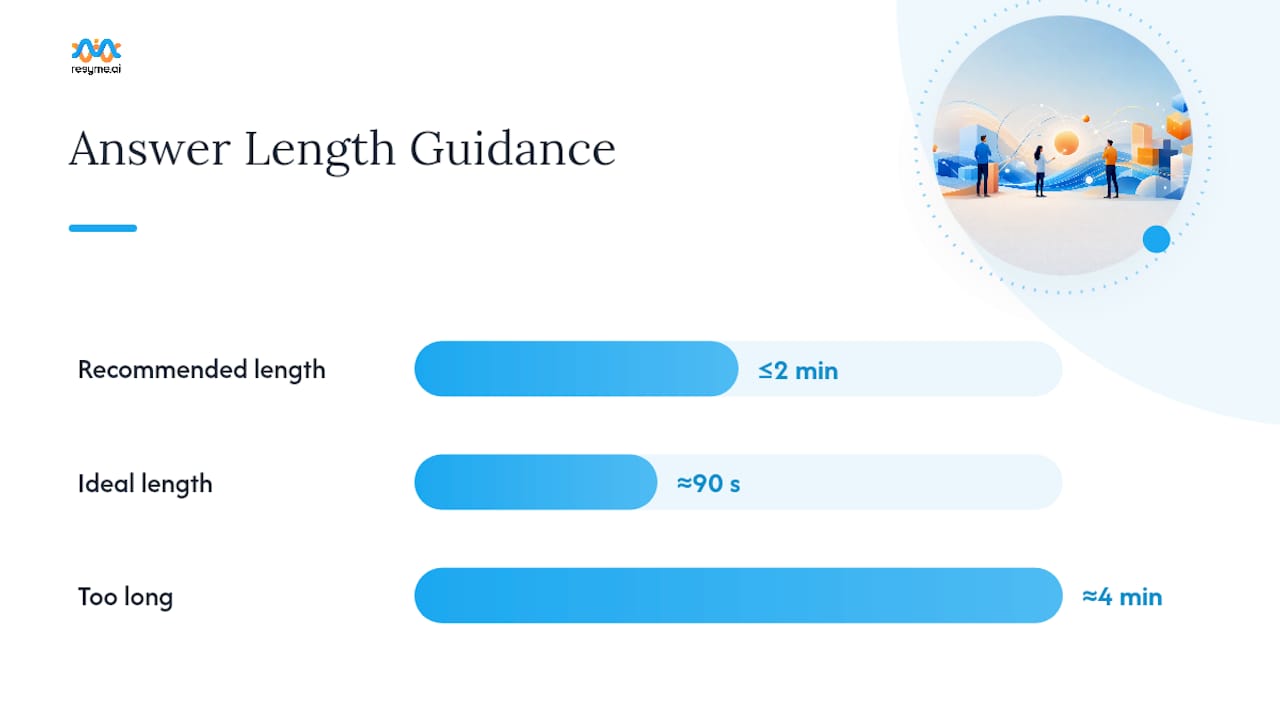
The STAR framework, Situation, Task, Action, Result, turns a rambling story into a scored answer in under two minutes. Set the scene in one sentence, name your specific responsibility, describe the concrete actions you took, then close with a measurable outcome.
Behavioral micro-example: “Our support queue backed up to 400 open tickets (Situation). I was asked to bring it under 100 within a week (Task). I triaged by severity, delegated repeat issues to a knowledge base article, and ran daily 15-minute standups (Action). We hit 80 open tickets by day five and cut average response time by half (Result).”
Technical micro-example: “A checkout page was timing out under load (Situation). I owned the fix before the holiday sale (Task). I profiled the query, added an index, and cached the product catalog lookup (Action). Response time dropped from 4 seconds to under 300 milliseconds (Result).”
Three common pitfalls:
- Skipping the result and ending on the action, which leaves the interviewer to guess whether it worked.
- Choosing a story so small it doesn’t demonstrate real ownership.
- Talking for four minutes when 90 seconds would land the same point harder.
Score your own answer with a three-item rubric before moving on: was it clear (one situation, no tangents), did it name a result, and did it include a metric or comparison wherever possible.
Building a Practice Routine That Actually Sticks
A question bank only helps if you use it on a schedule, not in a single cramming session the night before. Micro-practice sessions paired with spaced repetition improve recall of both behavioral stories and technical approaches far more than one long study block.
- Daily drills (10-15 minutes): pick three questions from a single category and answer them out loud, timed.
- Weekly timed mock interview (30-45 minutes): simulate a full round with a peer, a coach, or a recording app, then review the tape for pacing and filler words.
- Spaced review: revisit your strongest stories after two days, then again after a week, so they stay sharp without going stale from over-rehearsal.
A simple four-week plan:
- Week 1: Build a bank of 8 to 10 STAR stories covering common competencies.
- Week 2: Drill situational and common questions daily; run your first mock interview.
- Week 3: Shift to role-specific and technical prompts; get peer feedback on clarity.
- Week 4: Run two full mock interviews under real time pressure and tighten weak answers.
Pro Tip: Record yourself answering the same question in week one and week four. The difference in pacing and confidence is usually more obvious on tape than it feels in the moment.
What Makes a Question Bank Trustworthy?
Not every question bank deserves your practice time. Look for entries with corroboration (more than one candidate reporting the same or a similar prompt), clear date stamps, and tags for role, level, and interview round. Verified databases index questions by company and round and flag stale entries to keep the pool current rather than recycling prompts from years ago.
Red flags to watch for:
- No date on the entry, so you can’t tell if it’s current or from a defunct hiring process.
- Vague role tags like “tech job” instead of a specific title and level.
- A single unverifiable submission with no corroborating report.
A genuine “last updated” stamp and a verification badge should mean the entry was cross-checked, not just posted once and left untouched.
How Resyme.ai Complements Manual Question Bank Practice
Resyme.ai builds on the same principle behind a good question bank, matching prompts to real competencies, but applies it automatically at scale. It tailors behaviorally anchored questions to each role’s domain knowledge and validates candidate honesty during the interview itself. For hiring teams screening high volumes or specialized roles, that combination of structure and verification does what a static list alone cannot: compare candidates on equal footing.
The Gap Between a Good Question List and a Good Interview
Most advice on interview prep treats the question bank as the finish line: memorize enough prompts, rehearse enough answers, and you’re ready. That’s backwards. The bank is raw material. What separates a strong candidate from a well-rehearsed one is whether they can adapt a STAR story on the fly when the interviewer asks a follow-up they didn’t script for.
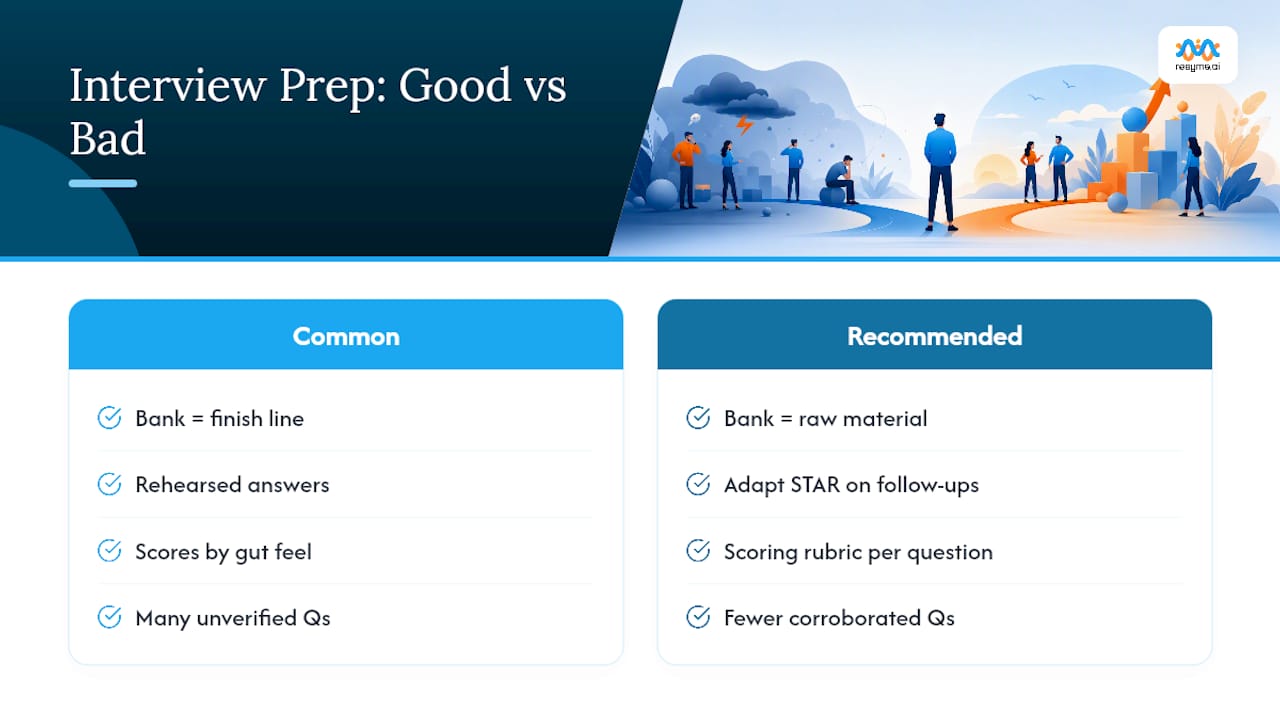
The same gap shows up on the hiring side. A list of behavioral questions doesn’t fix inconsistent interviewing if every hiring manager scores answers by gut feel. Pairing each question with a scoring rubric reduces that inconsistency, but most teams skip the rubric step because it takes more setup than pulling a question off a list.
If you take one thing from this bank, prioritize verification over volume. A hundred unverified questions from a forgotten thread are worth less than twenty recent, corroborated prompts tagged to your exact role and level. Depth of practice on the right questions beats breadth across the wrong ones every time.
— Raul
A Faster Path to Structured, Verified Interviews
Manual question banks work well for individual prep, but hiring teams juggling dozens or hundreds of candidates hit a wall fast: no single interviewer can ask every candidate the same depth of question, let alone score them consistently. Resyme.ai closes that gap by running behaviorally anchored interviews automatically, tailored to each role’s domain, with built-in honesty validation so you’re comparing candidates on substance, not polish.

It fits best when you’re screening at volume, hiring for specialized roles where generic questions fall short, or trying to compare candidates objectively instead of relying on interviewer memory. Pricing runs on a pay-per-interview basis or through the Company and Agency subscription plans, depending on your hiring volume. Visit Resyme to see how automated, validated interviews could fit into your next hiring round.
Where to Go Deeper on Question Banks and Behavioral Interviewing
For structured, role-specific practice, explore InterviewLift’s verified question bank, Workable’s categorized question guide, InterviewSense’s practice platform, and UW Oshkosh’s downloadable competency-based question PDF.
Sources
- Behavioral Interviewing and Question Bank
- Ask Better Interview Questions, Hire Better Candidates
- Question Bank – 10,000+ Interview Questions | InterviewLift
- 14,000+ Real Interview Questions — Practice Free | InterviewSense
FAQ
What Questions Get Asked in a Bank or Finance Interview?
Bank and finance interviews typically mix behavioral questions about handling client relationships and pressure with technical prompts on financial statements, valuation, or reconciling discrepancies. Expect at least one situational question testing how you’d manage a client or compliance conflict under time pressure.
What Are the 10 Main Interview Questions?
Most interviews circle back to a core set: tell me about yourself, why this role, your greatest strengths and weaknesses, a time you faced conflict, a time you failed, why you’re leaving your current job, your salary expectations, where you see yourself in three years, and whether you have questions for the interviewer. These fall under the common and basic category covered above.
What Are the 5 Basic Interview Questions?
The five most common opening prompts are: “Tell me about yourself,” “Why do you want this job,” “What are your strengths,” “What are your weaknesses,” and “Why are you leaving your current position.” They’re designed to establish communication style and motivation before deeper questioning begins.
What Is the Best Way to Answer “What Are Your Three Strengths”?
Pick three strengths that map directly to the job description, then back each one with a brief, specific example rather than a generic claim. A structure like “I’m strong at X, for example when I did Y, which led to Z” turns a vague trait into evidence an interviewer can actually score.
How Much Does Resyme.ai Cost?
Resyme.ai offers a pay-per-interview rate of €4.50 to €7.99 per interview, along with Company and Agency subscription plans. Enterprise and Free tiers are also available, with exact enterprise pricing available on request.