Save $200,000: HR’s Finance Ready Method to Calculate Cost of Bad Hires

A bad hire costs at least 30% of that employee’s first-year salary, according to the U.S. Department of Labor’s conservative benchmark. For a role with a mid-range salary, that’s a substantial floor before you count lost deals, coaching hours, or team morale damage. Industry averages run higher, and the number climbs fast for senior or client-facing positions. Budget for the low end. Model for the high end.
TL;DR:
- The actual cost of a bad hire often exceeds 30% of the first-year salary once indirect costs like lost productivity and managerial time are included.
- Indirect costs, which are less visible, can account for 60% to 70% of total losses and include underperformance, project delays, and team morale damage.
- Calculating the true cost involves estimating direct expenses, internal hours lost, productivity decline, and replacement costs, with a typical bad-hire cost around $17,000 to $25,000.
- Early-stage screening methods, such as outcome-based job descriptions and structured interviews, significantly reduce hiring mistakes and improve ROI.
- Slowing down the hiring process for better assessment can lower failure rates, especially for high-salary or client-facing roles, by increasing screening accuracy and reducing costly bad hires.
Table of Contents
- What Is the Cost of Bad Hires, Really?
- How to Calculate the Cost of a Bad Hire
- The Benchmarks HR Leaders Cite Most Often
- How a Bad Hire Drags Down Teams and Clients
- A Prevention Playbook That Actually Reduces Failure Rate
- Building the ROI Case for Prevention
- Why Speed Alone Never Solves the Hiring Problem
- A More Consistent Way to Screen Early-Stage Candidates
- Sources
What Is the Cost of Bad Hires, Really?
Most HR teams underestimate the cost of bad hires because they only count what shows up on an invoice. Recruiting fees, signing bonuses, background checks. That’s the visible layer. The bigger problem sits underneath it.
Direct costs are what you’d expect: job board postings, agency commissions (often a significant percentage of first-year salary), assessment tools, background screening, relocation packages, and severance if it comes to that. These are the easiest line items to pull from your accounts payable system, and they’re the ones finance teams already understand.
Indirect costs are where the real damage lives. You’re paying full salary to someone who isn’t producing full value. Meanwhile a manager is spending hours coaching, correcting, and covering gaps instead of running the business. Peers are quietly redoing work or picking up slack. Deadlines slip. Clients notice.
- Direct costs: job ads, agency or recruiter fees, assessment and background check fees, onboarding materials, equipment, relocation, severance
- Indirect costs: salary paid during underperformance, missed revenue or delayed projects, manager hours spent coaching or correcting, peer time spent on rework, team morale and engagement decline
Direct costs are simple to measure because they’re line items. Indirect costs require estimation, which is exactly why so many organizations skip them and end up with a number that’s a fraction of the truth. Robert Half’s research on bad-hire costs found that hidden costs often make up 60% to 70% of the total economic loss from a single bad hiring decision. If you’re only tracking the invoice trail, you’re missing most of the damage.
How to Calculate the Cost of a Bad Hire
Calculating recruitment costs for a failed hire follows a repeatable four-step method. You don’t need a finance degree, just a spreadsheet and some honest inputs.
- Tally direct costs. Add recruiting fees, ad spend, assessment costs, onboarding materials, and any severance or relocation paid.
- Estimate internal hours lost. Multiply manager and peer hours spent managing the underperformance by their fully loaded hourly rate.
- Apply a productivity loss percentage. Use the Department of Labor’s 30% of first-year salary as your conservative floor, or build a fuller estimate using actual output data if you have it.
- Add replacement cost. You’ll likely need to run the hiring process again, which means paying your cost-per-hire a second time, a point SHRM’s research on recruitment costs makes explicit for roles filled externally.
Presenting both to finance shows you’re not inflating the number, and it usually makes the fuller figure more credible, not less.*
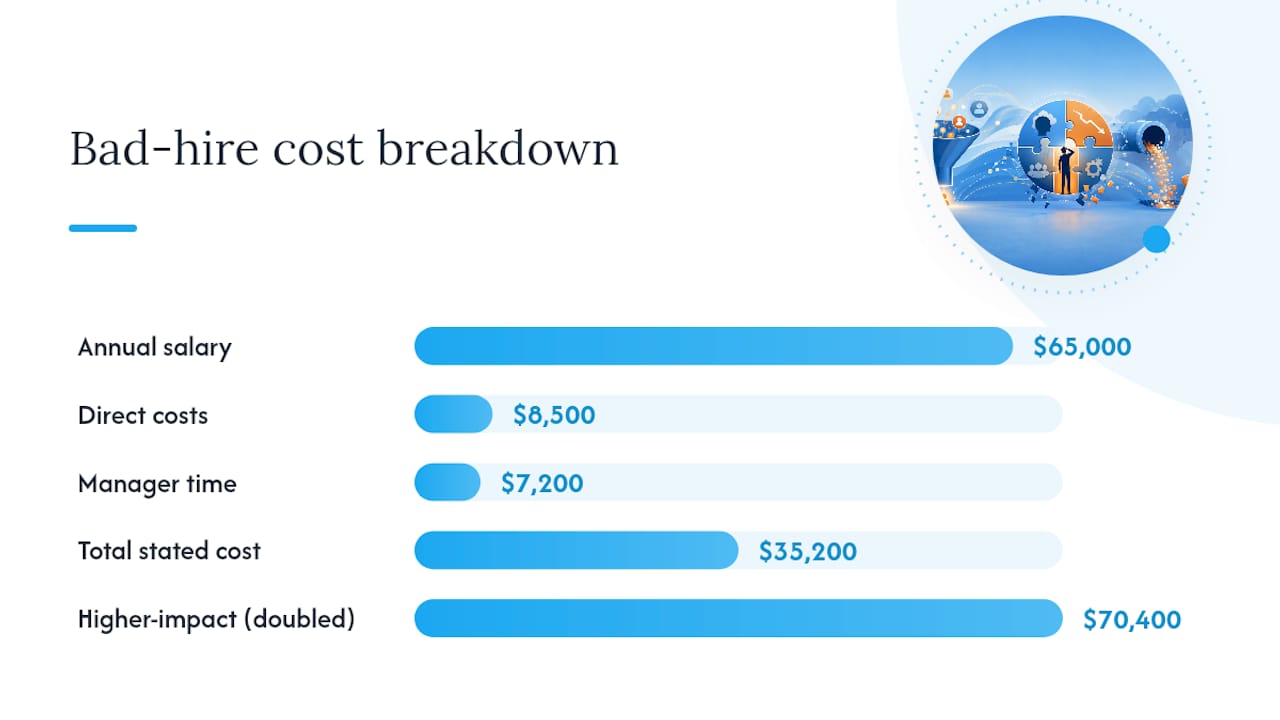
Worked example: Say you hire a marketing coordinator at $65,000 base salary. Direct costs (agency fee, assessments, onboarding) run $8,500. Add 120 manager hours at a $60 loaded rate ($7,200), and you’re at $35,200, already more than half the person’s annual salary. In a higher-impact scenario, where the hire alienated a key client account, that figure could reasonably double.
The Benchmarks HR Leaders Cite Most Often
The Department of Labor’s 30% rule is the most widely cited benchmark because it’s simple and conservative. It only accounts for lost productivity relative to salary, not agency fees, manager time, or client damage, so treat it as a floor, not a ceiling.
CareerBuilder-era data, still referenced across the industry, puts average bad-hire costs around $17,000 for a typical role, according to Forbes’ reporting on hiring mistakes. That number climbs fast for management or specialist roles where the ripple effects reach further. SHRM’s benchmarking work shows median cost-per-hire figures that vary sharply by seniority, with executive cost-per-hire rising notably compared to nonexecutive roles, per SHRM’s human capital benchmarking report.
| Benchmark source | Typical figure cited | Best used for |
|---|---|---|
| Department of Labor | ~30% of first-year salary | Conservative floor estimate |
| CareerBuilder / Forbes | ~$17,000 average | Mid-level role sanity check |
| SHRM | Median cost-per-hire, higher for executives | Scaling replacement cost inputs |
| Robert Half | ~15 hours/week manager time lost | Estimating indirect labor cost |
These figures come from different survey populations and industries, so don’t average them into one universal number. Use the Department of Labor figure as your floor, and layer in SHRM or Robert Half data to reflect your own role mix.
How a Bad Hire Drags Down Teams and Clients
The damage rarely stays contained to one role. Managers surveyed by Robert Half report losing significant weekly hours managing around a struggling employee, correcting mistakes, reassigning work, and having difficult conversations. That’s nearly two full workdays a week diverted from actual management.
Recognition lag makes it worse. Robert Half Canada’s research found it takes several weeks to recognize a hire isn’t working out, and some managers reported losing the equivalent of a full role’s worth of team capacity before the problem was addressed. Every week that passes before action is a week of compounding cost.
- Peers often quietly absorb the failed hire’s workload, which erodes their own output and, over time, their willingness to stay
- A single bad hire in a client-facing role can damage an account relationship that took years to build
- Turnover tends to cluster: teams stretched thin by covering for one weak performer see higher voluntary attrition among the people doing the covering
Pro Tip: When you’re estimating reputational or client-facing cost, don’t guess a dollar figure. Instead, tie it to a real event, a missed deadline, a lost renewal, an escalation, and cost that specific incident. It’s far more defensible in a finance conversation than a made-up percentage.
A Prevention Playbook That Actually Reduces Failure Rate
Minimizing hiring mistakes starts before you post the job, not after you’ve made the offer. Most breakdowns trace back to the same handful of gaps.
- Write outcome-based job specs. A job description that lists tasks tells you nothing about success. One that defines what the person needs to accomplish in 90 days gives you something to interview and measure against.
- Use structured, behaviorally-anchored interviews. Every candidate gets the same core questions, scored against the same rubric. This is one of the highest-leverage changes you can make, because most hiring failures trace back to cultural or attitudinal mismatch rather than a skills gap.
- Add work-sample tests where the role allows it. Watching someone do a scaled-down version of the actual job beats any interview answer.
- Run reference checks that ask specific, scenario-based questions, not “would you rehire them,” which almost everyone answers politely regardless of the truth.
- Stage the offer and monitor probation checkpoints at 30, 60, and 90 days, with concrete performance markers at each stage rather than a single pass/fail review at the end.
Pro Tip: Standardize the first-round screen before you touch anything else. Inconsistent early screening is where most bad hires slip through, and it’s the cheapest stage in the process to fix. Standardized, AI-driven automated interviews can help here specifically, since they apply the same role-tailored questions and scoring to every candidate, which removes the interviewer-to-interviewer variance that lets weak fits advance.
Building the ROI Case for Prevention
Justifying recruitment costs upfront is the easier sell once you can show finance what a failure actually costs. The math is straightforward: compare your average avoided bad-hire cost against the annual cost of the prevention measures you’re proposing.
Using a conservative $25,000 average cost per bad hire (blending the Department of Labor floor with actual manager-hour estimates), that’s eight failures a year at $200,000 in avoidable cost.
- Model sensitivity on three levers: failure-rate reduction, time-to-fill improvement, and manager hours saved
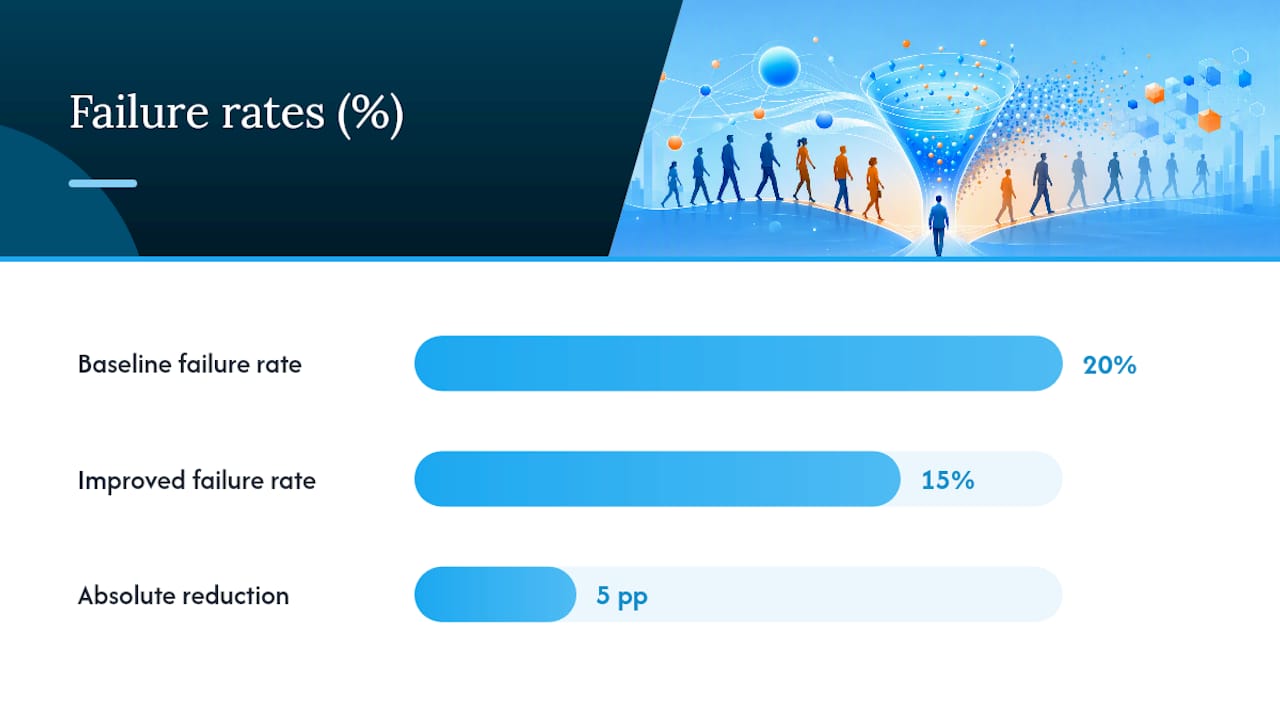
- Even a modest failure-rate drop, from 20% to 15%, on high-salary or client-facing roles produces the largest avoided-cost impact
- Present both a conservative and an optimistic scenario so finance sees you’ve stress-tested the assumptions, not just picked a flattering number
Prevention spending pays back fastest on roles with high salary or high client exposure, since the avoided cost per prevented failure scales directly with what that role touches.
Why Speed Alone Never Solves the Hiring Problem
The trade-off every hiring team wrestles with is speed versus accuracy, and most organizations default to speed because it’s the metric everyone can see. Time-to-fill gets reported in the weekly recruiting update. The cost of the wrong hire shows up three months later, scattered across a dozen different budget lines nobody connects back to the hiring decision.
That disconnect is the actual root problem, not a lack of good interviewers. If you want to test whether slowing down the screening stage pays off, run it as a 90-day pilot on one role family: track time-to-spot, manager hours logged against new hires, and 90-day performance ratings before and after. Report those three numbers to stakeholders, not a vague “quality improved” claim.
The organizations that get this right treat screening rigor as a cost-avoidance line item, not a recruiting nicety.
— Raul
A More Consistent Way to Screen Early-Stage Candidates
Most of the prevention tactics above break down for one reason: they’re hard to apply consistently once you’re hiring at volume. A structured rubric only works if every interviewer actually follows it, every time.

An automated interview platform can run role-tailored, behaviorally-anchored interviews automatically, so every candidate answers the same domain-specific questions and gets scored against the same criteria, without depending on which hiring manager happens to run the call. It may also include features to validate candidate honesty during the interview, potentially catching misrepresentations that usually only surface after hiring. Comparing candidates on the same objective basis helps generate a shortlist that goes beyond just a stack of resumes and gut feelings. If your early screening stage is where bad hires are slipping through, Resyme is built specifically for that stage. Check the product page to see how a pilot would run for your next open role.