Candidates & Recruiters: Use 4–6 Competencies in Competency Interviews

A competency-based interview asks every candidate the same behavior-focused questions so interviewers can compare evidence-based answers side by side, rather than relying on gut feeling. If you’re a candidate, the fix is simple: answer with STAR (Situation, Task, Action, Result) and real examples. If you’re hiring, the fix is just as simple: pick 4 to 6 competencies in advance and score every answer on a rubric before the next question starts.
TL;DR:
- Candidates should prepare 5 to 8 specific STAR stories, focusing on measurable results and including real numbers to demonstrate impact.
- Interviewers must define 4 to 6 key competencies beforehand, use behavioral indicators, and score answers immediately after each response for consistency.
- Maintaining strict question scripts, using behavioral rubrics, and training interviewers help reduce bias and ensure fair, comparable assessments.
- Inaccurate or vague answers, especially hypotheticals or without concrete outcomes, are key red flags; inconsistency between interviewers signals score reliability issues.
- Utilizing automated systems like Resyme can help manage large candidate pools by standardizing question delivery and scoring based on predefined competencies.
Table of Contents
- What Is Competency-Based Interviewing and Why Do Employers Use It?
- How Do You Structure Answers Using STAR or STARR?
- What Are Common Competency-Based Interview Questions?
- How Should You Prepare for a Competency-Based Interview?
- How Should Interviewers Score Competency-Based Interviews?
- What Mistakes Should Candidates and Interviewers Avoid?
- How Do You Link Competencies to Job Analysis and Role Requirements?
- How Do You Train Interviewers for Consistency and Fewer Biases?
- How Should You Interpret Competency Interview Results for Hiring Decisions?
- How Do You Reduce Bias and Support Diversity in Competency Interviews?
- What Actually Makes Competency Interviews Work
- Bring Structure to Every Interview With Resyme
- Sources
- FAQ
What Is Competency-Based Interviewing and Why Do Employers Use It?
Competency-based interviewing goes by a few names: behavioral interviewing, structured interviewing, sometimes situational interviewing when the question is framed as a hypothetical rather than a past event. All three share the same premise. Instead of asking “Are you a good leader?” the interviewer asks, “Tell me about a time you had to lead a team through a setback.” Past behavior, the theory goes, predicts future behavior better than a candidate’s self-assessment does.
Employers lean on this format because hiring on instinct has a well-documented failure rate. Totaljobs reports that 70% of employers find sourcing candidates with the right skills challenging, and a structured format is one of the more direct responses to that problem. It forces every candidate through the same filter, which makes comparisons fairer and easier to defend later.
Most organizations test several competencies per role during a session lasting up to around an hour and a half. Anything longer starts to fatigue both the candidate and the panel, and answer quality drops in the back half of long interviews.
How Do You Structure Answers Using STAR or STARR?
STAR breaks a behavioral answer into four parts, and it works because it forces specificity instead of generalities.
- Situation. Set the scene in one or two sentences: what was the context, and why did it matter?
- Task. State what you were specifically responsible for, not what your team was responsible for.
- Action. Describe exactly what you did, step by step. This is the part candidates rush, and it’s the part interviewers care about most.
- Result. Close with what happened, ideally with a number or a concrete outcome attached.
Some interviewers extend this to STARR by adding a Reflection step, which covers what you learned or what you’d do differently next time. It’s a small addition, but it signals self-awareness, which is its own competency in most frameworks.
The biggest structural mistake candidates make is spending most of their answer on Situation and Task, then rushing the Action and Result parts; recruiters can enhance candidate experience by providing trackable career fair giveaways to maintain engagement and follow-up, as detailed in trackable career fair giveaways by budget tier. Aim for roughly 1 to 2 minutes per answer, with Action taking up the largest share. And don’t assume every example has to come from paid work. A volunteer project, a class assignment, or a community role can carry a strong answer if it shows real ownership and a measurable outcome.
Pro Tip: Record yourself answering a practice question out loud, then time it. Most people are shocked to find their “two-minute” answer actually runs six minutes with no Result in sight.
What Are Common Competency-Based Interview Questions?
Interviewers usually map each question to a specific competency they’re trying to measure, and knowing that mapping helps you prepare the right story instead of a generic one.
- “Tell me about a time you disagreed with a colleague’s approach.” Tests conflict resolution and communication; interviewers look for how you raised the disagreement, not just the outcome.
- “Describe a project that failed. What did you do?” Tests resilience and accountability, not blame-shifting.
- “Give an example of when you had to meet a tight deadline.” Tests planning and organizing under pressure.
- “Tell me about a time you led a team without formal authority.” Tests leadership and influence.
- “Describe a situation where you had to adapt to a sudden change.” Tests flexibility.
- “Tell me about a time you solved a difficult problem with limited information.” Tests problem-solving and judgment.
- “Give an example of when you went beyond your job description.” Tests initiative.
- “Describe how you handled a mistake you made at work.” Tests integrity and self-awareness.
- “Tell me about a time you had to persuade someone to change their mind.” Tests communication and influence.
- “Describe a time you used data to make a decision.” Tests analytical thinking.
Common categories drawn from these questions include teamwork, communication, problem-solving, leadership, resilience, integrity, planning and organizing, and technological awareness. One story rarely maps to just one competency. Rehearse how to angle the same project toward “leadership” in one interview and “problem-solving” in another, depending on what the job posting emphasizes.
How Should You Prepare for a Competency-Based Interview?
Preparation for this format is less about guessing questions and more about building a flexible inventory of stories you can reshape on demand.
- Decode the job description. Highlight every verb and skill word. That’s your competency list before the interviewer even reveals theirs.
- Match competencies to past experiences. For each competency, jot down one or two moments where you demonstrated it.
- Prepare 5 to 8 STAR stories, not one per competency. A single strong project usually stretches across three or four competencies with different framing.
- Write out the numbers. Revenue saved, time cut, people managed. Vague results (“it went well”) are the single most common thing that makes a strong story fall flat.
- Practice out loud, not just in your head. Silent rehearsal hides rambling; speaking it out loud exposes it.
- Run a mock interview with a friend or mentor who asks follow-up questions you didn’t plan for.
Prospects’ guidance on preparing competency examples stresses tying each story directly to language in the job posting rather than answering in the abstract. That’s the difference between an answer that sounds rehearsed and one that sounds relevant.
Pro Tip: Keep a running document of “story ideas” as they happen at work, not just before an interview. Memory fades fast, and the sharpest details (the exact number, the exact objection someone raised) are gone within a few weeks if you don’t write them down.
How Should Interviewers Score Competency-Based Interviews?
Consistency is the entire point of this format, and it falls apart the moment interviewers wing the scoring. The United Nations Competency-based Interviewing Guide_0.pdf) recommends capping the assessment at around five core competencies so the panel can go deep instead of skimming across too many traits.
- Write behavioral indicators for each competency before the interview: what does a strong answer actually sound like versus a weak one?
- Use an assessment sheet with a numeric rating scale tied to those indicators, not a vague “good/bad” gut call.
- Rate each answer immediately after the candidate finishes, before moving to the next question.
- Probe past the rehearsed opening with follow-ups like “What exactly was your role?” or “What did you do next?”
- Allow the candidate a moment of silence to think. Rushing them produces shallower answers.
70% of employers say sourcing candidates with the right skills is a real challenge. Totaljobs ties this directly to inconsistent interview practices, not just a thin talent pool.
Rating on the spot matters more than it sounds. Delaying scores until after four or five candidates blur together in memory, and the last interview of the day tends to win by recall bias alone, not merit.
What Mistakes Should Candidates and Interviewers Avoid?
The most common candidate failure is answering hypothetically (“I would probably…” ) instead of recounting something that actually happened. Interviewers are trained to catch this, and it reads as a dodge even when it isn’t intended as one.
- Rambling through Situation and Task, leaving no time for Action and Result.
- Using “we” instead of “I,” which hides your specific contribution behind the team’s.
- Skipping the outcome entirely, ending the story right after the action.
- Interviewers who don’t probe, accepting a vague first answer instead of digging for specifics.
- Interviewers who ask different candidates different questions, which quietly breaks the fairness the format is supposed to guarantee.
If you catch yourself rambling mid-answer, pause and say, “Let me refocus on what I specifically did.” Interviewers should treat a candidate who asks for a second to think as a good sign, not a red flag. The real red flag is a candidate who can’t name a single concrete number or decision they personally made.
How Do You Link Competencies to Job Analysis and Role Requirements?
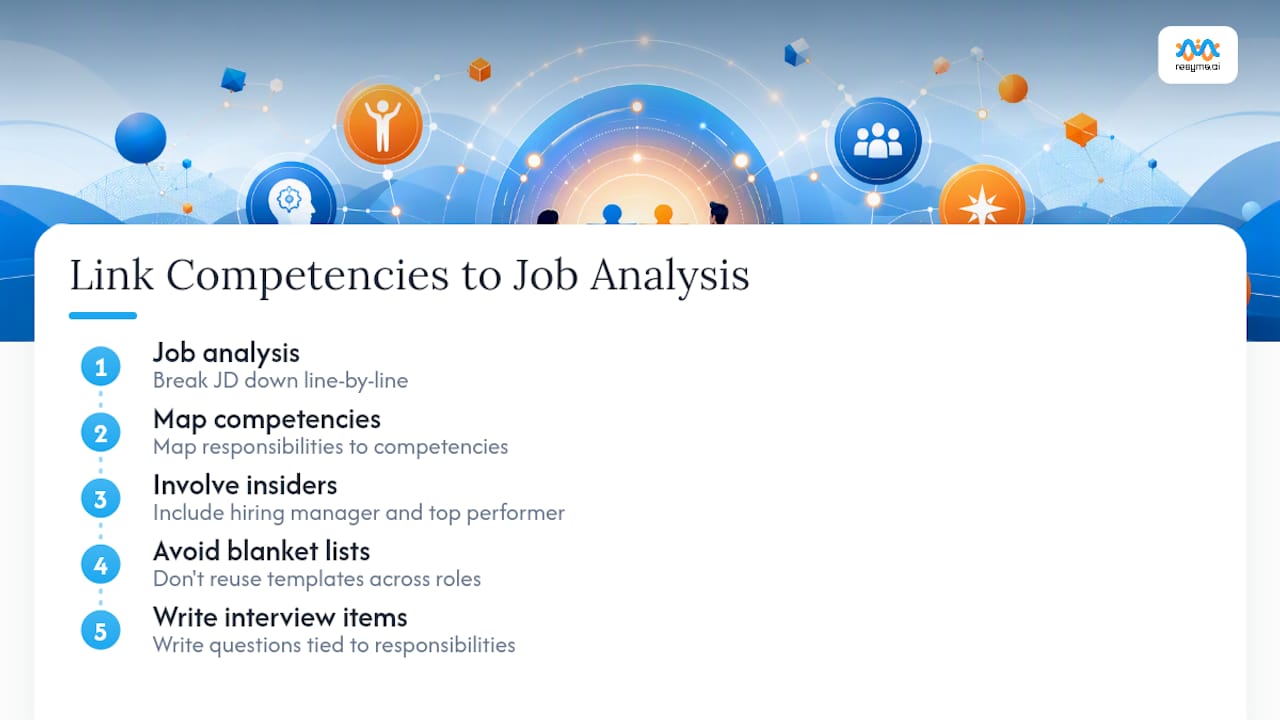
A competency framework built without reference to the actual job is just a generic personality test with better branding. The starting point should always be a job analysis: a breakdown of what the role actually requires day to day, not what a template says a “manager” or “analyst” generally needs.
Start by pulling the job description apart line by line. Every responsibility implies a competency. “Manages a team of five” implies leadership and delegation. “Coordinates across three departments” implies communication and stakeholder management. “Works with incomplete data to forecast demand” implies analytical thinking and comfort with ambiguity. This mapping exercise should happen before a single interview question gets written, not after.
Where possible, involve the hiring manager and a current top performer in that role when building the competency list. They see gaps a generic template misses, like the fact that a customer success role in a specific company actually leans more on written communication than verbal, because most interactions happen over email and chat.
Resist the temptation to reuse the same competency list across unrelated roles just because it’s convenient. A competency framework built for a sales role rarely transfers cleanly to an engineering role, even inside the same company. The indicators of “strong problem-solving” look different when the job is debugging code versus resolving a client escalation.
Once the list is set, write the interview questions to target those specific responsibilities, not abstract traits. That link back to the actual job is what makes a competency interview predictive instead of just a structured conversation.
How Do You Train Interviewers for Consistency and Fewer Biases?
Untrained interviewers are the single biggest source of inconsistency in a competency-based process, even when the questions and rubric are well designed. A great framework on paper does nothing if two panelists interpret a “4” rating differently.
Start training with calibration sessions: give a group of interviewers the same recorded or written sample answer and have each of them score it independently using the rubric. Compare results out loud. The gaps that show up (one person rates the same answer a 2, another rates it a 4) are exactly where training needs to focus.
Behaviorally anchored rating scales help here because they replace subjective judgment with concrete descriptions. Instead of asking an interviewer to decide what “good communication” feels like, the rubric specifies what a 2, 3, or 4 actually sounds like in an answer. That single change removes a large share of the disagreement between raters.
A two-person panel, with one interviewer engaging the candidate and the other focused entirely on note-taking and scoring, also improves accuracy. It’s hard to actively listen, think of follow-up probes, and take detailed notes at the same time, and something usually gives.
Refresher training matters more than a one-time session. Rating drift happens gradually. An interviewer who scored strictly in January can loosen up by June without noticing it, especially under hiring pressure. Periodic recalibration, even informally, keeps the scale meaning the same thing months apart.
How Should You Interpret Competency Interview Results for Hiring Decisions?
A single high score on one competency should never override a low score on another that the role genuinely requires. This is where a lot of otherwise well-designed processes break down at the finish line: the panel falls in love with one great story and lets it paper over a gap somewhere else.
Look at the pattern across all 4 to 6 competencies rather than an average score. A candidate who scores a 4 on communication and a 2 on problem-solving isn’t a solid 3 overall if problem-solving is the competency that actually drives success in the role. Weight the scores against what the job analysis flagged as most critical, not evenly across the board.
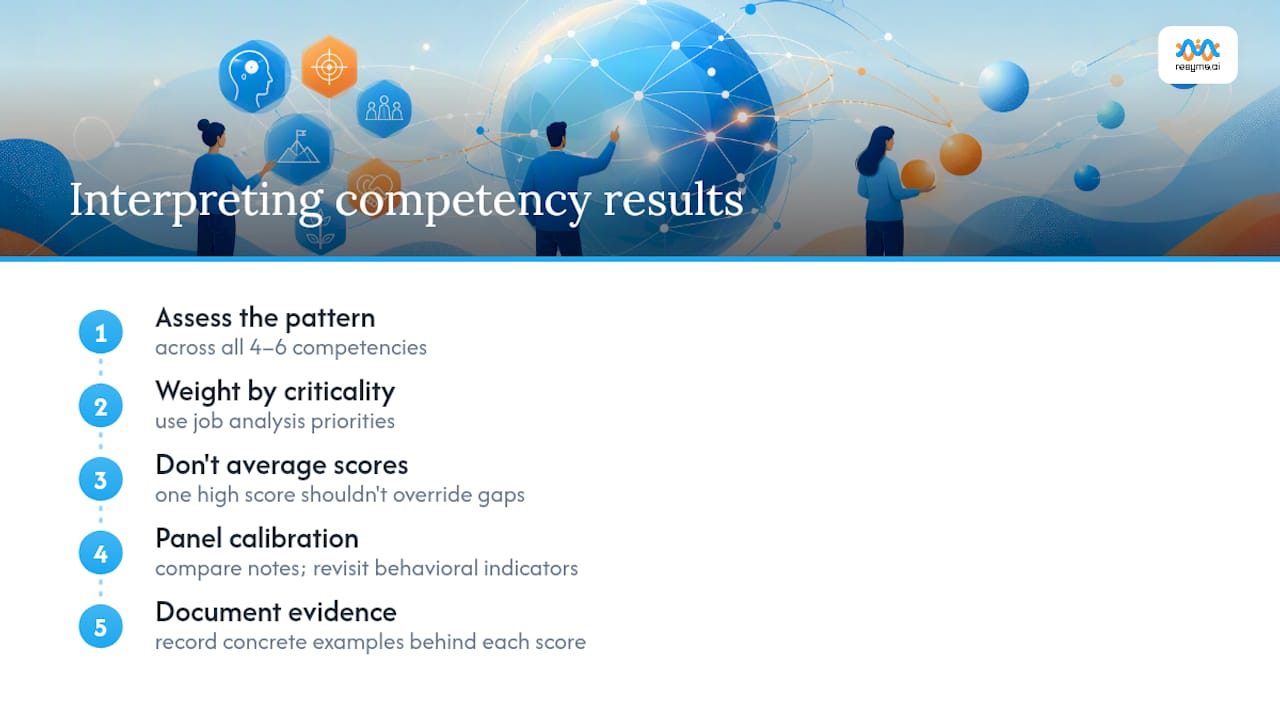
Compare notes as a panel before revealing individual scores. If two interviewers land on wildly different ratings for the same answer, that’s a signal to revisit the behavioral indicators, not to average the discrepancy away and move on.
Treat a candidate’s inability to answer a specific competency question as real data, not an oversight to explain away. If someone can’t produce a single concrete leadership example after being given a fair chance and a follow-up prompt, that absence is informative on its own. It doesn’t necessarily disqualify them, especially for an entry-level hire, but it should shape the onboarding conversation if they’re hired.
Document the specific evidence behind each score, not just the number. Six months later, when someone asks why a candidate was hired over another, “she scored a 4” explains nothing.
How Do You Reduce Bias and Support Diversity in Competency Interviews?
Structure is the primary tool competency-based interviewing offers for reducing bias, but structure alone doesn’t guarantee a fair process. The design choices around it matter just as much.
Ask the identical questions, in the identical order, to every candidate for a given role. Departing from the script, even to follow an interesting tangent, reopens the door to the kind of inconsistency that lets unconscious preference creep back in.
Written behavioral indicators matter more here than anywhere else in the process. Without them, “strong leadership” can quietly mean “reminds me of myself” to an interviewer who isn’t paying attention to their own bias. With them, the rubric forces a specific, observable standard that applies the same way regardless of who’s sitting across the table.
Watch for competencies phrased in ways that unintentionally favor a narrow cultural or communication style. “Assertive” and “confident” phrasing in a rubric can penalize candidates from backgrounds or cultures where a more measured communication style is the norm, even when the underlying skill is equally strong. Reviewing rubric language for this kind of bias before the interview cycle starts is worth the time it takes.
Panels with mixed interviewer backgrounds tend to catch these blind spots that a single interviewer, however well-intentioned, would miss on their own. Rotating who sits on interview panels, rather than always defaulting to the same one or two people, spreads out whatever individual biases each interviewer carries rather than letting one perspective dominate every hiring decision for a role.
What Actually Makes Competency Interviews Work
Most guides treat competency-based interviewing as a script to follow. The bigger lever is discipline in the scoring, not just the elegance of the questions. Panels that write behavioral indicators in advance and rate immediately catch real differences between candidates; panels that wing the rubric tend to rely on gut instinct alone.
For candidates, the uncertainty in these interviews usually comes from not trusting your own experience enough to state it plainly. Preparation doesn’t create the evidence. It just uncovers evidence you already have and puts it into a shape someone else can evaluate fairly.
— Raul
Bring Structure to Every Interview With Resyme
Building behavioral indicators, running a consistent question set, and rating every candidate immediately sounds straightforward until you’re doing it across 40 applicants for a single role. That’s where the process usually breaks down, not in the design, but in the execution at volume.

Resyme automates the part hiring teams struggle to keep consistent: it asks every candidate role-tailored, behaviorally anchored questions in the same structured format, then scores responses against predefined competencies instead of leaving the rating to memory at the end of a long day. For recruiters running high-volume screening or specialized technical hiring, that means every candidate gets compared on the same evidence. It may also include honesty and integrity checks during the interview itself, potentially catching inconsistencies a resume alone won’t reveal. If your team is designing a competency framework using the guidance above, Resyme is where you put it into practice at scale, without hiring more interviewers to keep pace with the volume.
Sources
- A Complete Guide to Conducting Competency Based Interviews | Totaljobs
- Competency-based interviews | Prospects
- Behavioral / Competency-based interviewing | University of Washington HR
FAQ
What Are Common Competency-Based Interview Questions?
Common prompts include describing a time you resolved a conflict, missed a deadline, led without authority, or solved a problem with limited information. Each one is designed to test a specific competency like communication, resilience, or leadership.
How Do You Prepare for a Competency-Based Interview?
Decode the job description for the skills it implies, prepare 5 to 8 STAR stories that cover those skills, and practice saying them out loud with real numbers attached to the results.
What Is the 30-60-90 Rule in an Interview?
The 30-60-90 rule refers to a plan candidates present (often for management roles) outlining goals for the first 30, 60, and 90 days on the job. It’s a separate concept from STAR and typically comes up when interviewers ask how you’d approach the role’s first quarter.
What Is the Biggest Red Flag in an Interview?
For candidates, the biggest red flag is an inability to describe a specific personal action or outcome, relying instead on vague or hypothetical answers. For interviewers, the biggest red flag is inconsistent questioning between candidates, which undermines the fairness the format is supposed to guarantee.
Can Interviewing for Competencies Be Automated?
Yes. Platforms like Resyme can generate role-tailored behavioral questions and apply consistent scoring automatically, which helps standardize the process across a high volume of candidates.