Hiring Managers: Candidate Scorecards to Reduce Bias, 4–6 Template

A candidate scorecard is a short, job-anchored evaluation form interviewers fill out after each interview to rate evidence against pre-defined competencies. The single biggest payoff: it forces every interviewer to judge the same things, the same way, which makes final hiring decisions more consistent and easier to defend. Below is a copy-ready template, a rating scale explainer, and the calibration steps that keep scorecards from becoming just another form nobody reads.
TL;DR:
- Effective scorecards must be based on thorough job analysis to ensure their criteria accurately predict success in the role.
- Limiting criteria to four to six competencies prevents evaluator fatigue and maintains focus on the most relevant skills.
- Using behaviorally-anchored scales with explicit instructions improves scoring consistency and justifies ratings with concrete evidence.
- Conducting calibration sessions before evaluating candidates helps identify and reduce inter-rater discrepancies.
- Maintaining documented, job-related evidence supports legal defensibility and enhances the reliability of the hiring process.
Table of Contents
- What a Candidate Scorecard Actually Is
- The Real Benefits of Using Candidate Scorecards
- What Makes a Good Candidate Scorecard
- How to Build, Pilot, and Operationalize a Candidate Scorecard
- A Candidate Scorecard Template You Can Copy Today
- Common Pitfalls That Undermine Candidate Scorecards
- Legal Considerations and Compliance With Candidate Scorecards
- Where AI Fits Into Scorecard Evidence
- Try Resyme for More Consistent Interview Evidence
- Sources
- FAQ
What a Candidate Scorecard Actually Is
An interview scorecard is different from a generic evaluation form. A generic form asks “how did they do?” A scorecard asks “how did they perform against this specific job’s competencies?” That distinction is the whole point of structured hiring. Interview scorecards standardize evaluations by listing job-specific competencies, a predetermined rating scale, space for evidence-based comments, and a final hire or no-hire recommendation.
The “job-anchored” part matters because a scorecard built around vague traits like “culture fit” or “seems sharp” collapses into a popularity contest. A good scorecard ties every criterion back to something the job analysis identified as necessary for success in the role.
Most scorecards share the same skeleton:
- A header with job title, interviewer name, and date
- Three to six competencies pulled directly from the role
- A rating scale for each competency
- A comments field where the interviewer writes the evidence behind the number
- An overall recommendation: hire, no hire, or a defined middle tier
Interviewers fill these out themselves, typically at the end of the interview or within minutes of it ending, before the next candidate or the next meeting erases the details. On a panel, each interviewer scores independently first, then the group compares notes in a debrief. That sequencing matters more than most hiring teams realize, and it’s the first thing to fix if your scorecards feel more like formalities than decisions.
The Real Benefits of Using Candidate Scorecards
Scorecards exist to fix a specific, well-documented problem: unstructured interviews are unreliable. Two interviewers can sit through the exact same conversation and walk away with opposite impressions, largely because human judgment is vulnerable to predictable distortions. Harvard Business Review’s research on interview bias points to structured questions and consistent evaluation criteria as the fix. Scorecards operationalize that fix by giving every interviewer the same yardstick.
Three effects show up consistently once teams adopt them:
- Bias reduction. A shared rubric interrupts the halo effect (one strong answer coloring everything after it) and primacy/recency bias (overweighting the first or last impression).
- Inter-rater consistency. When five interviewers score the same candidate against the same anchors, their ratings converge instead of scattering.
- Documentation and defensibility. Written evidence tied to each score gives hiring teams a paper trail if a decision is ever questioned.
Quick fact: Harvard Business Review’s guidance on hiring scorecards notes that scorecards built on solid job analysis, with well-aligned criteria and interview questions, correlate with actual on-the-job performance. That’s the part teams skip when they borrow a generic template instead of building one from their own role requirements. A scorecard is only as predictive as the job analysis underneath it. Copy a template blindly and you get consistency without accuracy, which is arguably worse than no scorecard at all, because it creates false confidence in a bad signal.
What Makes a Good Candidate Scorecard
Most ineffective scorecards fail due to too many criteria, vague language, or lack of justification for ratings. Here’s what separates a scorecard that actually improves decisions from one that just adds paperwork.
- Limit criteria to four to six competencies. HBR’s research on hiring scorecards recommends keeping the list tight, around five items, because longer forms dilute focus and hurt scorer reliability.
- Use behaviorally-anchored scales. Instead of a bare 1 to 5, define what each number means: a 2 might read “showed the skill with heavy prompting,” a 4 might read “demonstrated the skill unprompted with a strong example.”
- Write explicit instructions for interviewers. State exactly when to fill the form out and what “evidence” means in this context.
- Build in a dedicated comments field. Clemson University’s interview evaluation form requires a comment to justify every numeric rating, not just the low or high ones.
- Add a calibration step before scores get compared. Interviewers should score independently first, then discuss.
- End with a clear recommendation field, not just a total score.
Pro Tip: Don’t average scores across a panel and call it a decision. Averaging hides disagreement. If one interviewer rates a candidate a 5 on technical skills and another rates them a 2, that’s a conversation your team needs to have, not a number to smooth over.
How to Build, Pilot, and Operationalize a Candidate Scorecard
Building a scorecard that actually works is a process, not a template download. Here’s the sequence that holds up across most hiring teams.
- Start with job analysis, not job titles. Pull the actual competencies that predict success in the role. OPM’s job analysis framework is a solid public model for identifying which skills genuinely separate strong performers from weak ones.
- Write anchors and pick a scale. Most teams use a 1 to 5 or Likert-style scale, focusing on clear anchor language attached to each number.
- Decide when notes get taken. Many institutional templates, including Case Western Reserve’s candidate evaluation form, instruct interviewers to complete the scorecard during the interview or immediately after, while the evidence is still fresh.
- Train interviewers and run a pilot. Walk the panel through what each score means with real examples before the first live use. Then run a calibration session: have two interviewers independently score a recorded or practice interview and compare.
- Use structured debriefs to resolve gaps. When scores diverge by more than a point, that’s the conversation, not the tiebreaker average.
- Track scores against early performance. Six months in, check whether your top-scored hires are actually outperforming. If they’re not, the criteria or the anchors need revisiting, not the candidates.
Pro Tip: Run your first calibration session on a candidate everyone already agreed was a strong hire. If your panel’s scores still disagree wildly on someone with an obvious outcome, the scorecard itself has a design problem, not a people problem.
A Candidate Scorecard Template You Can Copy Today
Here’s a bare-bones structure that covers the fields most hiring teams actually need, adaptable to almost any role.
- Header: Job title, interviewer name, date, candidate name
- Competencies: Three to six role-specific skills, each with a 1 to 5 anchored scale
- Evidence/comments: A short text field under each competency, required for every score
- Overall recommendation: Strong hire / hire / no hire / strong no hire
Two sample rows show how this plays out in practice:
Competency: Cross-functional communication. Score: 4. Comment: “Walked through a conflict with a product team using specific dates and outcomes, not generalities. Answered the follow-up question without hesitation.”
Competency: Technical troubleshooting. Score: 2. Comment: “Named the right diagnostic tools but could not explain why they’d choose one over another. Needed two prompts to get to a workable answer.”
If your team already runs interviews through an applicant tracking system, build the scorecard as a required field tied to each interview stage rather than a separate document. A shared doc works for small teams, but anything past a handful of open roles benefits from a scorecard that lives inside the same system tracking resumes and candidate stage, so scores don’t end up scattered across inboxes.
Common Pitfalls That Undermine Candidate Scorecards
A scorecard with twelve criteria is a scorecard nobody fills out honestly. Interviewers rush the back half, and the resulting scores get noisier, not more precise. Mixing unrelated criteria into one form, technical skill and “gut feeling,” for instance, produces the same problem: it lets subjective impressions hide inside what looks like a rigorous number.
- Waiting a day or more to fill out the form lets memory fade and bias creep back in.
- Some interviewers score generously by habit (leniency bias), others score harshly (stringency bias); a quick calibration session before hiring season catches this.
- If scores consistently fail to predict who succeeds on the job, the fix is revisiting the criteria and interview questions, not scrapping the process.
Pro Tip: If two interviewers on the same panel always land a full point apart on identical candidates, don’t blame the candidates. Run a five-minute calibration check where both score a mock answer and compare notes before the next hiring round.
Legal Considerations and Compliance With Candidate Scorecards
Scorecards carry legal weight because they’re evidence. If a hiring decision is ever challenged, the scorecard is often the first document an employer has to produce. That reality cuts both ways: a well-built scorecard protects a company by showing every candidate was measured against the same job-relevant criteria, while a sloppy one can expose it.
The core compliance principle is straightforward: every criterion on the scorecard should trace back to an actual job requirement, not a personal preference or a proxy for a protected characteristic. Criteria like “energy” or “polish” tend to correlate with demographic patterns that have nothing to do with job performance, and they’re the first thing an employment attorney will flag in a discrimination claim. Anchoring every competency in job analysis, the same discipline behind a fair scorecard, is also the strongest legal defense.

Retention matters too. Scorecards should be kept for the same period an organization retains other hiring records, since many jurisdictions require documentation to be available if a complaint is filed. Consistency in application matters as much as the content: if one candidate gets five interviewers and a detailed scorecard while another gets one interviewer and a verbal impression, that inconsistency itself can become a liability, regardless of the outcome. Hiring teams operating across multiple states or countries should confirm retention periods and documentation requirements with legal counsel, since these rules vary by jurisdiction and aren’t standardized.
Where AI Fits Into Scorecard Evidence
Structured interviews only work if the evidence behind each score is accurate, and that’s the part most teams struggle to standardize. Resyme runs AI-driven automated interviews built from deep domain knowledge, tailoring questions to the specific role rather than recycling generic prompts, which gives scorers more consistent, comparable evidence to work from instead of interviewer notes scribbled at different levels of detail.
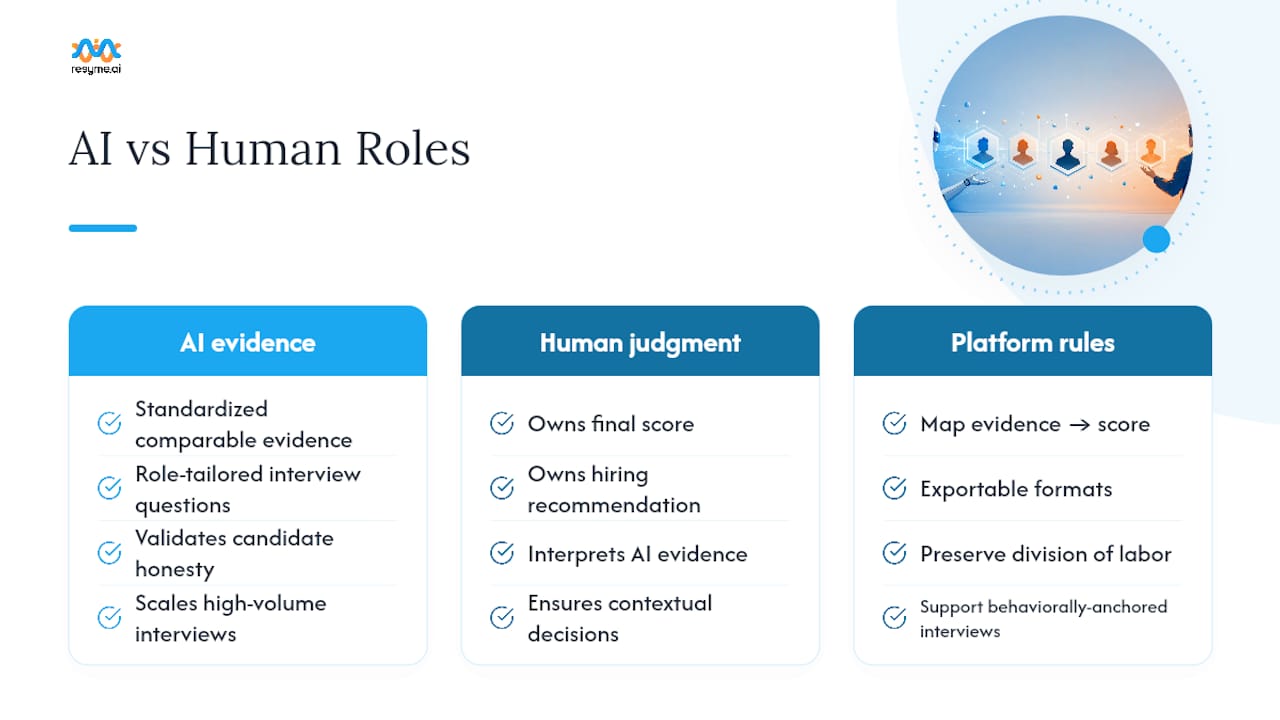
The platform also validates candidate honesty during the interview itself, addressing a common problem in hiring: candidates presenting a polished version of themselves that doesn’t hold up under follow-up questions. For teams juggling high-volume roles alongside specialized ones, running behaviorally-anchored interviews at scale in a format candidates find accessible rather than stressful matters as much as the accuracy of the output.
None of this replaces human judgment on the scorecard itself. Automated interview outputs feed the evidence field. Interviewers and hiring managers still own the score and the recommendation. Export formats and evidence-to-score mapping should support that division of labor, not blur it. Recruitment has spent decades trying to standardize what a “good answer” looks like on paper; getting there without losing the human judgment at the finish line is the real challenge.
— Raul
Try Resyme for More Consistent Interview Evidence
If your scorecards keep coming back thin on evidence because interviewers are scrambling to type notes mid-conversation, the fix isn’t a better form. It’s better raw material to score against. Resyme runs AI-driven automated interviews tailored to the specific role, producing structured, comparable evidence that slots directly into whatever scorecard format your team already uses.

For high-volume roles, that means every candidate answers questions calibrated to the same job, instead of whatever the interviewer happened to improvise that day. For specialized hiring, it means domain-specific questions that surface depth rather than surface-level familiarity. Either way, your interviewers spend less time on repetitive pre-screening and more time on the judgment calls that actually require a human. Visit Resyme to see how the platform structures interview evidence, or request a demo to test it against your current scorecard process.
Sources
- A Guide to Interview Scorecards (With a Template and Example) | Indeed
- Interview Evaluation Form | Clemson University
- How to take the bias out of interviews | Harvard Business Review
- Job analysis | U.S. Office of Personnel Management
- Candidate interview evaluation form | Case Western Reserve University
FAQ
What Is the Purpose of a Scorecard in Recruitment?
A candidate scorecard standardizes how interviewers evaluate applicants, using job-specific criteria and a shared rating scale so hiring decisions rest on consistent evidence rather than gut feeling.
What Is a Scorecard in HR?
In HR, a scorecard is a structured evaluation document, sometimes called an interview evaluation form, that records ratings and comments against pre-defined job competencies for each candidate interviewed.
What Are the 5 C’s of Interviewing?
There’s no single universally agreed-upon “5 C’s” framework in interviewing; definitions vary by organization. Focus instead on building criteria directly from job analysis rather than chasing a generic acronym.
What Is the Biggest Red Flag to Hear When Being Interviewed?
From a scorecard perspective, the biggest red flag isn’t a specific phrase. It’s an answer with no concrete evidence behind it, since vague responses give interviewers nothing to score against a behaviorally-anchored scale.
How Long Should a Candidate Scorecard Be?
Keep it to four to six competencies. HBR’s research found longer scorecards reduce focus and hurt how reliably interviewers score.