Automated Interviews for Recruiters: 3 Formats That Work
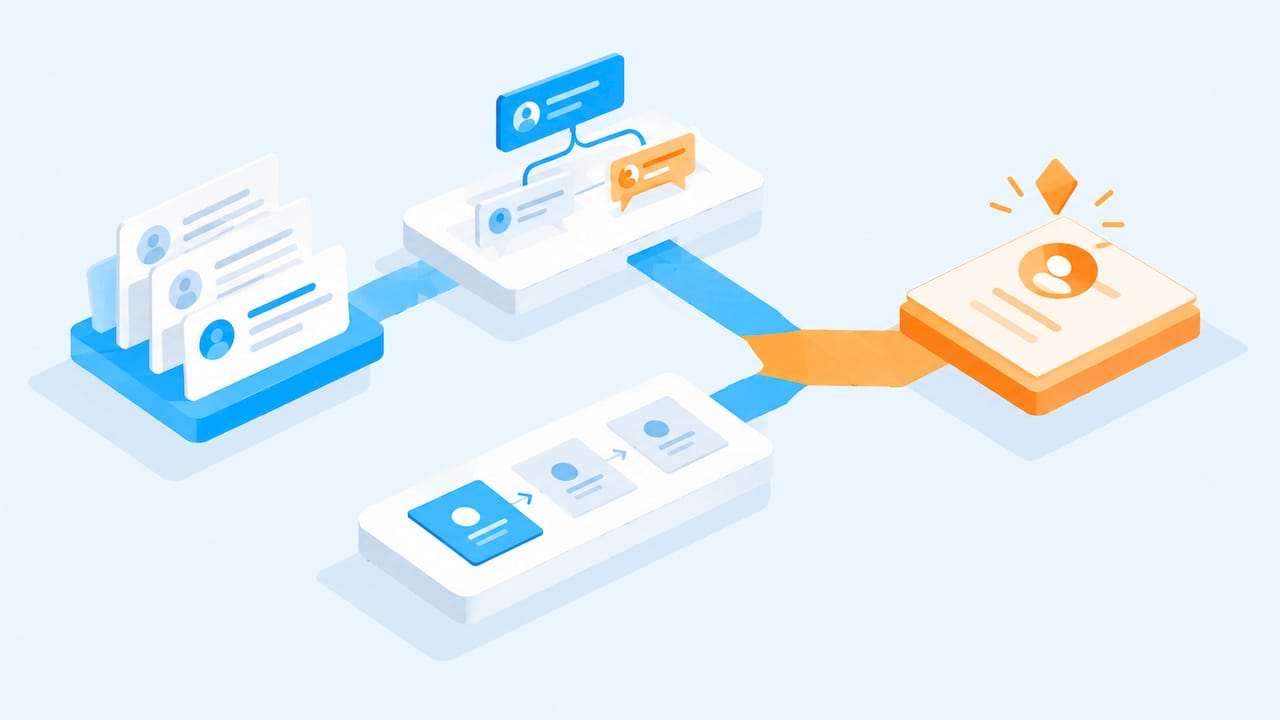
Automated interviews work best as a first-round filter for high-volume, structured hiring, not as a replacement for human judgment later in the funnel. They cut scheduling friction, standardize how candidates get evaluated, and let one recruiter cover ground that used to take a team. The trade-off is real: automation misses nuance a live conversation catches, so pair it with fairness safeguards and keep humans in the loop for final decisions. Keep reading for the mechanics, the pilot checklist, and where this approach breaks down.
TL;DR:
- Automated interviews are most effective for initial high-volume screening rather than final hiring decisions, requiring human oversight for nuanced judgments.
- Different formats suit different funnel stages, with asynchronous video best for early screening, chat for high-turnover roles, and live prompts for second-round assessments, each with distinct trade-offs.
- Platforms should generate role-specific questions, provide transparent scoring rubrics, and seamlessly integrate with ATS systems to ensure fairness, reliability, and reviewer confidence.
- Pilot testing with clear success metrics is essential to validate whether automated tools correlate with long-term performance, especially when evaluating candidate diversity and experience.
- Transparency, candidate consent, and technical reliability are critical, with robust accessibility features, data security practices, and clear communication for regulatory compliance and candidate trust.
Table of Contents
- What Are Automated Interviews, and Which Format Fits Your Funnel?
- How Automated Interview Platforms Actually Work
- Benefits and Limitations: What to Actually Expect
- Bias, Fairness, and Accessibility: Building a Defensible Process
- How to Implement Automated Interviews: A Pilot-to-Scale Checklist
- Where Resyme Fits the Checklist
- Best Practices for Candidates Preparing for Automated Interviews
- Automated Interview Tools: What’s Out There
- Impact of Automated Interviews on Hiring Outcomes and Quality
- Ethical Considerations: Transparency and Candidate Consent
- Technical Requirements and Platform Reliability
- What I’ve Learned Watching Recruiters Adopt This Technology
- Try Resyme for Your Next Hiring Cycle
- Sources
- FAQ
What Are Automated Interviews, and Which Format Fits Your Funnel?
An automated interview replaces a live recruiter screen with software that asks candidates a set of questions and captures their answers for later review, sometimes with a scoring layer attached. The term covers a wider range of tools than most people assume, and picking the wrong format for the wrong stage is the most common early mistake.
Three formats dominate this category:
- Asynchronous video or phone interviews: candidates record answers to preset questions on their own schedule, and recruiters review the recordings later.
- Chat or text-based automation: candidates type responses to scripted or adaptive prompts, often used for high-volume roles where written communication matters more than presentation.
- Live automated prompting: a hybrid where a system guides a real-time conversation (voice or chat) with dynamic follow-up questions based on prior answers.
Each format has a natural home in the funnel. Asynchronous video suits early-stage screening for roles where volume is high and scheduling dozens of live calls isn’t realistic. Chat-based tools tend to work well for entry-level or high-turnover positions where speed matters more than depth. Live automated prompting sits closer to a second-round interview, useful when you want adaptive follow-up questions without tying up a human interviewer’s calendar.
The trade-offs are straightforward. Asynchronous formats scale well but lose the back-and-forth that catches inconsistencies in real time. Chat automation is fast and cheap to deploy but weak for roles requiring verbal communication assessment. Live automated prompting captures more nuance than either alternative but costs more per interview and demands tighter technical reliability, since a dropped connection mid-interview creates a poor candidate experience. Matching format to funnel stage, rather than picking one tool for everything, is the difference between automation that saves time and automation that just moves the bottleneck.
How Automated Interview Platforms Actually Work
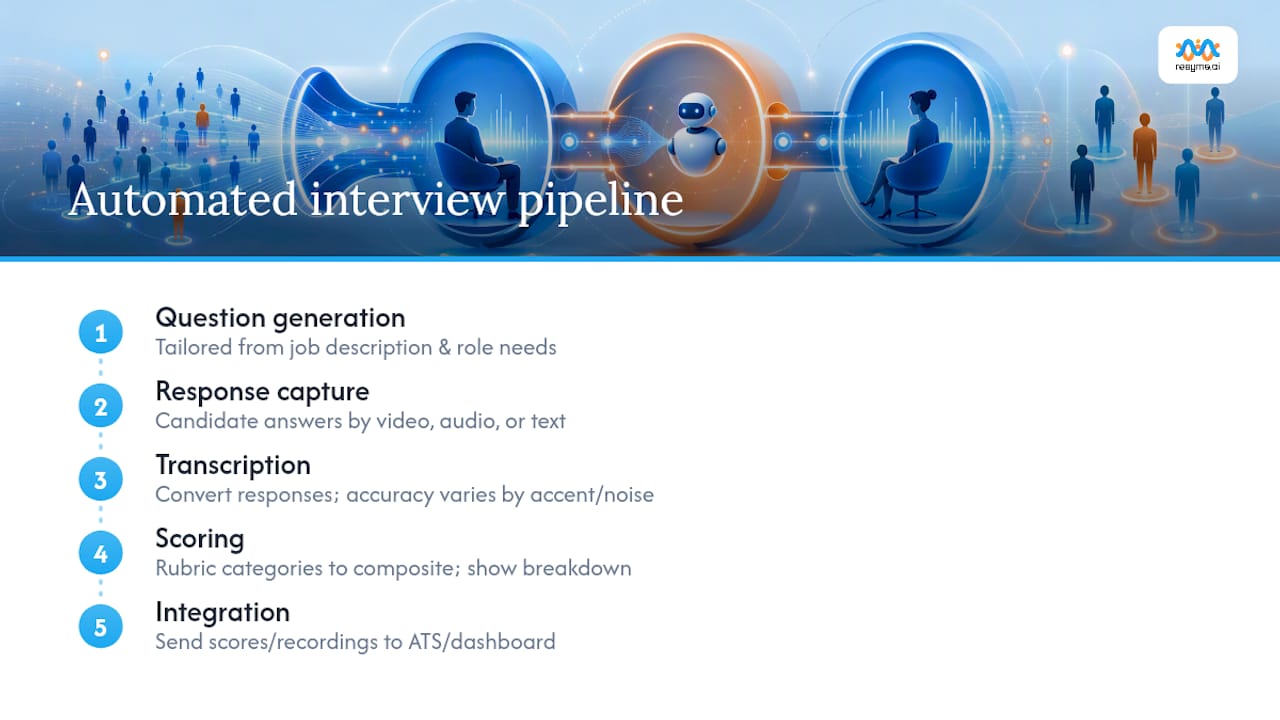
Most platforms follow a similar pipeline: generate role-relevant questions, capture the candidate’s response, convert it into something reviewable, score it against a rubric, and push the result somewhere a recruiter can act on it. The details of each step vary a lot between vendors, and those details are what separate a useful tool from a frustrating one.
1. Question generation. Better platforms pull from the job description and role requirements to generate or select questions rather than reusing a generic template for every posting. A platform tailoring questions to actual domain knowledge, rather than asking the same five behavioral prompts for every role, tends to surface more meaningful signal about whether a candidate can actually do the job.
2. Response capture. Candidates answer by video, audio, or text, depending on the tool and the stage. Video and audio responses get run through transcription, and transcription accuracy varies by accent, background noise, and audio quality. This matters more than most buyers expect: a transcription error rate that seems trivial in a demo can quietly skew scoring at volume, especially for candidates with accents underrepresented in the training data.
3. Scoring. Systems typically score against rubric categories, things like communication clarity, role-specific knowledge, or behavioral indicators, then roll those into a composite score. The best implementations show recruiters the rubric breakdown, not just a single number, so a reviewer can see why a candidate scored the way they did rather than trusting a black box.
4. Integration and workflow. Scores and recordings need to land somewhere recruiters actually work, which usually means ATS integration, exportable reports, and a review queue that doesn’t require logging into a fourth separate system.
A typical candidate path looks like this: the candidate receives an invite link, completes the interview on their own time within a set window, the system transcribes and scores the response, and the recruiter sees a ranked shortlist with rubric detail in their existing dashboard. The recruiter’s job shifts from “conduct 40 screening calls” to “review 40 scored summaries and advance the top 10 to a live conversation.”
Pro Tip: Before you commit to a platform, ask to see a rubric breakdown for a real sample interview, not just a composite score. If the vendor can’t show you why a candidate scored a 7 out of 10, your reviewers won’t be able to defend that score to a hiring manager either.
Benefits and Limitations: What to Actually Expect
The upside is concrete. Automated interviews compress time-to-screen because candidates complete them on their own schedule instead of waiting for a recruiter’s calendar to open up. They let a single recruiter evaluate far more candidates than live screening allows, and because every candidate answers the same questions under the same conditions, the process is inherently more consistent than a recruiter who unconsciously varies their questions call to call.
The operational gains compound from there:
- Fewer scheduling emails and calendar conflicts to manage.
- A recorded, timestamped audit trail for every screening decision.
- Reviewer time redirected from live calls to faster, structured review sessions.
- Easier comparison across candidates using the same rubric.
The limitations are just as real, and skipping past them is where pilots fail. Transcription and scoring models make mistakes, particularly with atypical speech patterns or unconventional career paths that don’t fit a rubric neatly. Asynchronous formats strip out the context a live interviewer picks up on, like a hesitant answer that actually reflects thoughtfulness rather than uncertainty. Accessibility and drop-off are genuine risks too: candidates without reliable broadband, a quiet space, or comfort with on-camera formats can abandon the process entirely, and that drop-off isn’t evenly distributed across demographics.
Complaints about automated video interviews are common enough in recruiter and candidate forums that they’re worth taking seriously as a design constraint, not dismissing as edge cases. Frustration tends to cluster around opaque scoring and clunky mobile experiences, according to discussions among recruiters and candidates, which is a fixable implementation problem, not an inherent flaw in the format.
Track these metrics from day one of any deployment: completion rate (candidates who start versus finish), time-to-screen (invite sent to decision made), pass-through ratio (percentage advancing to the next stage), and correlation to downstream performance (do high scorers actually perform better in later interviews and on the job). Without that last metric, you’re optimizing for speed without knowing if you’re optimizing for quality.
Bias, Fairness, and Accessibility: Building a Defensible Process
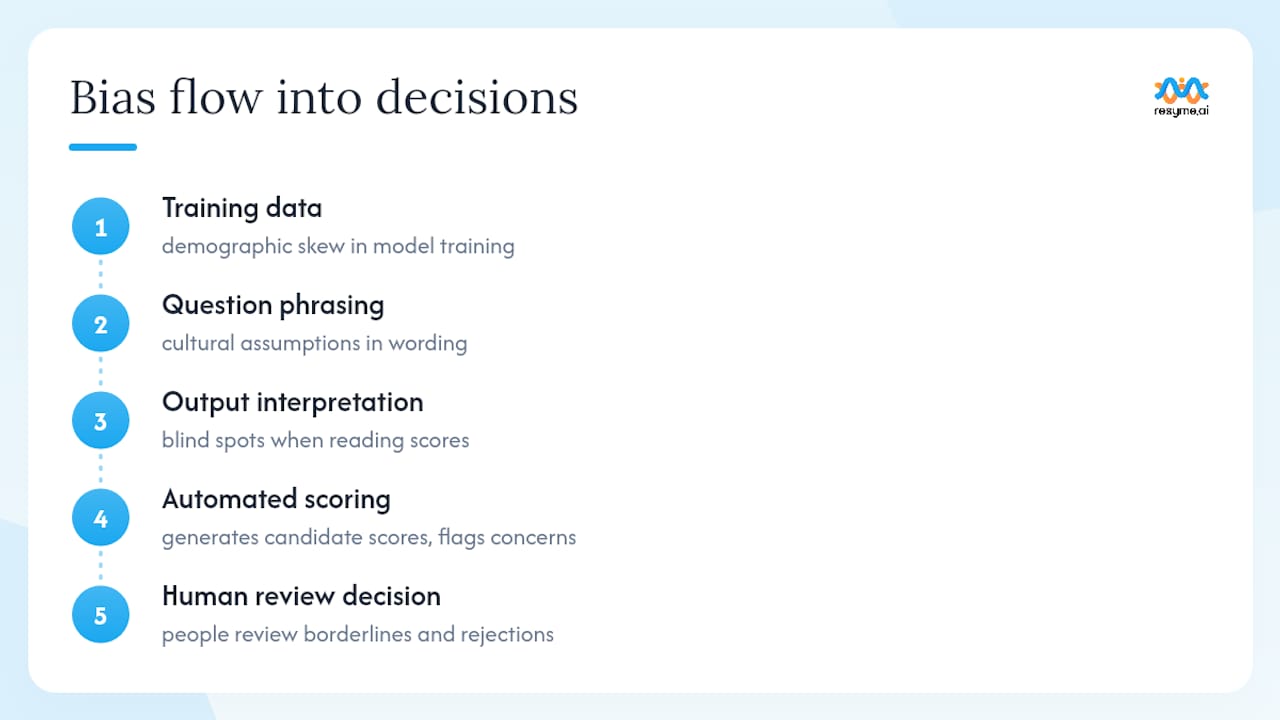
Bias enters automated interview systems through three main channels: the training data behind scoring models, the phrasing of the questions themselves, and blind spots in how outputs get interpreted. A model trained mostly on one demographic’s speech patterns will misjudge candidates outside that pattern, and a question written with cultural assumptions baked in will disadvantage candidates who didn’t grow up with those same references.
None of that means automation and fairness are incompatible. It means fairness has to be engineered in, not assumed.
1. Use structured rubrics, not gut-feel scoring. Every candidate should be evaluated against the same defined criteria, and those criteria should be visible to reviewers, not buried in a proprietary algorithm.
2. Keep a human in the loop for borderline and rejected cases. Automated scoring should narrow the pool and flag concerns, but a person should review any decision that ends a candidate’s process, especially near the cutoff line.
3. Test the system against diverse sample sets before full rollout. Run a pilot batch that intentionally includes a range of accents, communication styles, and backgrounds, and check whether scores cluster in ways that don’t track with actual qualification.
4. Offer accessible formats and accommodations by default. That means text alternatives to video, extended time options, and a clear path for candidates to request accommodations without penalty.
5. Document everything. Keep records of the rubric, the questions asked, and the review process for every hire. If a hiring decision is ever challenged, a documented process is your defense.
When you’re evaluating vendors, ask for the trust signals that actually mean something: third-party audit reports, transparency into how scores get generated, and a willingness to walk you through their rubric rather than just their marketing deck. The AICPA’s System and Organization Controls suite is the standard framework vendors use to demonstrate operational and security controls, and asking whether a vendor holds a current SOC report is a fair, direct question during procurement.
Pro Tip: Legal requirements around automated hiring tools vary significantly by jurisdiction, some regions require bias audits or candidate notification before AI-assisted screening. Check your local and industry-specific rules before rollout, and loop in legal counsel rather than assuming a vendor’s compliance claims cover your specific situation.
How to Implement Automated Interviews: A Pilot-to-Scale Checklist
Rolling out automated interviews without a pilot is how recruiting teams end up with a tool nobody trusts by month three. A structured pilot answers the questions a sales demo can’t: does this actually work for your roles, your candidate pool, and your reviewers.
Step 1: Pick the right pilot role. Choose a position with high volume, objective evaluation criteria, and a repeatable task profile, think customer support, sales development, or entry-level technical roles. Avoid piloting on a role with low volume or highly subjective criteria; you won’t get a clean read on whether the tool works.
Step 2: Design the pilot with real success metrics. Run it against at least one full hiring cycle, ideally a suitable number of candidates, so you have enough data to spot patterns rather than noise. Define success upfront: what completion rate is acceptable, what time-to-screen improvement justifies the switch, and how you’ll validate that automated scores actually correlate with later-stage performance.
Step 3: Validate against outcomes, not just efficiency. The easy trap is declaring victory because time-to-screen dropped. Track whether candidates who scored well in the automated round also performed well in live interviews and, eventually, on the job. Vendor throughput claims should always get checked against your own pilot data rather than taken at face value, since efficiency numbers in a sales deck rarely reflect your specific candidate pool.
Use this checklist when comparing vendors during the pilot phase:
- Does the platform show rubric-level scoring, or just a single opaque number?
- Does it integrate cleanly with your existing ATS, or will reviewers need a separate login?
- What accessibility accommodations are built in by default?
- What data security and retention practices does the vendor document, and can they produce a SOC report or equivalent?
- How does the platform communicate with candidates, do they know what to expect, how long it takes, and when they’ll hear back?
Step 4: Roll out deliberately once the pilot validates. Get sign off from hiring managers who’ll actually use the scores, not just the recruiting team. Train reviewers on how to interpret rubric output so nobody’s rubber stamping an AI score without understanding it. Build candidate messaging templates that explain the process clearly, since candidates who don’t know what to expect are far more likely to abandon the interview or leave with a bad impression of your company. Set up a dashboard tracking your core KPIs, completion rate, time-to-screen, pass-through ratio, and downstream correlation, so you catch drift early rather than six months in.
Step 5: Know your stop signs. If completion rates fall below what you’d expect for a comparable live process, something in the candidate experience is broken. If your rubric scores show consistent skew against a particular group, pause the rollout and investigate before scaling further. If reviewers start ignoring the scores entirely and just watching every recording anyway, the tool isn’t actually saving the time it promised, and it’s worth asking why.
A pilot that fails cleanly is more valuable than a rollout that limps along unmeasured. If the numbers don’t support scaling, that’s useful information, not a wasted quarter.
Where Resyme Fits the Checklist
Everything in that pilot checklist points to the same underlying question: does the platform give recruiters transparency and control, or does it just promise speed and hope you don’t check the math. Resyme is built around role-tailored questions generated from actual domain knowledge rather than a generic template, which addresses the question-generation weak point that undermines a lot of automated screening tools.
Here’s how the platform maps to the criteria that matter during evaluation:
- Role-tailored questions: interviews are built around the specific domain and role rather than reused across every posting, which improves the odds that scoring reflects real job fit.
- The platform includes features to identify inconsistencies in candidate responses, addressing a gap traditional screening methods often miss entirely.
- The platform uses questions structured around actual behavioral evidence rather than hypothetical scenarios, which tends to produce more defensible scoring.
- Scoring transparency: recruiters can see how a candidate’s score breaks down rather than trusting an unexplained composite number.
- ATS integration: results flow into existing recruiter workflows instead of requiring a separate system to check.
Because the platform handles both high-volume screening and more specialized, technical hiring, teams don’t need a separate tool for each use case, which is a practical advantage when a recruiting function is juggling multiple open roles at different seniority levels. On the candidate side, the interview format is designed to be accessible and straightforward to complete, which matters given how often drop-off and frustration get traced back to a confusing or overly long interview experience.
Best Practices for Candidates Preparing for Automated Interviews
Recruiters who roll out automated interviews should share preparation guidance with candidates, both because it improves response quality and because it reduces the frustration that drives drop-off. A few pointers worth including in your candidate communications:
Candidates should test their camera, microphone, and internet connection before starting, since a technical failure mid-interview is one of the most common sources of a bad experience. They should treat the automated format with the same seriousness as a live interview: dress appropriately, find a quiet space, and avoid treating it as a formality to rush through.
Structuring answers matters more in an automated format than a live one, since there’s no interviewer to redirect a rambling response. Encourage candidates to use a clear framework, state the situation, the action they took, and the result, so their answer stays organized even without a conversational back-and-forth. Short pauses to think are fine; most platforms don’t penalize a few seconds of silence before an answer.
Candidates sometimes wonder whether using AI tools to generate answers in real time will go undetected. It’s a fair question, and it’s an unreliable strategy: inconsistent phrasing between an AI-assisted answer and a candidate’s natural speech pattern is often noticeable to a trained reviewer, and platforms with honesty and integrity validation are specifically designed to catch mismatches between a candidate’s claimed experience and their actual responses. Authenticity reads better than polish in an automated interview.
Automated Interview Tools: What’s Out There
The automated interview category includes a range of tools with different strengths, and recruiters evaluating options should look past the marketing language to what each tool actually does well. Broadly, the market splits into a few categories.
High-volume screening platforms are built for roles with large applicant pools, retail, call center, hospitality, where speed and consistency across hundreds of candidates matters more than deep customization per role. Specialized or technical hiring platforms lean into domain-specific question generation, useful for roles where a generic behavioral question set won’t surface whether a candidate can actually do the job. Enterprise suites bundle automated interviewing with broader talent acquisition features, applicant tracking, onboarding, workforce analytics, appealing to larger organizations that want one vendor relationship instead of several.
Resyme sits closer to the specialized end of that spectrum, with its emphasis on domain-tailored questions and honesty validation, while still supporting high-volume use cases. When comparing tools generally, look past headline throughput claims. Review platforms like G2 surface recurring themes across this category, particularly around ease of use, transcription reliability, and how well a tool handles candidates outside the “typical” profile its model was built around. Those patterns are worth reading before you sign a contract, not after.
Impact of Automated Interviews on Hiring Outcomes and Quality
The honest answer on hiring quality is that automated interviews improve consistency more reliably than they improve accuracy, and the two aren’t the same thing. Every candidate answering the same questions under the same conditions removes a lot of the variance that comes from recruiter mood, time of day, or unconscious rapport-building with candidates who remind them of themselves. That consistency alone tends to produce a more defensible, comparable shortlist than an unstructured live screen.
Whether that shortlist actually correlates with better hires depends entirely on whether the questions and rubric were built around real job requirements, and whether someone validated that correlation with pilot data. A platform that generates generic behavioral questions will produce consistent scores that don’t predict much of anything. A platform that ties questions to actual domain knowledge and role requirements has a better shot at surfacing candidates who perform well after they’re hired, but “better shot” is doing real work in that sentence. No automated tool guarantees quality of hire; it only removes some of the noise between application and interview.
The most useful outcome measure isn’t the automated score itself. It’s whether that score, tracked over enough hires, actually correlates with performance reviews, retention, or whatever quality-of-hire metric your organization already uses. Skip that validation step, and you’re just automating a guess faster.
Ethical Considerations: Transparency and Candidate Consent
Bias mitigation gets most of the attention in conversations about automated hiring ethics, but transparency and consent deserve equal weight. Candidates have a right to know when they’re being evaluated by an automated system, what that system is scoring them on, and whether a human ever reviews the result before a decision gets made.
Disclosing the use of automated interviews isn’t just good practice, it’s increasingly a legal expectation in some jurisdictions, and candidates who feel blindsided by an unexplained AI-driven process tend to form a negative impression of the employer regardless of the outcome. Clear, upfront communication solves most of this: explain what the interview involves, roughly how long it takes, and what happens to their responses afterward.
Consent should extend to data handling too. Candidates should know how long their recorded responses are retained, who has access to them, and whether the data trains or improves the underlying model. A recruiting team that can’t answer those questions clearly for its own candidates has a vendor relationship worth revisiting.
Transparency about scoring matters just as much internally. If your reviewers can’t explain to a hiring manager, or a candidate who asks, why a particular score was assigned, the process isn’t actually accountable, no matter how sophisticated the underlying model is. Ethical automated hiring isn’t about eliminating human judgment; it’s about making sure the judgment that does happen, human or automated, is visible and explainable.
Technical Requirements and Platform Reliability
Automated interview platforms are only as good as the infrastructure behind them, and reliability issues surface fast at volume. Candidates need a functioning webcam or microphone, a stable internet connection, and a modern browser, requirements that sound minor until you’re screening candidates in regions with inconsistent broadband or on older devices that struggle with video upload.
Mobile compatibility deserves specific attention. A large share of candidates, particularly for high-volume and entry-level roles, will attempt an automated interview from a phone rather than a desktop, and a platform that wasn’t built mobile-first tends to produce a frustrating experience: cramped text fields, video that won’t upload on a spotty connection, or a layout that breaks on a smaller screen.
On the recruiter side, integration reliability matters just as much. An ATS connection that drops candidate data or fails to sync scores in real time creates the exact bottleneck automation is supposed to eliminate. Before committing to a platform, ask about uptime history, what happens if a candidate’s session disconnects mid-interview, and whether there’s a support path for candidates who hit a technical wall during a time-sensitive application window. A tool that works flawlessly in a sales demo and buckles under real candidate volume isn’t actually solving your screening problem, it’s just relocating it.
What I’ve Learned Watching Recruiters Adopt This Technology
Automation earns its place in the first round, where the questions are objective and the volume is high enough that consistency beats nuance. It loses its edge fast in later rounds, where you’re weighing judgment calls, culture fit, or a candidate’s reasoning under ambiguity, things a rubric struggles to capture and a live conversation reads instantly.
The mistake I see most often isn’t choosing automation. It’s skipping the pilot and rolling out to every role at once, then discovering six months later that completion rates were quietly terrible for one candidate segment nobody was tracking. The second most common mistake is treating the composite score as gospel instead of a starting point for a human reviewer to interrogate.
My recommendation: automate the repetitive, high-volume first screen, validate relentlessly against downstream outcomes, and never let the system make the final call alone. Speed without fairness just produces bad hires faster.
— Raul
Try Resyme for Your Next Hiring Cycle
Everything in the pilot checklist above, rubric transparency, ATS integration, role-tailored questions, honesty validation, is what Resyme was built around. Instead of asking recruiting teams to bolt automation onto an existing process and hope it holds up, the platform is designed to fit the exact evaluation criteria that separate a useful screening tool from one your reviewers quietly stop trusting.

If you’re weighing whether automated interviews belong in your funnel, the fastest way to find out is a real pilot with your own roles and your own candidates, not a generic demo. Request a demo at Resyme and run it against a role with enough volume to give you a clean read: completion rate, time-to-screen, and how the scores hold up once candidates move to a live interview. That’s the data that actually tells you whether this fits your hiring funnel.
Sources
- AICPA System and Organization Controls (SOC) suite of services
- Reddit r/recruitinghell Automated video interviews are some bullshit
FAQ
What does “automated interview” mean?
An automated interview uses software, rather than a live recruiter, to ask candidates preset or adaptive questions and capture their responses by video, audio, or text for later review and scoring.
What is the 30-60-90 rule in an interview?
The 30-60-90 rule refers to a candidate’s plan for their early time in a new role, and interviewers sometimes ask candidates to outline one during later-stage, human-led interviews rather than automated first screens.
Can interviewers tell if you’re using AI to generate answers?
Often, yes: platforms with honesty and integrity validation, like Resyme’s, are specifically designed to flag inconsistencies between a candidate’s response pattern and their claimed experience, and mismatched phrasing or unnatural pacing tends to stand out to trained reviewers too.
What is the biggest red flag to hear when being interviewed?
For candidates, vague or evasive answers about day-to-day responsibilities, compensation, or team turnover are common warning signs; for recruiters evaluating automated platforms, the equivalent red flag is a vendor that can’t explain how its scoring works or won’t produce a rubric breakdown on request.