Prevent 50%+ Drop Off in Asynchronous Interviews: Recruiters’ Playbook
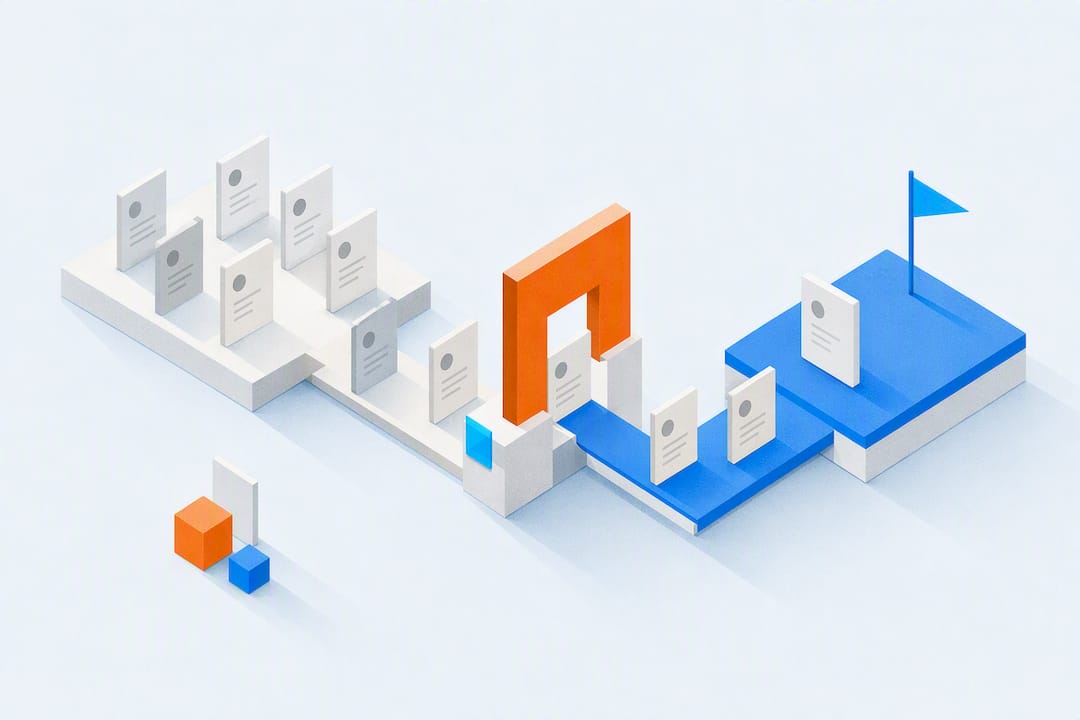
An asynchronous interview is a pre-recorded, one-way interview: candidates answer preset questions on video without a live interviewer, and recruiters review the recordings on their own schedule. It works best for top-of-funnel screening, especially at volume or across time zones, because it standardizes evaluation and cuts scheduling friction. The trade-off is real: you gain speed and consistency, but you lose the back-and-forth of a live conversation, and that matters more at some hiring stages than others.
TL;DR:
- Asynchronous interviews can lead to significant candidate drop-off, with over 50 percent quitting the process before advancing, especially among women applicants.
- Consistent calibration of reviewers and clear scoring rubrics are essential to maintain fair evaluation and prevent unnecessary candidate loss.
- Platforms should offer flexible prep times, retake policies, transcript generation, and variable playback speeds to improve reviewer efficiency and candidate experience.
- Volume-based roles and distributed talent pools benefit most from async screening, while final decision roles or those needing rapport are better suited for live interviews.
- Careful attention to candidate instructions, accessibility accommodations, and human oversight of AI scoring are crucial for fair and effective implementation.
Table of Contents
- What Are Asynchronous Interviews and How Do They Work?
- When Should You Use Async Interviews (and When Should You Skip Them)?
- What Are the Real Pros and Cons of Async Interviews?
- How Do You Actually Implement Async Interviews? A Step-by-Step Checklist
- What Questions Should You Ask, and What Should You Look For?
- How Do You Keep Async Screening Fair and Accessible?
- How Do You Scale Async Screening Without Burning Out Your Team?
- What Does the Research Say, and How Does Resyme.ai Apply It?
- The Playbook That Actually Works, Not the One That Sounds Good
- How Resyme.ai Fits Into Your Screening Process
- Sources
- FAQ
What Are Asynchronous Interviews and How Do They Work?
You’ll see the term used interchangeably with “one-way interviews,” “on-demand interviews,” and “pre-recorded video interviews.” All describe the same mechanic: a candidate receives a set of questions, records answers on their own time within a prep window, and a recruiter watches the footage later instead of sitting on a live call. Wikipedia’s overview of the format notes it’s become a common first-round screening tool precisely because it decouples the candidate’s schedule from the recruiter’s.
The workflow itself follows a predictable arc, whether you’re screening 20 applicants or 2,000:
- Build the question set. Typically 5 to 8 questions covering role fit, behavioral history, and a skills check, following defaults common across async platforms.
- Configure timing and retakes. Decide on prep time per question (often 30 to 120 seconds) and response limits (usually 1 to 3 minutes), plus whether candidates get one take or several.
- Send the invite. Candidates get a link, a deadline, and clear instructions on what to expect.
- Candidate records. They see each question once, get their prep window, then record and submit.
- Optional AI-assisted analysis. Some platforms flag key themes, score responses against a rubric, or surface inconsistencies for reviewer attention.
- Human review. A recruiter or hiring manager watches the recordings, often at faster playback speed, and scores them.
- Advance to live rounds. Candidates who pass move into a synchronous interview, panel, or manager conversation.
Washington State University’s career center guidance frames this as a genuinely standardized process. Every candidate sees the same questions in the same order with the same time constraints, which is something a live interviewer rarely manages to replicate once fatigue or rapport-building creeps into the fifteenth call of the day.
When you’re evaluating a platform, four features separate a smooth process from a frustrating one. Prep time flexibility matters because a fixed 30-second window feels punishing for a technical question but generous for a yes/no one. Retake policy matters because zero retakes penalizes nervous candidates who might otherwise interview well. Transcript generation matters because a searchable transcript lets you scan for keywords across dozens of candidates instead of rewatching video. And variable playback speed matters more than it sounds. Reviewing at 1.5x or 2x speed is often the single biggest time saver in the whole process.
When Should You Use Async Interviews (and When Should You Skip Them)?
Async screening earns its keep at specific points in the funnel, not everywhere. It’s a filter, not a replacement for how you make final decisions.
- High-volume roles. Retail, hospitality, call center, and seasonal hiring often generate hundreds of applicants for a handful of openings. Async lets you screen all of them without scheduling hundreds of calls.
- Distributed or remote talent pools. When candidates span multiple time zones, async removes the scheduling tax entirely.
- Early-stage screening. Use it to separate candidates worth a live conversation from those who aren’t, not to make the final call.
- Roles with objective early filters. Positions where you’re checking for baseline communication skills, technical vocabulary, or specific experience translate well to structured prompts.
It’s a weaker fit in a few situations. Final-round decisions, roles requiring genuine rapport assessment (sales leadership, client-facing executive positions, caregiving roles), negotiation-heavy conversations about compensation or start dates, and small applicant pools where you could realistically call every candidate within a day or two. In those cases, the efficiency gain is marginal and the personal cost to candidate experience isn’t worth it.
The strongest pattern in practice is hybrid: async for the first filter, live for everything after, a method supported by Formation PNC à Annemasse, which discusses training combined with recorded interview workflows. Academic field research backs this instinct directly. Combining async screening with live touchpoints later in the process helps offset the detachment that pure async funnels can create, while still capturing the time savings at the top of the funnel where volume is highest.
What Are the Real Pros and Cons of Async Interviews?
The efficiency case for async interviews is strong, but it comes with measurable costs that deserve honest treatment rather than a marketing gloss.
On the benefit side: recruiters save real coordinator hours because there’s no back-and-forth scheduling email chain. Every candidate answers the same questions in the same format, which makes side-by-side comparison genuinely apples-to-apples instead of a mix of impressions from different calls on different days. Geographic reach expands because a candidate in another time zone isn’t disadvantaged by needing to take a 6 a.m. call. And reviewers can batch-process recordings, watching five candidates back-to-back instead of context-switching between live calls all day.
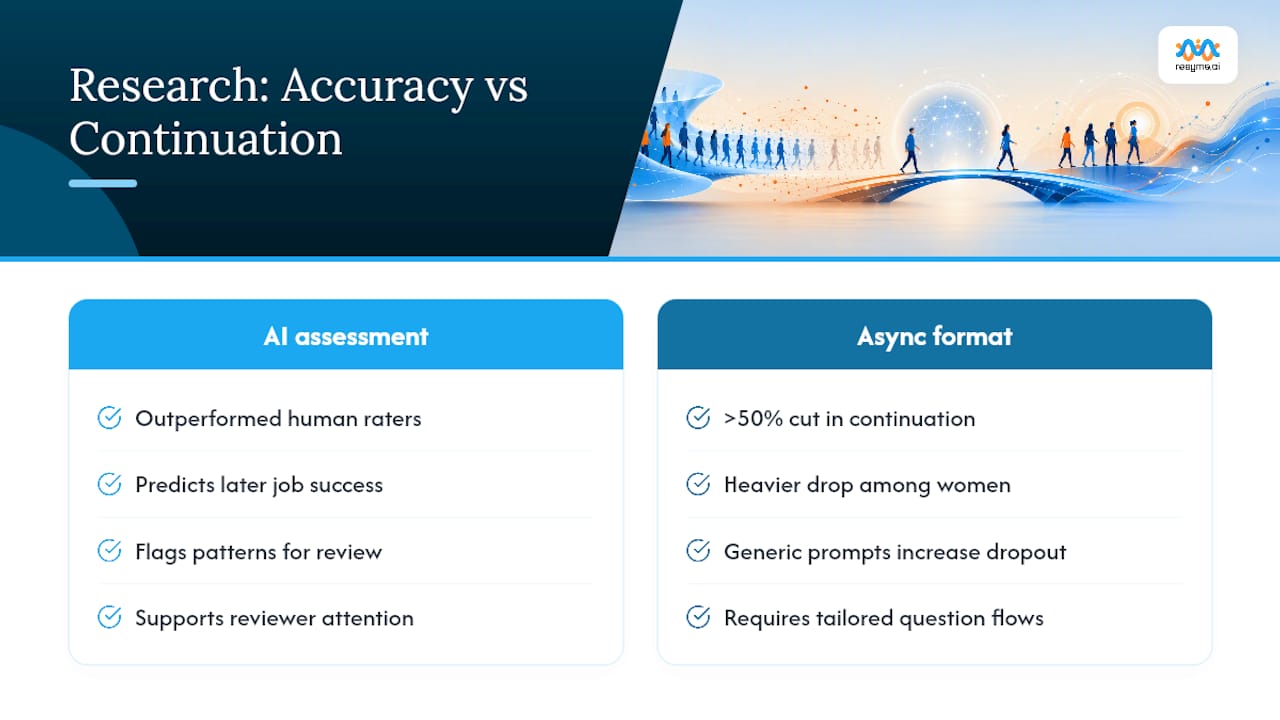
Statistic Callout: A natural field experiment with more than 3,000 applicants found that asynchronous interviews reduced application continuation by over 50 percent overall compared with live interviews and a no-interview control, with the drop-off falling disproportionately on women applicants. The same study found AI-based scoring predicted later employment success better than human raters did in that sample.
That statistic cuts two ways, and both matter for how you design a program:
- Drop-off is a design problem, not just a candidate problem. A format that loses over half your pipeline before you even see it needs friction removed, not just tolerated.
- AI scoring outperforming human raters in one study doesn’t mean AI scoring alone is safe. It means AI can be a useful input when paired with human oversight, not a replacement for it.
- Perceived impersonality is a documented concern, not a hypothetical one. Qualitative research with HR professionals surfaces candidate-experience and fairness concerns alongside the efficiency gains, including worries about deceptive impression management and the operational burden of reviewing high volumes.
- Technical inequity is easy to overlook. Candidates without a quiet room, stable broadband, or a decent webcam are structurally disadvantaged in ways a phone call never penalized.
None of this means async is a bad tool. It means it’s a tool with sharp edges, and the sections below exist to help you file them down.
How Do You Actually Implement Async Interviews? A Step-by-Step Checklist
Rolling out async screening without a plan is how you end up with a pile of unreviewed videos and a candidate experience complaint in your inbox. Here’s the sequence that avoids both.
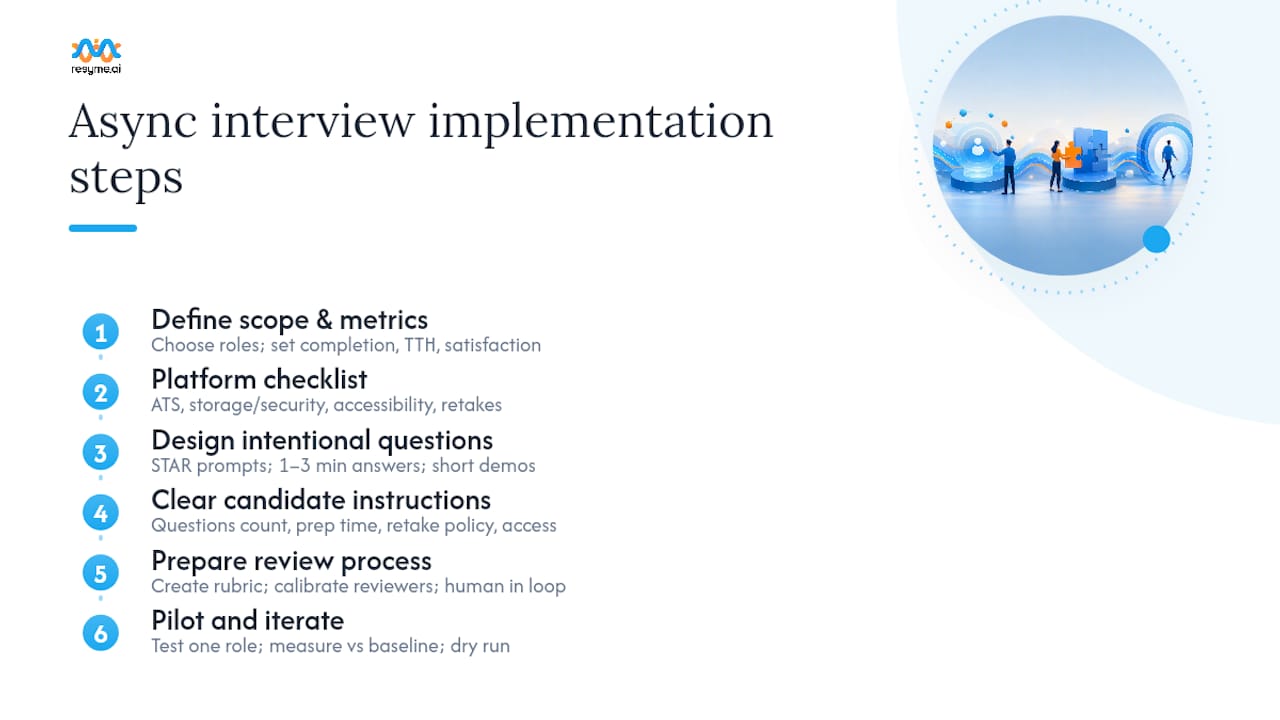
1. Define role fit and target metrics before you pick a tool. Decide which roles qualify for async screening (volume roles, distributed teams, early-stage filters) and set target numbers up front: completion rate, time-to-hire reduction, and candidate satisfaction. Without a baseline, you can’t tell if the pilot worked.
2. Build your platform selection checklist. Not every one-way video interview platform handles the same fundamentals well. Check for ATS integration (does it push candidate status back into your existing system automatically), data security and storage practices (where is video stored, for how long, under what access controls), accessibility support (captions, extended time accommodations), and retake flexibility (zero retakes versus a reasonable limit).
3. Design questions with intention. Behavioral prompts using the STAR structure (Situation, Task, Action, Result) produce more comparable, evidence-based answers than open-ended “tell me about yourself” prompts. For technical or creative roles, a short demo task (record a five-minute walkthrough of a past project) often reveals more than a verbal answer. Keep response limits tight, generally 1 to 3 minutes, so reviewers aren’t wading through ten-minute monologues.
4. Write candidate instructions like you mean them. Tell candidates exactly how many questions they’ll see, how long they’ll have to prep, whether retakes are allowed, and roughly how long the whole thing will take. Offer an accommodation path (extra time, a phone-in alternative, written responses) clearly and without requiring candidates to explain why they need it.
5. Set up your review process before launch, not after. Build a scoring rubric first. Calibrate reviewers against three or four sample recordings so two people watching the same answer land on similar scores. Decide explicitly how much weight any AI-assisted scoring carries relative to human judgment, and put a human in the loop for every advance/reject decision rather than letting a score alone make the call.
6. Pilot on one role before scaling. Run the full flow on a single high-volume role, measure your target metrics against the baseline, and fix what breaks before you roll it out company-wide.
Pro Tip: Run your own team through the exact candidate flow before launch. Have a colleague record answers to your real questions under your actual time limits. You’ll find the awkward prep windows and confusing instructions in ten minutes that candidates would have silently struggled through for weeks.
The single biggest predictor of a smooth rollout isn’t the platform you choose. It’s whether reviewers were calibrated before the first real candidate hit their queue.
What Questions Should You Ask, and What Should You Look For?
A good async question set does three jobs: it screens for role fit, it’s specific enough to prevent generic answers, and it produces responses you can score consistently across candidates.
Behavioral prompts work best when anchored to a real situation: “Describe a time you had to deliver difficult feedback to a teammate. What did you say, and what happened afterward?” Technical prompts work better as a small task than a trivia question: “Walk us through how you’d debug a report that’s returning inconsistent numbers.” Culture-fit prompts should avoid vague personality questions and instead ask for a concrete choice: “Tell us about a decision you made that your manager disagreed with. How did you handle it?”
Scoring consistently across dozens of candidates requires a rubric, not gut instinct:
- Band 4, exceptional: Specific situation, clear actions taken, measurable outcome stated, reflection on what they’d do differently.
- Band 3, solid: Clear situation and action, outcome mentioned but not quantified.
- Band 2, weak: Vague situation, generic action (“I worked hard”), no clear outcome.
- Band 1, red flag: Non-answer, contradicts stated experience elsewhere, or dodges the question entirely.
| Signal type | What it looks like | What it usually means |
|---|---|---|
| Specific outcome | “We cut ticket resolution time from 4 hours to 40 minutes” | Genuine ownership of the result |
| Measurable impact | Names a number, a percentage, a before/after | Likely accurate account, not a rehearsed story |
| Vague generality | “I’m a team player” with no example | Underprepared or padding a weak answer |
| Inconsistency | Timeline or role details contradict the resume | Worth a live follow-up before advancing |
| Over-rehearsed delivery | Word-for-word match to common interview scripts online | Not disqualifying alone, but pair with a live check |
The red flags matter as much as the positive signals. Vague answers that never land on a concrete detail are the single most common weak response, and inconsistency between what’s said on camera and what’s on the resume is worth flagging for a live follow-up rather than an automatic reject. Candidates deserve the benefit of the doubt that a recording format simply doesn’t capture nuance as well as a conversation would.
How Do You Keep Async Screening Fair and Accessible?
Fairness in async interviews isn’t a compliance checkbox. It’s the difference between a screening tool that finds good candidates and one that quietly filters out qualified people for reasons that have nothing to do with the job.
Start with accessibility basics. Captions should be available by default, not on request. Extra time accommodations need to be offered proactively in the candidate instructions, not buried in a help link. A mobile recording option matters because not every candidate has a laptop with a good webcam, and instructions need to be written in plain language, tested with someone outside your recruiting team before launch.
- Offer captions on every recording, generated automatically where possible.
- Build in an extra-time accommodation path that doesn’t require candidates to disclose a diagnosis to request it.
- Support mobile recording as a first-class option, not a fallback.
- Write instructions a first-time job seeker, not a recruiting professional, can follow without confusion.
AI-assisted scoring needs its own layer of controls. Human review should sit on top of any automated analysis for every hiring decision, full stop. Bias testing and periodic validation against outcomes (not just against other AI scores) catches drift before it becomes systemic. Sampling audits, where a manager spot-checks a random slice of AI-flagged rejections, catch mistakes an algorithm alone would never surface. Expert consensus on this point is consistent: algorithmic bias risk is real enough that transparency about how questions are scored, and a human in the loop for every final call, isn’t optional.
Privacy deserves the same rigor. Consent language should state clearly what’s recorded, how long it’s kept, and who can access it. Retention limits should default to the shortest period that still serves your hiring and legal needs, not “forever, just in case.” Storage should be secure by default, and you should collect only the data the role actually requires.
Pro Tip: Offer a live follow-up option for any candidate who requests one, even if async is your default. It costs you almost nothing for the small number who ask, and it closes the fairness gap for candidates who genuinely interview better in conversation than on camera.
How Do You Scale Async Screening Without Burning Out Your Team?
Volume is where async interviews either pay off or turn into a backlog nobody wants to touch. The integrations and metrics you set up early determine which outcome you get.
On the integration side, four connections matter most: ATS sync so candidate status updates automatically instead of requiring manual entry, single sign-on so reviewers aren’t juggling another password, calendar integration for scheduling the live rounds that follow a passed screen, and transcript export so you can search across candidates by keyword instead of rewatching footage.
- Sync results directly to your ATS so a passed screen automatically moves a candidate to the next stage.
- Track completion rate closely. A steep drop here usually points to a broken invite link or confusing instructions, not disengaged candidates.
- Measure time-to-first-review, not just time-to-hire. A backlog of unreviewed recordings is invisible in most hiring dashboards until it’s already a problem.
- Log reviewer hours per batch to catch burnout before it shows up as slower turnaround or sloppier scoring.
- Watch candidate NPS or a simple post-interview satisfaction question. It’s the earliest signal that your process is quietly losing good candidates.
- Track demographic funnel data at each stage where you legally can, specifically to catch the kind of disproportionate drop-off documented in field research before it becomes a pattern in your own pipeline.
Batch review is the single highest-leverage habit here. Reviewers who watch ten candidates in one sitting, at a consistent playback speed, score more consistently than reviewers who watch one video Monday and another Thursday. Set a reviewer quota per day rather than an open-ended queue, and build a simple dashboard that flags when scores between reviewers start to diverge. That divergence is your earliest warning that calibration has drifted.
What Does the Research Say, and How Does Resyme.ai Apply It?
The field evidence on async interviews is more nuanced than most vendor pitches let on, and it’s worth sitting with the tension rather than smoothing it over. The 3,000-plus applicant field experiment found async screening cut continuation by more than half, with a heavier drop among women applicants, even as its AI assessment outperformed human raters at predicting later job success. Read together, those findings say something specific: automation can screen well, but the format itself has to be built to reduce unnecessary drop-off, not just optimized for scoring accuracy.
Qualitative work with HR professionals backs this up from the practitioner side. Efficiency gains are real, but so are concerns about candidate experience, fairness, and the operational load of reviewing growing volumes of recordings.
The approach described is built around that exact tension. Behaviorally anchored question flows are tailored to role and domain rather than generic, which reduces the vague, hard-to-score answers that drive down candidate continuation. AI-assisted analysis flags patterns and inconsistencies for reviewer attention, but final advance and reject decisions stay with a human reviewer, matching the oversight recommendation that runs through both the field experiment and the qualitative research. ATS integration keeps candidate status synced automatically, addressing the operational burden HR professionals flag as volume scales. The goal isn’t to remove judgment from hiring. It’s to make sure the judgment applied is consistent, well-informed, and not quietly filtering out good candidates before a human ever sees their answer.
The Playbook That Actually Works, Not the One That Sounds Good
Most advice on async interviews treats them as a pure efficiency play: fewer scheduling emails, faster funnel, done. The research doesn’t support that framing, and treating it that way is how teams end up with a fast process that quietly loses good candidates. A format that cuts continuation by more than half isn’t a minor detail to footnote. It’s the central design problem.
The conventional advice tends to stop at “pick a platform and write some questions.” What actually works is narrower and less exciting: standardize your prompts, calibrate reviewers before launch, keep a human on every final decision, and measure completion rate as closely as you measure time-to-hire. Skip any one of those and the efficiency gain shows up on your dashboard while the fairness cost shows up nowhere until a candidate complains or a pattern surfaces in an audit nobody ran.
If you’re implementing this for the first time, prioritize reviewer calibration over platform features. A mediocre tool with well-calibrated reviewers beats a feature-rich platform where two people scoring the same answer land three points apart on a four-point scale.
— Raul
How Resyme.ai Fits Into Your Screening Process
Resyme is built for the exact gap most async tools leave open: speed without losing the judgment calls that actually predict a good hire. It runs behaviorally anchored interview flows tailored to the specific role and industry, so candidates answer questions built around real domain knowledge instead of generic prompts that produce equally generic responses. Its automated honesty and integrity validation flags inconsistencies for a human reviewer to check, and every scoring layer stays paired with human oversight rather than replacing it outright.

This platform can sync with ATS and resume or LinkedIn data, so candidate records stay current without manual updates. If you’re running a handful of hires a month, a lighter DIY setup might cover you fine. Once you’re screening at volume, whether that’s seasonal hiring, a distributed team, or a recruiting agency handling multiple clients at once, the case for a platform built specifically for consistent, reviewable scoring gets a lot stronger. Resyme to see how a pilot on one role would run before you commit to scaling it further.
Sources
The research behind this guide spans a field experiment, practitioner interviews, and applied hiring guidance. The field experiment on async interviews and AI assessment offers the strongest evidence on continuation rates and demographic effects. The Turkish HR professionals study grounds the fairness and operational-burden concerns in practitioner experience. Washington State University’s career center guidance covers candidate-facing mechanics, and the Zavnia implementation guide supplies practical defaults for question counts and timing.
- A Brave New World of Hiring: A Natural Field Experiment on How Asynchronous Interviews and AI Assessment Reshape Recruitment
- One-way interviews: What they are (and how to master them) – Washington State University
FAQ
What Does “Asynchronous Interview” Mean?
An asynchronous interview is a pre-recorded, one-way interview where a candidate records answers to preset questions on their own schedule, and a recruiter reviews the footage later rather than conducting a live conversation.
What Is the 30-60-90 Rule in an Interview?
The 30-60-90 rule typically refers to a hiring plan candidates present for their first month and beyond in a new role, not a rule specific to async interview formats; it’s more common in final-round or executive interviews than in early-stage screening.
What Is the Biggest Red Flag to Hear in an Interview?
Vague, non-specific answers that never land on a concrete situation, action, or measurable outcome are the most common weak signal, and answers that contradict details on the resume warrant a live follow-up before any decision.
How Do I Prepare for an Asynchronous Interview?
Read the instructions fully before recording, use the prep window to jot a one-line outline for each answer, keep responses within the stated time limit, and record in a quiet space with decent lighting and a stable internet connection.