Extracted but Unverified: AI Resume Parsing Recruiters Need

AI resume parsing takes a messy PDF, DOCX, or scanned resume and converts it into structured, searchable candidate data: contact details, work history, education, and skills tagged into fields your ATS can query. Modern parsers rely on layout-aware extraction and language models to achieve strong accuracy on well-formatted documents, though scanned images and unusual layouts still cause errors. How much time you save depends on your deployment choice, since hosted APIs, self-hosted containers, and local models trade off speed, privacy, and cost differently.
TL;DR:
- Most resume parsing systems perform best with native PDF and DOCX files, while OCR support for images remains less reliable for low-quality scans.
- Biases in training data can influence parsing accuracy, making regular fairness audits and human oversight essential for fair hiring practices.
- Parsing alone cannot verify candidate claims; subsequent automated interviews or validation tools are necessary to confirm the accuracy of listed skills and experience.
- Deployment options vary between hosted APIs for ease and accuracy, or self-hosted models for privacy and compliance, with latency considerations depending on use case.
- Conducting a structured pilot with real, diverse resumes enables early identification of format issues and accuracy gaps before full implementation.
Table of Contents
- How Does AI Resume Parsing Work?
- What Structured Fields Does a Resume Parser Return?
- What File Formats Does AI Resume Parsing Support?
- What Are the Benefits of Resume Parsing for Recruiters?
- Hosted API, Self-Hosted, or Local: Which Deployment Fits?
- How Accurate Is AI Resume Parsing, and Where Does It Fail?
- How Do You Pilot AI Resume Parsing Before Rolling It Out?
- What Recruiters Get Wrong About Parsing and Validation
- A Faster Way to Confirm What Resumes Only Claim
- Sources
- FAQ
How Does AI Resume Parsing Work?
Resume parsing has come a long way from the keyword scanners of the early 2000s. Those systems just hunted for exact-match terms. Then came grammar-based rule engines, followed by machine learning classifiers trained on labeled resume sections. Today’s leading systems combine layout-aware document processing with instruction-tuned language models, and the difference in output quality is not subtle.
The pipeline typically runs in four stages.
- Optical character recognition and layout normalization. The parser first has to figure out what it’s looking at: a single-column resume, a two-column Canva template, or a scanned image with skewed text. Layout-aware regeneration reconstructs the reading order before any extraction happens, which matters enormously for designer resumes that split skills and experience into side columns.
- Section detection and linearization. The system identifies boundaries between the summary, work history, education, and skills blocks, then flattens the document into a sequence a model can process reliably.
- Extraction. This is where named entity recognition (NER), fine-tuned machine learning models, or compact instruction-tuned language models pull out specific data points: job titles, company names, dates, degree names, skill mentions. A unified framework for resume extraction shows that parallelizing these extraction sub-tasks, rather than asking one large model to do everything at once, cuts both inference cost and latency without sacrificing accuracy.
- Post-processing and normalization. Raw extracted text gets cleaned up: “Sr. Software Eng.” becomes “Senior Software Engineer,” dates get parsed into consistent formats, and skills get mapped to a standard taxonomy so “React.js” and “ReactJS” register as the same skill.
Pro Tip: If a vendor can’t explain what happens between “we read the PDF” and “here’s your JSON,” ask them directly about layout handling. That gap is where most parsing failures live.
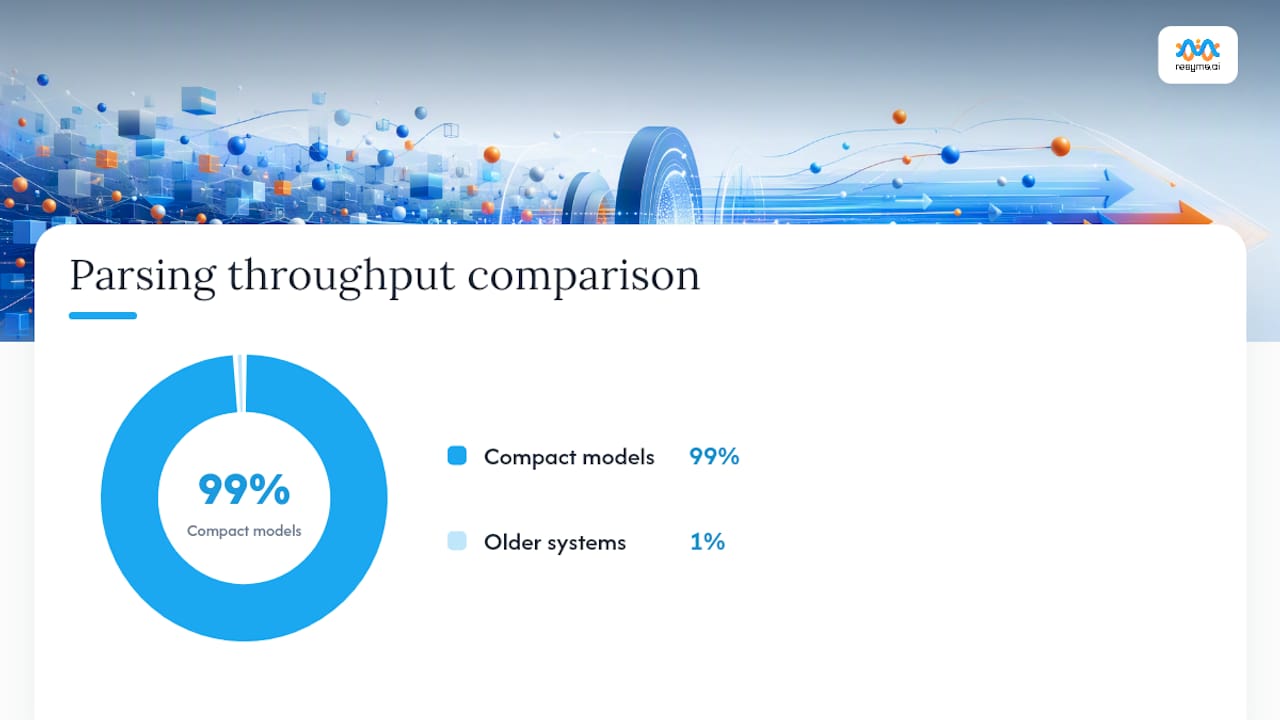
One technical detail worth understanding: some newer systems use index-based pointer outputs instead of having the model generate free text for every field. The model points to where in the source document a piece of information lives rather than retyping it, which reduces hallucination risk and cuts token costs substantially, according to the same extraction research. Compact, instruction-tuned models paired with this approach can match the accuracy of much larger general-purpose language models while running faster and cheaper, which is the difference between parsing being viable at 500 applications a day versus 50,000.
What Structured Fields Does a Resume Parser Return?
A parser worth paying for returns more than a name and phone number. The output generally splits into three tiers: core identity fields, structured history blocks, and derived metadata that recruiters actually use for screening decisions.
- Contact and identity: full name, email, phone number, location, and often LinkedIn or portfolio URLs.
- Work history: company name, job title, start and end dates, and a normalized description of responsibilities, structured as a repeating block rather than a wall of text.
- Education: institution name, degree, field of study, and graduation date or expected date.
- Skills: both hard skills (tools, languages, certifications) and soft skills, ideally normalized against a shared taxonomy so “project management” doesn’t show up as five different variants across your candidate pool.
- Derived fields: total years of experience, inferred seniority level, and sometimes an ATS completeness score that flags resumes missing key sections.
That last category matters more than most teams realize. Schema-driven parsers that support optional AI backends, like the open-source resumix project, demonstrate how hybrid rule-based and AI-assisted extraction can compute seniority and completeness on top of the raw fields, not just extract them. Good parsers also attach confidence scores or provenance metadata to individual fields, so a low-confidence date range or an oddly parsed job title gets flagged for human review instead of silently entering your ATS as fact.
What File Formats Does AI Resume Parsing Support?
Most production parsers handle PDF, DOCX, and TXT natively, with PNG and JPG support layered on through OCR. Some tools extend to ODT or HTML, though that’s less common. The ai-resume-parser package on PyPI is a useful example of production-ready tooling that supports this multi-format range along with configurable AI backends for higher-accuracy extraction on tricky documents.
The catch is that format support doesn’t guarantee accuracy. OCR still struggles with low-resolution scans, decorative fonts, and resumes exported as flattened images rather than searchable text. Two-column layouts and heavily designed templates confuse parsers that aren’t layout-aware, scrambling the reading order and merging unrelated fields.
- Require PDF or DOCX submission when your careers page lets you set the rule.
- Add a short candidate-facing note like “Upload a one- or two-page resume, avoid heavy graphic templates,” which measurably improves parsing yield.
- Flag any resume that returns low-confidence scores across multiple fields for manual review rather than auto-rejecting it.
Pro Tip: If your applicant pool skews toward creative or design roles, test your parser against Canva and Adobe-exported resumes specifically before rolling it out. That’s where most format failures cluster.
What Are the Benefits of Resume Parsing for Recruiters?
The most obvious win is time. Manually keying resume data into an ATS or spreadsheet, then screening each one against role requirements, eats hours a recruiter could spend on candidate conversations instead. Parsing collapses that manual entry into seconds and surfaces a structured, filterable record the moment a candidate applies.
The less obvious win is match quality. Normalized skill tags and inferred seniority levels let you run more precise searches across your candidate database instead of relying on whatever keywords happened to appear in a resume’s exact wording. A candidate who wrote “led a cross-functional team” instead of “management experience” doesn’t disappear from your search results just because they phrased it differently.
Track these metrics once parsing is live:
- Time-to-fill, watching for compression once screening moves from manual review to structured filtering.
- Shortlist-to-interview conversion rate, which should improve as matching gets more precise.
- Data completeness rate, the percentage of parsed resumes with all critical fields populated at acceptable confidence.
- Recruiter hours per requisition, a direct proxy for the manual work parsing removes.
There’s a candidate experience angle too. Faster acknowledgment and faster movement through the pipeline reduces the dead air that makes applicants assume they’ve been ignored. Combined with the internal productivity gain, most teams that adopt parsing seriously end up reallocating recruiter time toward sourcing and candidate conversations, the work that actually moves requisitions to close.
Hosted API, Self-Hosted, or Local: Which Deployment Fits?
Deployment choice is where privacy, cost, and speed pull in different directions, and getting it wrong shows up later as either a compliance headache or a frustrating latency bottleneck.
- Hosted API. Fastest to implement, no infrastructure to manage, and usually the best accuracy since vendors update models continuously. The trade-off is that candidate data leaves your environment, which raises data residency questions in regulated jurisdictions, particularly under the EU’s AI Act framework governing automated decision systems.
- Self-hosted container. You run the parsing model inside your own infrastructure, keeping data in-house while still getting model-level accuracy. This costs more in engineering setup but satisfies stricter procurement and privacy requirements.
- Local or ONNX inference. Fully offline extraction using lightweight NER models. Projects like somus/resume-extract demonstrate text-only extraction running under 15 milliseconds per resume after the model loads, which makes real-time apply-flow parsing genuinely instant rather than “instant” with a hidden queue.
For real-time apply flows where a candidate expects immediate confirmation, latency matters more than raw accuracy ceiling. For bulk migrations, batch overnight processing tolerates slower, higher-accuracy models. Integration points to map out ahead of time include the apply-flow trigger, ATS field mapping, any enrichment pipeline that adds inferred fields, and how historical resumes get bulk migrated if you’re switching ATS platforms.
Pro Tip: Ask any vendor directly whether resume data trains their models. That single question separates vendors with a clean data-use policy from ones that quietly improve their product using your candidates’ personal information.
How Accurate Is AI Resume Parsing, and Where Does It Fail?
No parser is perfect, and the failure modes are predictable once you know what to look for. Date parsing breaks on ambiguous formats and overlapping roles. Two-column layouts still occasionally scramble field order even in layout-aware systems. OCR errors compound on low-quality scans. Entity alignment mismatches happen when a candidate lists the same employer twice under slightly different names.
Bias is the failure mode that carries the highest stakes. Training data skew can cause parsers to weight certain institution names, employment gaps, or location patterns as signals correlated with proxies for race, gender, or age, even without anyone intending that outcome. Reporting from the University of Washington on AI bias in resume screening documents how automated screening tools can produce disparate impact across race and gender lines, which is exactly why human oversight has to stay in the loop rather than becoming a rubber stamp.
The good news is that evaluation doesn’t have to be subjective guesswork. A two-stage automated evaluation framework uses entity-alignment algorithms, including the Hungarian algorithm, to compare extracted work-experience lists against ground truth data. This produces field-level strict and relaxed accuracy scores you can track over time instead of relying on anecdotal “seems fine” impressions.
- Run stratified sampling audits across demographic and format variables monthly, not once at launch.
- Keep a human-in-the-loop gate on any auto-reject decision the parser feeds into.
- Retune your skills taxonomy quarterly as new job titles and tools enter your market.
- Run fairness testing specifically comparing outcomes across protected classes before scaling volume.
How Do You Pilot AI Resume Parsing Before Rolling It Out?
Skipping straight to full deployment is how teams end up discovering accuracy problems after they’ve already made hiring decisions based on bad data. Run a structured pilot first.
- Define success metrics and acceptance criteria up front. Decide what field-level accuracy threshold counts as a pass before you see a single result, not after.
- Build a representative test set. Pull 100 to 200 real resumes spanning your actual formats, languages, and role types, not a cherry-picked sample of clean single-column PDFs.
- Run the pilot and measure by error type. Break failures into categories: date parsing, OCR, entity alignment, missing fields. This taxonomy tells you whether the vendor needs to fix something or whether your intake process needs adjusting instead.
- Iterate on intake before blaming the model. Half of “parsing accuracy” problems are actually “candidates uploading badly formatted files” problems.
- Plan integration mapping and monitoring cadence. Confirm how parsed fields map into your ATS schema, set a retraining or re-evaluation cadence, and document your privacy policy for how resume data moves through the pipeline.
Pro Tip: Run your pilot test set through the parser twice, a week apart, and compare outputs. Inconsistent results on identical inputs is a red flag most teams don’t think to check for.
What Recruiters Get Wrong About Parsing and Validation
Parsing solves the data entry problem, not the truth problem. A resume can be perfectly extracted, every field accurate and normalized, and still contain claims that don’t hold up: inflated titles, exaggerated scope, skills listed because a candidate assumes everyone does it.
That’s the gap most teams underestimate. Parsing tells you what a resume says. It cannot verify whether the candidate can actually do the things listed on it. The two problems get treated as one, and that’s a mistake worth correcting early in any adoption process.
Where automated interviews earn their place is right after parsing, not instead of it. Some automated interview platforms take the structured output parsing produces and run role-tailored, behaviorally-anchored interviews that check whether the claims match reality, including honesty and integrity validation that catches misrepresentation before it reaches a hiring manager’s desk. Parsing gets candidates into a searchable pipeline fast. Validation decides which of those candidates are worth a recruiter’s time.
— Raul
A Faster Way to Confirm What Resumes Only Claim
Parsing gives you clean data. It cannot tell you whether the person behind that data actually did what their resume says. Resyme fills exactly that gap: automated, behaviorally-anchored interviews that check candidate claims against role-specific questions built from deep domain knowledge, so a title or skill listed on a resume gets verified before it reaches a hiring manager.

Instead of manually screening every parsed candidate to catch inflated experience or misrepresented skills, some platforms run that verification automatically, comparing candidates on objective criteria rather than gut impressions. These tools fit naturally downstream of any parsing tool you already use: parsing narrows the pool, then the verification confirms who in that pool is actually qualified. Recruiters running high-volume pipelines get honesty checks and behavioral profiling without adding manual interview hours, and candidates get an accessible, low-friction interview experience instead of another gatekeeping hurdle. If your team is parsing resumes but still guessing at who to trust, see how Resyme’s automated interviews validate candidate claims before you schedule a single human interview.
Sources
- Layout-Aware Parsing Meets Efficient LLMs: A Unified, Scalable Framework for Resume Information Extraction and Evaluation
- somus/resume-extract
- ai-resume-parser · PyPI
- University of Washington reporting on AI bias in resume screening
FAQ
Is AI resume parsing accurate for scanned resumes?
Scanned resumes rely on OCR, which loses accuracy on low-resolution images, decorative fonts, and complex layouts, so accuracy tends to run lower than for native PDFs or DOCX files.
How does AI resume parsing handle bias?
Parsers can inherit bias from training data, weighting institution names or location patterns as unintended proxies, which is why audits, human oversight, and fairness testing matter before scaling volume.
What’s the difference between resume parsing and resume screening?
Parsing extracts and structures the data on a resume; screening or validation, including automated interviews like Resyme’s, checks whether the claims in that data are actually true.
Should I use a hosted or self-hosted parsing model?
Hosted APIs are faster to deploy and usually more accurate out of the box, while self-hosted or local models keep candidate data in-house for stricter privacy or compliance needs.
What resume formats should I ask candidates to submit?
PDF and DOCX parse most reliably; asking candidates to avoid heavy graphic templates and stick to one or two pages materially improves parsing accuracy.