Turn Job Descriptions Into 6–12 AI Interview Questions for Recruiters

AI-generated interview questions turn a single job description into a ready-to-use set of behavioral, technical, and screening prompts in minutes instead of hours. Candidates use them to rehearse answers against real role requirements; recruiters use them to build structured interviews with consistent scoring. The best tools, including Resyme, tailor the output to seniority and domain rather than spitting out generic questions anyone could Google.
TL;DR:
- AI-generated questions are most effective when based on a detailed and specific job description, including responsibilities, key tools, and success metrics.
- A balanced set of 6 to 12 questions should cover behavioral, technical, screening, and leadership topics for fair candidate assessment.
- Crafting prompts with clear role, seniority, responsibilities, skills, and focus improves question relevance and reduces generic or biased outputs.
- Human review and adaptation remain essential, with questions validated against real candidate answers and adjusted for fairness and clarity.
- Using role-specific platforms like Resyme can streamline high-volume or specialized hiring, providing consistent scoring and bias validation.
Table of Contents
- How AI Generates Interview Questions From a Job Description
- What Types of Questions Does an Interview Question Generator Produce?
- How Do You Write a Prompt That Gets Better Interview Questions?
- How Should Job Seekers Practice With AI-Generated Questions?
- How Should Recruiters Turn AI-Generated Questions Into a Fair Interview?
- Why Domain-Aware AI Improves Interview Question Relevance
- Customizing AI Questions for Fair, Inclusive Interviews
- How to Integrate AI-Generated Questions Into Your ATS or Interview Workflow
- What Are the Limitations of AI-Generated Interview Questions?
- Prompt Templates for Different Roles and Industries
- Popular AI Tools for Generating Interview Questions
- An Editorial Note on Realistic Expectations
- Try Resyme.ai for Role-Tailored Interview Generation
- Sources
- FAQ
How AI Generates Interview Questions From a Job Description
The fastest path from job description to usable questions runs through three steps, not ten. Skip any of them and you either get a bloated list nobody uses or answers that sound rehearsed instead of real.
Step 1: Feed it the job, not just the title. Paste the full job description, or summarize it in a few sentences covering seniority, core responsibilities, and required skills. Workable’s generator works exactly this way: type the position, optionally set industry and tone, and it returns role-specific questions in seconds rather than a generic template.
Step 2: Generate a balanced set, then cut it down. A good first draft mixes question types instead of leaning on one:
- 4 to 5 behavioral questions tied to actual responsibilities
- 2 to 3 technical questions matched to listed tools or methods
- 1 to 2 screening questions for logistics and baseline fit
- 1 leadership or scenario question if the role has any people or project management scope
Trim the raw output to 6 to 12 questions. More than that and interviews run long; fewer and you cannot cover enough ground to compare candidates fairly.
Step 3: Practice or pilot, then refine. Candidates should record themselves answering aloud using the STAR framework. Recruiters should run the set through one or two pilot interviews before locking it into a scorecard. Whatever falls flat, feed back into the prompt. Adjust seniority language, add a missing skill, or ask for more scenario depth, then regenerate.
What Types of Questions Does an Interview Question Generator Produce?
Most generators sort output into four or five recognizable buckets, and knowing which is which helps you judge whether the list is actually useful or just padded.
- Behavioral (STAR-based): These probe for evidence, not opinion. Example: “Tell me about a time you had to fix a process that wasn’t working. What did you change, and what happened?” LeadershipFreak’s curated behavioral list is a solid model for how tight and specific these should be.
- Technical: These ask for named tools, techniques, or a walkthrough of a problem-solving process. Example: “Walk me through how you’d debug a memory leak in a production service.”
- Screening: Quick checks for baseline fit, availability, and logistics. Example: “What’s your notice period, and are you open to occasional weekend on-call rotations?”
- Leadership and problem-solving: Scenario-based, asking for tradeoffs. Example: “You have two underperforming team members and one performance-review cycle left. How do you prioritize your time?”
- Culture-fit: Lighter, but still evidence-seeking. Example: “Describe a work environment where you struggled to do your best work, and why.”
Generic AI tools often produce only the first two categories well. Domain-aware platforms, Resyme among them, extend into leadership and culture-fit because they draw on broader behaviorally anchored prompt libraries.
How Do You Write a Prompt That Gets Better Interview Questions?
The output is only as sharp as the input. A one-line prompt like “give me interview questions for a marketing manager” returns generic filler. A prompt with five specific elements returns something you could actually run an interview from.
The five elements that matter:
- Job title and seniority level (junior, mid, senior, lead)
- Three to five core responsibilities, in the language of the actual job description
- Key skills or tools the role requires, named specifically
- One success metric that defines what “good” looks like in the first six to twelve months
- The interview focus and desired mix, stated as a number
Recruiter prompt template: “Generate 8 interview questions for a senior data analyst role. Responsibilities include building dashboards, cleaning large datasets, and presenting findings to non-technical stakeholders. Required skills: SQL, Python, Tableau. Success looks like reducing reporting turnaround from five days to one. Give me 4 behavioral questions, 3 technical questions, and 1 culture-fit question, with a one-line note on what a strong answer sounds like for each.”
Candidate self-prep prompt template: “I’m interviewing for a senior data analyst role requiring SQL, Python, and Tableau, with a focus on dashboard building and stakeholder communication. Generate 8 likely interview questions mixing behavioral and technical, and suggest what a strong STAR-format answer would include for each.”
Pro Tip: Skip vague adjectives like “detail-oriented” or “team player” when describing the role. Name the actual tool, dataset size, or deliverable instead. Generators trained on specific inputs consistently return sharper, less generic questions than ones fed soft descriptors.
Common mistakes: Pasting a bloated job posting full of boilerplate benefits language (dilutes the signal), skipping seniority (the AI defaults to mid-level phrasing), and asking for too many questions at once (you end up cutting half of them anyway, so ask for what you’ll actually use).
How Should Job Seekers Practice With AI-Generated Questions?
Treat the list as a training set, not a script to memorize. Kickresume’s generator, for instance, can produce personalized questions and even suggested answers tied to a resume and job title, which gives you a benchmark to compare your own phrasing against rather than a script to copy.
- Pick 6 to 10 questions that map directly to the job description, not generic ones you found online.
- Record yourself answering aloud, using STAR: situation, task, action, result.
- Compare your recorded answer against an AI-suggested model answer, and flag where yours lacks a concrete outcome or number.
- For any answer that felt weak, ask the AI for a harder follow-up probe on that same story, then rehearse a deeper version.
Rehearsing every question equally is a mistake. Kickresume’s own guidance suggests deeply rehearsing only 2 to 3 stories while staying loosely familiar with the rest, since over-rehearsing all of them tends to make answers sound stiff instead of specific.
How Should Recruiters Turn AI-Generated Questions Into a Fair Interview?
A generated list becomes a real interview tool the moment you attach a rubric to it. Without one, two interviewers scoring the same candidate on the same question routinely land in different places.
- Use the same core 6 to 8 questions across every candidate for the role, then layer in calibrated follow-ups for depth.
- Attach a short “what to listen for” note to each question: name the evidence a strong answer includes (a specific tool, a measurable result, a clear decision point), not a vague label like “good communicator.”
- When labeling scoring anchors, use evidence language rather than adjectives. “Named the tool and quantified the outcome” scores more consistently across interviewers than “excellent” or “strong.”
- Let the AI suggest adaptive follow-ups that chase down specifics rather than reward polish, following research-backed guidance on assessing communication and problem-solving. Adaptive interviewing that incorporates follow-up questions improves decision accuracy by a modest margin over fixed scripts, largely because it can branch into a candidate’s actual experience instead of moving down a checklist regardless of the answer given.
Pro Tip: Write the “what to listen for” note before you see any candidate answers, not after. Retrofitting a rubric to justify a gut reaction defeats the entire point of structuring the interview.
Structured, consistent questioning is not a nice-to-have layered on top of good hiring. It is what separates a repeatable process from five interviewers each running their own private interview.
Why Domain-Aware AI Improves Interview Question Relevance
Generic AI question generators work off pattern matching against job titles. A platform built with deep domain knowledge across industries works differently. Resyme, rather than recycling the same “tell me about a challenge” prompt for every role from warehouse logistics to backend engineering.
That distinction shows up most in high-volume and specialized hiring, where recruiters cannot manually write fresh questions for every requisition. Certain platforms build in automated honesty and integrity validation and objective candidate comparison, so the questions generated do double duty: they surface real signal and they let hiring teams compare candidates against the same evidence-based bar instead of subjective impressions.

Customizing AI Questions for Fair, Inclusive Interviews
Raw AI output almost always needs a pass for bias before it reaches a candidate. Left unedited, generated questions can default to phrasing that assumes a specific background, working style, or even a particular career path, none of which the role actually requires.
Start by stripping any question that isn’t tied to a documented responsibility or skill on the job description. “Where do you see yourself in five years” reveals nothing measurable; “How would you prioritize three competing deadlines in your first month” does.
Watch for coded language. Phrases like “fast-paced environment” or “works well under pressure” can unintentionally screen out candidates with caregiving responsibilities or disabilities who can absolutely do the job, just not on an assumed schedule. Rewrite these into concrete, testable asks: “How do you handle a week with three overlapping deadlines?”
Run every generated set through a quick consistency check across roles at the same level. If your senior engineer questions probe for leadership evidence but your senior analyst questions don’t, candidates in equivalent roles aren’t being evaluated on comparable ground.
Finally, keep a human in the loop for every batch before it goes live. AI is efficient at generating volume and consistent at applying a template, but it has no context for your specific team’s history with a phrase that landed badly in a past interview, or a question that consistently confuses candidates for reasons unrelated to their competence. Treat the AI output as a strong first draft, not a finished product.
How to Integrate AI-Generated Questions Into Your ATS or Interview Workflow
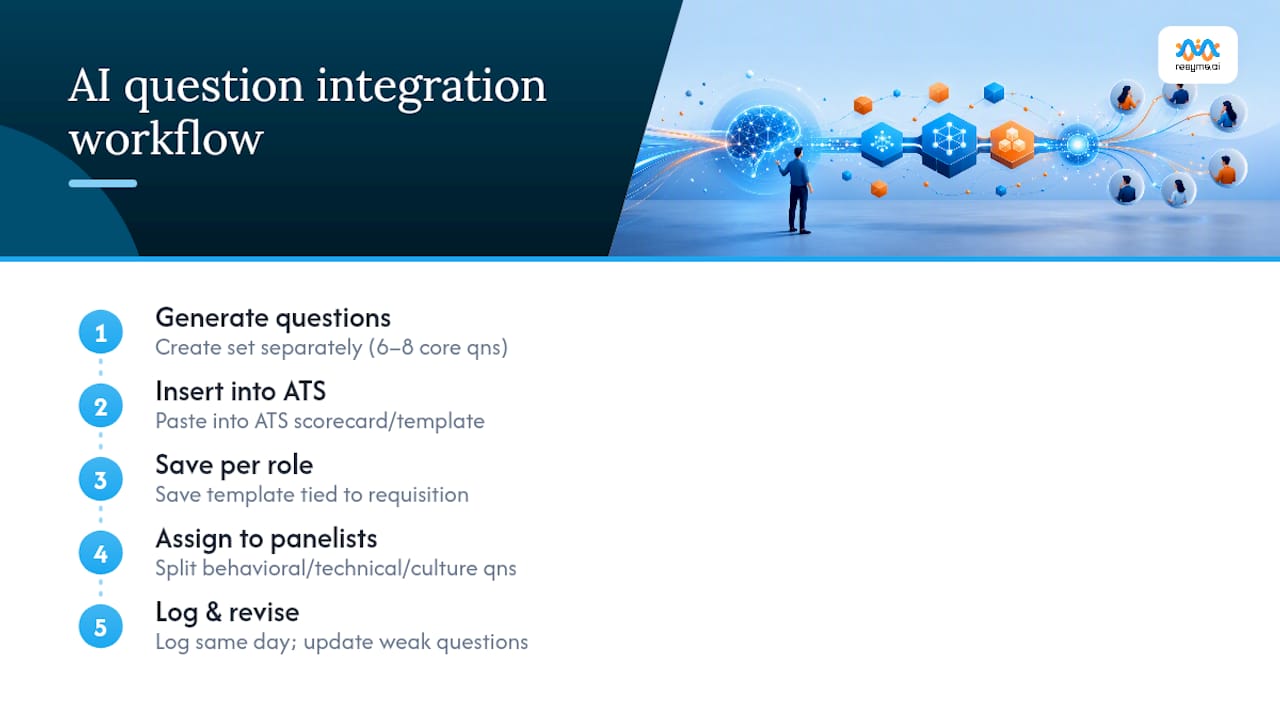
Most applicant tracking systems don’t generate questions natively, so the practical move is to generate the set separately, then paste it into the interview kit or scorecard template your ATS already supports. Systems like Greenhouse, Lever, and similar platforms let you attach a structured scorecard to each job requisition. That’s where the AI-generated question set and its rubric both belong.
Build the scorecard once per role, not once per interview. Store the core 6 to 8 questions with their “what to listen for” notes as a saved template tied to the job requisition, so every interviewer on the panel pulls the same set instead of improvising.
Assign specific questions to specific interviewers rather than letting everyone ask everything. A five-person panel asking the same behavioral question five times wastes time and annoys candidates; splitting behavioral, technical, and culture-fit questions across panelists covers more ground in the same total interview time.
Log outcomes back into the ATS the same day. If a question consistently produces weak or confusing responses across multiple candidates, that’s a signal to revise the prompt and regenerate, not a candidate problem. Treat the question set as a living document tied to the requisition, updated each time you spot a pattern worth fixing.
What Are the Limitations of AI-Generated Interview Questions?
AI-generated questions are only as good as the job description feeding them. A vague, boilerplate posting produces vague, boilerplate questions, no matter how sophisticated the underlying model.
The bigger risk sits in overreliance on the output without human judgment. An AI can generate a technically sound question that’s completely wrong for your team’s actual culture or a specific candidate’s context. It has no memory of the version of this role you hired for last year and where that hire struggled.
There’s also a fairness dimension. If the underlying model was trained heavily on questions common in one industry or region, it can default to assumptions, working hours, tools, or even communication norms, that don’t map cleanly onto every market or team. Reviewing generated questions for that kind of drift matters as much as reviewing them for bias in phrasing.
Finally, AI-generated questions are a starting point for evidence gathering, not a substitute for judgment in the room. A tool can suggest what to ask and even what a strong answer sounds like. It cannot replace an interviewer’s ability to read whether a candidate’s example actually holds up under a genuine follow-up question, or to notice when an answer, however polished, doesn’t match the rest of the conversation.
Prompt Templates for Different Roles and Industries
The core five-element prompt structure holds across roles, but the details shift by industry. A few worked examples:
Sales role: “Generate 8 questions for a mid-level SaaS account executive. Responsibilities: managing a 40-account book, running discovery calls, forecasting pipeline. Required skills: Salesforce, MEDDIC or a similar sales framework. Give me 4 behavioral, 3 technical/process, and 1 culture-fit.”
Healthcare role: “Generate 8 questions for a senior registered nurse in a fast-turnover surgical unit. Responsibilities: patient triage, cross-team coordination, documentation accuracy. Required skills: Epic EHR, sterile procedure protocols. Success looks like zero documentation errors over a quarter. Give me 5 behavioral, 2 technical, 1 screening.”
Skilled trades role: “Generate 8 questions for a journeyman electrician on commercial job sites. Responsibilities: reading blueprints, code compliance, coordinating with general contractors. Required skills: NEC code knowledge, conduit bending. Success looks like zero code-violation callbacks. Give me 4 behavioral, 3 technical, 1 screening.”
Notice what stays constant: named tools, a measurable success metric, and an explicit question-type breakdown. That structure is what separates a usable prompt from a lazy one, regardless of industry.
Popular AI Tools for Generating Interview Questions
Several tools now specialize in this exact task, each with a slightly different angle. Workable’s free generator focuses on speed: type a position, pick an industry and tone, and get a role-specific list in seconds, aimed at recruiters who need volume fast.
Kickresume’s generator leans toward the candidate side, tying question generation to an uploaded resume and job title and pairing each question with a suggested answer, useful for self-prep rather than panel interviews.
Lessie AI’s generator lets users select interview focus (screening, behavioral, technical, leadership) and seniority level directly, which gives more control over the question mix than a single-click generator.
Domain-specialized platforms sit in a different category entirely. Rather than a standalone question generator, some build tailored, behaviorally anchored questions directly into an automated interview process, adding honesty validation and candidate comparison on top of the question set itself. For recruiters who need question generation as one step in a larger hiring workflow rather than a standalone tool, that integration can be the meaningful difference.
An Editorial Note on Realistic Expectations
AI makes question generation faster and more consistent, but it doesn’t remove the need for a human to validate the output. A generated list still needs a pilot run, a bias check, and a rubric before it belongs in a real interview.
The teams that get the most value treat the AI as a first draft generator, not a final decision-maker. Iterate the prompt, test it on a real requisition, watch where candidates struggle to answer clearly, and adjust. Skip that loop and you’ve just automated a mediocre interview instead of building a better one.
— Raul
Try Resyme.ai for Role-Tailored Interview Generation
Generic AI chatbots can draft a question list, but they can’t run the interview, score it consistently, or catch when a candidate’s story doesn’t hold up. Certain platforms aim to close that gap by generating role-tailored questions from the job description, conducting behaviorally anchored interviews, and flagging honesty and integrity signals along the way, so recruiters get a scored, comparable candidate slate instead of a raw transcript to interpret alone.

That maps directly onto the generate, practice, improve workflow this article walks through, except Resyme.ai runs the practice and improve stages for you at scale, across dozens or hundreds of candidates rather than one at a time. If you’re screening high volume or specialized roles and the manual review is the bottleneck, Resyme or request a demo to see how it handles your next open requisition.
Sources
- What Is Dynamic Interview Adaptation? A 2026 Guide
- Free interview questions generator
- Generate Interview Questions For Any Job With AI | Kickresume
- 10 Dynamic Job Interview Questions
FAQ
What Are Typical AI Interview Questions?
Typical AI-generated questions fall into four categories: behavioral (STAR-based, evidence-seeking), technical (tool and process specific), screening (logistics and baseline fit), and leadership or scenario-based questions that ask for tradeoffs under pressure.
What Is the 30-60-90 Rule in an Interview?
The 30-60-90 rule refers to a candidate’s plan for their early months in a role, and it’s a common leadership or onboarding question you can ask AI generators to build around a specific job description’s early priorities.
Are AI Interviews a Red Flag?
An AI-driven interview isn’t inherently a red flag; the concern is usually whether it’s used to replace human judgment entirely rather than to structure and scale it. Platforms like Resyme.ai are built to add consistency and honesty validation to the process, not remove human oversight of hiring decisions.
What Are 20 Questions in Artificial Intelligence With Answers?
There’s no single canonical list of AI interview questions, since the right set depends heavily on the specific role, seniority, and industry; a generic list pulled from the internet almost always underperforms one generated from your actual job description.
How Many Questions Should an AI-Generated Interview Include?
Most structured interviews work best with 6 to 12 questions, mixing behavioral, technical, and screening types, since longer lists tend to run over time without adding meaningfully better signal.